
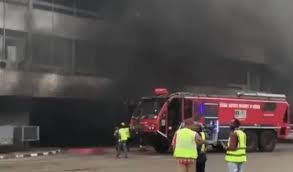
Aviation industry stakeholders have delivered a scathing assessment of the Federal Government’s handling of the fire outbreak at Terminal 1 of the Murtala Muhammed International Airport, arguing that the decision to divert multiple international flights outside Nigeria exposed deep-rooted weaknesses in the country’s emergency response framework and undermined confidence in its aviation management.
Following the incident, a British Airways flight was diverted to Abuja, while aircraft operated by Lufthansa and Emirateswere rerouted to Malabo, Equatorial Guinea. The diversions, which occurred despite reports that the runway remained unobstructed, have triggered criticism from industry professionals who described the response as excessive, poorly coordinated, and damaging to Nigeria’s aviation reputation.
Aviation security expert and Chief Executive Officer of Centurion Security Systems & Services Limited, Capt. John Ojikutu (rtd), said the episode highlighted what he termed a pattern of regression rather than progress in the sector’s crisis management capabilities. According to him, the decision to send international traffic outside the country was difficult to justify given that the runway was reportedly not affected by the fire.
“Let us speak frankly: this is not progress; it is retrogression,” Ojikutu said. “Why divert international flights to other countries when the runway was not blocked? Why were the aprons at MM1 and MM2 not considered as temporary holding areas, with passengers ferried by bus to other terminals? Why was one of NAMA’s mobile control towers not deployed for approach and aerodrome control if visibility or tower functionality was the concern? How many flights were involved? Certainly not an unmanageable number. This is embarrassing.”
His remarks reflect broader unease within the aviation community that local contingency options were either ignored or unavailable. Critics argue that diverting aircraft to another sovereign airspace, particularly in a non-catastrophic scenario, sends an alarming signal about Nigeria’s preparedness to handle operational disruptions at its busiest international gateway.
Ojikutu further warned that global aviation regulatory bodies, including the International Civil Aviation Organization and the International Air Transport Association, would be closely observing how Nigerian authorities respond to such emergencies. According to him, what unfolded in Lagos risks portraying a system struggling to meet international expectations on resilience and traffic management.
“What we are projecting to the world is not what ICAO and IATA expect from a country of Nigeria’s stature,” he said. “There are arrival facilities at MM2 capable of handling regional operations. Was that option even evaluated? Or were institutional rivalries allowed to override operational logic?”
His reference to rivalry alludes to longstanding tensions between the Federal Airports Authority of Nigeria and Bi-Courtney Aviation Services Limited, concessionaire of the Murtala Muhammed Airport Terminal 2 (MM2). Industry observers have repeatedly flagged such disputes as potential obstacles to coordinated crisis response, especially in multi-terminal environments where shared infrastructure demands seamless collaboration.
Ojikutu alleged that the fire incident exposed multiple lapses, not only in operational response but in inter-agency coordination and decision-making. “ICAO and other international agencies are watching,” he said. “When incidents occur, it is not just about extinguishing a fire; it is about demonstrating competence, redundancy and preparedness.”
Echoing these concerns, a former Chief Pilot of the defunct ADC Airlines, Capt. Mohammed Gbadamasi, directed criticism at both the Nigerian Airspace Management Agency and FAAN, accusing them of failing to operationalise robust Safety Management Systems (SMS).
According to Gbadamasi, the incident exposed what he described as the absence of a credible contingency plan. “This is the result of a failure in the Safety Management Systems of NAMA and FAAN,” he said. “A functioning SMS should anticipate exactly this type of disruption and provide a clear Plan B. What happened suggests there was none, or that it was not properly implemented.”
He questioned reports that the airspace had been closed, a move that, if accurate, would represent a far-reaching response to what was essentially a terminal fire rather than an airfield obstruction. “Was the entire airspace truly closed?” he asked. “If so, was that decision proportionate to the scale of the incident? These are serious questions.”
Industry analysts say the optics of the situation may be as damaging as the operational disruption itself. Lagos serves as Nigeria’s principal international aviation hub and a key gateway into West Africa. The inability to manage a terminal fire without resorting to international diversions risks reinforcing long-standing concerns about infrastructure resilience and crisis coordination in the sector.
While no casualties were reported from the fire, stakeholders argue that the absence of injuries does not absolve authorities from scrutiny. In modern aviation governance, they note, crisis management is measured not only by safety outcomes but by the efficiency, proportionality, and communication strategy deployed in response.
The episode has also revived debate about infrastructure redundancy at MMIA. Critics contend that for an airport handling significant international traffic, contingency protocols should be institutionalised, rehearsed, and technologically supported. Mobile towers, cross-terminal transfers, and inter-agency drills are standard components of emergency preparedness in many global hubs. The apparent reluctance or inability to activate such measures has fueled perceptions of systemic fragility.
Furthermore, stakeholders argue that repeated incidents whether runway incursions, bird strikes, or terminal disruptions have cumulatively eroded confidence in Nigeria’s aviation ecosystem. Each event, they say, becomes a reputational test not only for airport authorities but for the country’s broader regulatory credibility.
For international carriers, diversions outside the country introduce operational complexities, including diplomatic clearances, passenger logistics, crew duty limitations, and potential compensation liabilities. Such outcomes, analysts warn, may influence future risk assessments by foreign airlines operating into Lagos.
At the policy level, the incident raises fundamental questions about oversight and accountability. If, as critics allege, Safety Management Systems exist largely on paper without functional contingency layers, then regulators may face renewed pressure to conduct independent audits of emergency preparedness frameworks across major Nigerian airports.
Stakeholders insist that this episode should serve as a catalyst for reform rather than a footnote in the sector’s long list of disruptions. They are calling for transparent investigations, publication of incident reports, and clear timelines for corrective measures.
Ultimately, the diversion of international flights to foreign jurisdictions following a terminal fire has become more than an operational decision; it has evolved into a symbol of perceived institutional weakness. For a country seeking to position itself as West Africa’s aviation hub, critics argue, the bar must be significantly higher.
Unless authorities confront the structural gaps exposed by the MMIA fire ranging from inter-agency coordination to contingency planning the risk is not merely temporary disruption but sustained reputational damage in the eyes of global aviation stakeholders.
By Kehinde Ibrahim, Lagos

