
By Olugbenga Salami
Stakeholders in Nigeria’s livestock sector have been urged to adopt innovative reproductive technologies to boost productivity and safeguard food security.
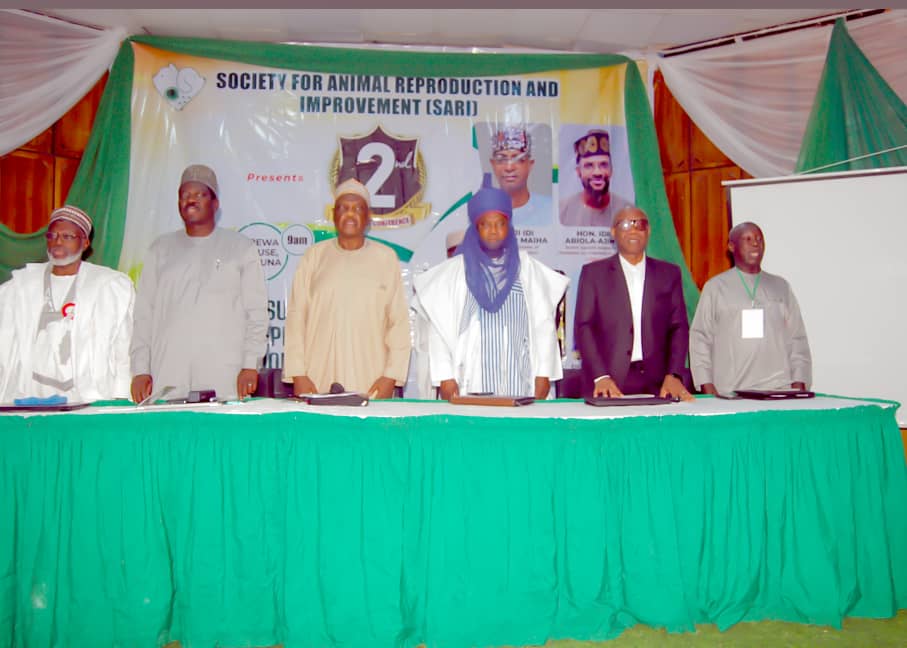
The call came at the second biennial conference of the Society for Animal Reproduction and Improvement, SARI, with the theme: “Sustainable Animal Reproduction for Food Security.”
Minister of Livestock Development, Idi Mukhtar said the timing fits his new ministry’s push to reposition animal agriculture for growth, jobs and poverty reduction.
He noted that the National Economic Council has approved the National Livestock Growth Acceleration Strategy, NL‑GAS, as the sector blueprint.
Mukhtar explained that meeting growth targets will hinge on better genetics, health services, disease control and feeding systems.
Breed improvement, he stressed, demands modern tools—artificial insemination, embryo transfer and genomic testing for cattle, goats, sheep and pigs.
The minister promised that the government would partner SARI and private players to run sustainable programmes, citing interest from Brazil, South Africa and Canada.
He added that traceability, certification and quality assurance are also advancing to protect consumers and open markets.
In his keynote address, Professor Demo Kalla of the Dairy Research and Development Centre, TETFund Centre of Excellence on Food Security at the Abubakar Tafawa Balewa University, Bauchi spoke on “Biology Meets Innovation—Advancing Animal Reproduction for Sustainable Food Security in Nigeria,” highlighting the transformative role of Assisted Reproductive Technologies, ART in modern agriculture.
According to Kalla, a combination of conventional and advanced reproductive techniques—including artificial insemination, embryo transfer, estrus synchronization, and cryopreservation has significantly improved reproductive efficiency and accelerated genetic improvement in livestock such as cattle, poultry, small ruminants, and aquatic species.
Beyond agriculture, he emphasized that ART has far-reaching applications in human health, particularly in fertility treatments and genetic disease management, demonstrating the interconnectedness of animal and human reproductive science.
Also speaking, the Senior Special Assistant to the President of Livestock, Idris Abiola Ajimobi, noted that emerging technologies like CRISPR-Cas9 gene editing, semen sexing, fixed-time artificial insemination, FTAI, and in vitro fertilization, IVF are enabling precision breeding the innovations.
He said, enhancing disease resistance, climate adaptability, and overall productivity in animal farming systems underscored the growing role of digital tools in animal reproduction, with artificial intelligence, biosensors, and nanotechnology supporting real-time monitoring, predictive analytics, and efficient herd management.
Earlier, Professor Idowu Ola
described the conference as a vital platform for knowledge exchange, research dissemination, and the strengthening of partnerships among academia, industry, and government stakeholders.
He emphasized that the present administration remains fully committed to supporting initiatives that drive innovation and growth in the livestock sector, adding that it recognizes the critical role of professional bodies like SARI in advancing research, building capacity, and facilitating policy dialogue.

