
By Michael Oche
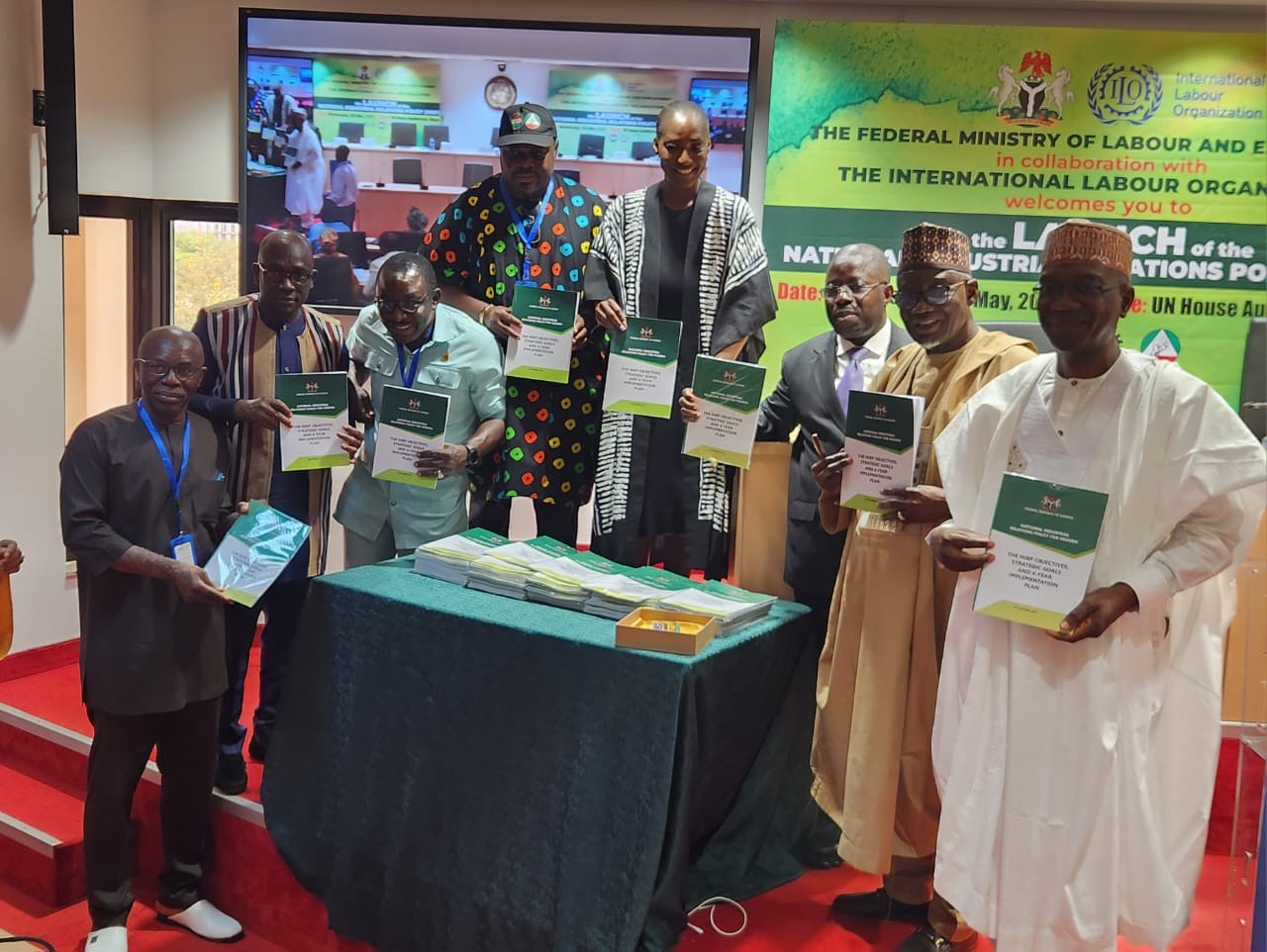
In a bid to curb persistent industrial disputes, strengthen collective bargaining, and safeguard workers’ rights, the Federal Government, with support from the International Labour Organization, on Wednesday launched the National Industrial Relations Policy (NIRP) in Abuja.
Nigerian Pilot reports that the National Industrial Relations Policy is expected to serve as a comprehensive framework for managing labour relations in Nigeria, with stakeholders expressing optimism that its implementation will reduce industrial unrest and foster sustainable economic growth.
Speaking at the launch held at the UN Building, the Minister of Labour and Employment, Dr Mohammed Maigari Dingyadi, described the policy as a “decisive step toward institutionalising industrial harmony, decent work, and inclusive economic growth” in Nigeria.
The minister noted that for decades, Nigeria’s industrial relations system had been guided by fragmented statutes and conventions without a unifying framework, a gap he said contributed to the frequent escalation of workplace disputes into nationwide strikes.
“Disputes that should be resolved at the workplace too often escalate, while collective bargaining becomes adversarial rather than collaborative,” Dingyadi said, adding that the new policy provides a “compass” for managing labour relations in a rapidly changing economy.
He explained that the NIRP is anchored on three key pillars: social dialogue, rights at work, and productivity.
According to him, the policy seeks to reposition government, employers, and workers as equal partners through strengthened platforms such as the National Labour Advisory Council and sectoral joint councils.
On workers’ rights, the minister reaffirmed Nigeria’s commitment to global labour standards, including freedom of association, elimination of forced and child labour, and non-discrimination, in line with ILO conventions already ratified by the country.
He stressed that industrial peace must go beyond the absence of strikes, noting that it should translate into improved productivity, job creation, better wages, and enhanced competitiveness of Nigerian enterprises.
Dingyadi revealed that the policy is the outcome of six years of tripartite consultations involving government, organised labour, and employers.
He commended key stakeholders, including the Nigeria Labour Congress, Trade Union Congress of Nigeria, and the Nigeria Employers’ Consultative Association, for their roles in shaping the document.
The minister outlined a series of reforms aimed at ensuring the effective implementation of the NIRP, saying that these include the upgrade of labour institutions such as the Industrial Arbitration Panel for faster dispute resolution, as well as nationwide capacity-building programmes for union leaders, human resource managers, and labour officers.
He also announced plans to establish a National Industrial Relations Observatory as an early warning mechanism to detect and address workplace grievances before they escalate into strikes.
He noted that the policy seeks to extend labour protections to Nigeria’s vast informal sector, which accounts for over 80 per cent of the workforce.
Dingyadi said artisans, market associations, and platform workers would be integrated into dispute resolution and social protection frameworks through cooperative structures.
The minister called on organised labour to embrace dialogue and use strikes only as a last resort, while urging employers to commit to fair negotiations and transparency.
He also charged Ministries, Departments and Agencies (MDAs) to mainstream the policy into public sector employment practices.
“You cannot create jobs in an atmosphere of distrust, and you cannot reduce poverty where wages are lost to avoidable strikes,” he said.
He emphasised that industrial harmony should not be seen as the absence of conflict, but as the presence of strong institutions and trust to manage disagreements effectively.
“With this policy, Nigeria is choosing dialogue over disruption, partnership over protest, and progress over polarisation,” the minister stated.
In her address, Dr Vanessa Phala, Director of the ILO Country Office for Nigeria, Ghana, Liberia and Sierra Leone, said the launch of the Policy is not an end in itself, saying that on the contrary, it marks the beginning of a decisive phase which is the phase of implementation.
She said, “I would like to reaffirm the full availability and continued commitment of the ILO to support the Government of Nigeria and the social partners in the effective operationalization, monitoring and evaluation of this Policy.”
She noted that Nigeria’s adoption of the policy sends a strong signal of its commitment to dialogue, shared responsibility, and a future of work anchored on dignity, productivity, and social cohesion.
She further explained that the policy offers a holistic response to both longstanding and emerging challenges in the world of work, including technological change, the growth of the informal economy, and shifting demographic realities.
She said, “What fundamentally distinguishes this National Industrial Relations Policy is the inclusive, participatory and nationally owned dynamic that shaped its development.
This is not a policy imported from elsewhere, nor a reform imposed from outside. It is a co-created policy, born out of dialogue, deliberation and, at times, robust debate, but always guided by a shared commitment to consensus and collective responsibility.”
In his address, President of Nigeria Labour Congress (NLC) Comrade Joe Ajaero expressed hope that the Policy provides a roadmap that can help address the intractable difficulties in industrial relations in Nigeria, including disrespect for collective bargaining agreements, which is the harbinger of most industrial conflicts in Nigeria.”
“We hope this will help restore a dispensation of respect for fundamental human and workers’ rights, and respect for fundamental principles and rights at work that translates into improved conditions of work, wages, livelihood, living standards and dignity of labour,” he said.
Ajaero who was represented by Comrade Eche Asuzu, noted that it is important for stakeholders to show commitment to the implementation of the policy.
He said, “The role of the Federal Ministry of Labour and Employment, especially with regard to workplace monitoring, inspection, dialogue and compliance, is critical for success.
“We must allow this national policy to moderate our approach to labour standards, working conditions, tripartite relations, collective bargaining, industrial action, industrial litigation, social dialogue, occupational health and safety, and productivity.”

