
By Michael Oche
The Fight Inequality Alliance (FIA) Nigeria has called for collective action among government, civil society organisations, development partners and citizens to address Nigeria’s widening inequality.
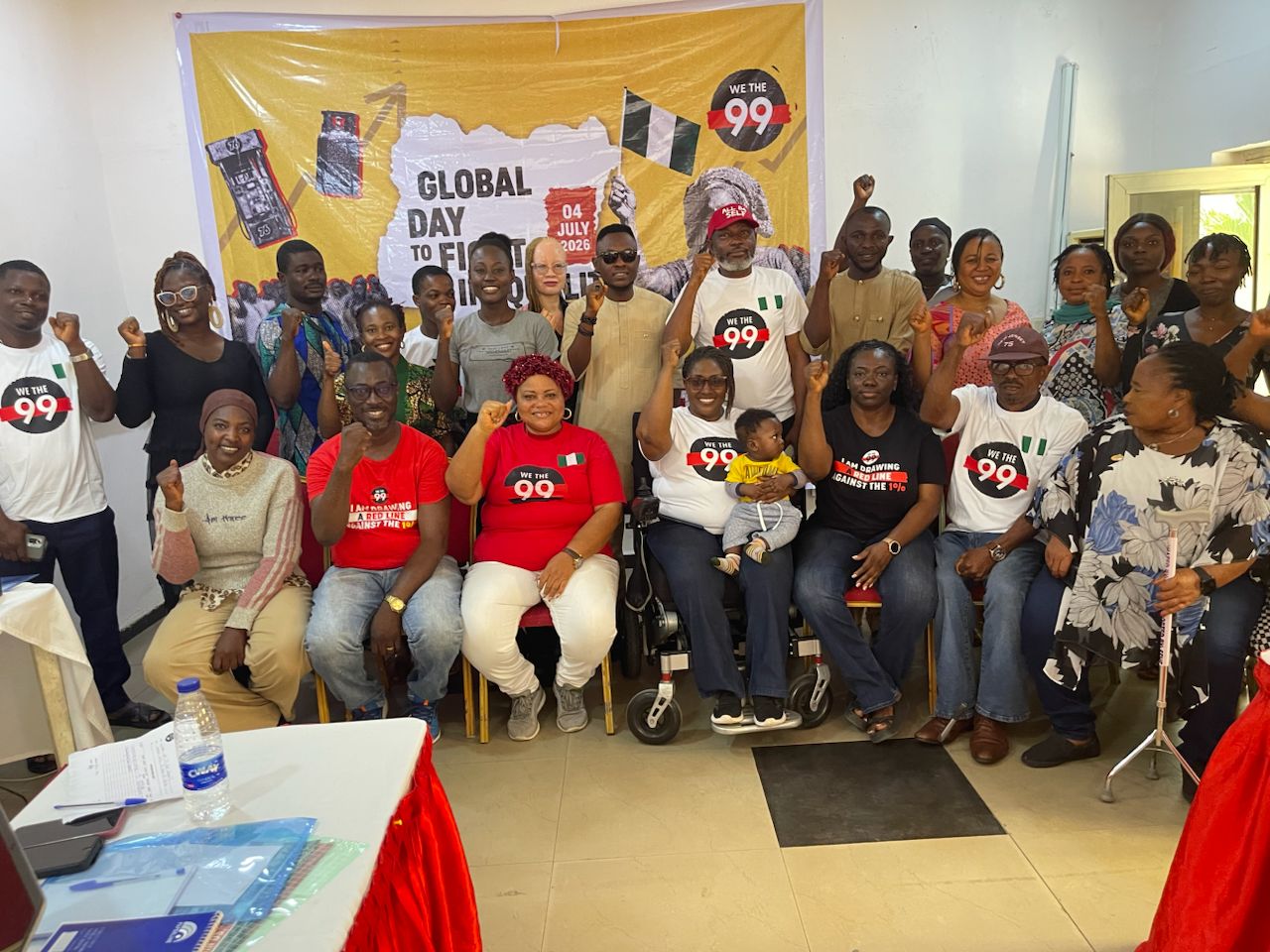
The alliance made the call during activities marking the Global Day to Fight Inequality in Abuja on Saturday, amid growing concerns over Nigeria’s widening wealth gap.
Speaking during the event, Convener of FIA Nigeria Ekaete Umoh, said the alliance was committed to building a common platform for collective action against inequality in all sectors.
According to the National Bureau of Statistics (NBS), about 63 per cent of Nigerians are multidimensionally poor, lacking adequate access to healthcare, quality education, decent housing and other basic services.
Umoh said that FIA is a global movement of civil society organisations, activists and grassroots networks striving for a just, equal and sustainable world.
She noted that inequality remained evident in health, education, gender, youth participation, disability inclusion and access to economic opportunities.
She explained that previous advocacy efforts, including the “Not Too Young to Run” campaign and the campaign that led to the signing of the Disability Act in 2019, were practical examples of efforts to reduce inequality.
“Our vision is to stand together to fight every form of inequality. We want a society where everyone has equal opportunities and access to resources,” she said.
According to her, the alliance seeks a fairer distribution of wealth and resources to ensure that all citizens can live dignified lives.
She described inequality in Nigeria as widespread, citing disparities in healthcare, education and opportunities for vulnerable groups, particularly persons with disabilities.
Umoh urged government to create more opportunities for civil society organisations to contribute practical solutions to reducing inequality and achieving the Sustainable Development Goals (SDGs).
“We are not just pointing out problems; we are bringing solutions and asking government to open up the space for dialogue and partnership,” she said.
Also speaking, Executive Director, Centre for Transparency Advocacy (CTA), Faith Nwadishi, said inequality had become impossible to ignore, with a small percentage of the global population controlling a significant share of wealth.
Nwadishi who is a member of the FIA National Council cited data showing widespread multidimensional poverty, disparities between rural and urban communities, and limited access to healthcare, quality education and housing.
“According to the National Bureau of Statistics (NBS), about 63 per cent of Nigerians experience deep deprivation, known as multidimensional poverty.
“This means poverty is not just about income; it affects people from different angles. It includes poor housing, inadequate healthcare, lack of quality education and limited access to other basic services”.
She called for policies that promote equitable wealth distribution, fair taxation and improved social protection, while stressing the need to address barriers affecting women, young people and vulnerable groups.
Nwadishi also advocated cultural and institutional reforms to eliminate discriminatory practices and expand opportunities for women and marginalised communities.
Similarly, Chief Executive Officer of Kids & Teens Resource Centre, Mr. Martin-Mary Falana, said “If there is one thing I would like to see happen, it is the establishment of systems that prevent people from intentionally oppressing others.
“For instance, if you own a car, that’s fine. But by the time you acquire a second car, it should attract a much higher tax so that excessive accumulation is discouraged.
“We live in a society where many people cannot afford basic food, while others enjoy enormous excesses.
“We walk through our streets and villages and see countless people without access to education or quality healthcare.
“At the same time, some people can afford to travel abroad for medical treatment”.
Falana who is also a member of the National Council of Fight Inequality Alliance Nigeria, added: “I believe there should be policies that encourage leaders and public officials to rely on healthcare services within the country”

