
By Aaron Ossai
The Executive Director of the Policy and Legal Advocacy Centre (PLAC), Clement Nwankwo, and the wife of the Speaker of the House of Representatives, Hajiya Fatima Tajudeen Abbas have called on members of the 10th National Assembly to pass the Constitution Alteration Bill seeking the creation of Special Reserved Seats for Women, describing it as the legislature’s defining democratic legacy.
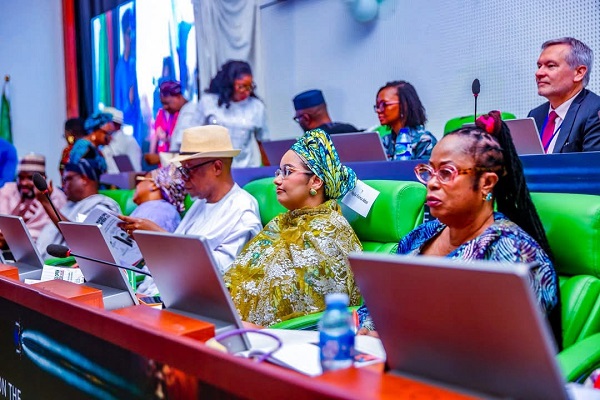
The appeal was made during the 2026 National Assembly Open Week at the National Assembly Complex, Abuja, where both speakers warned that failure to pass the bill would cast a shadow over the Assembly’s record despite its legislative achievements.
Speaking at the National Dialogue on the Electoral College Model for the Special Seats Bill, Nwankwo acknowledged the National Assembly’s productivity over the past three years through several reforms, bills and motions aimed at strengthening democratic governance.
However, he insisted that none of those initiatives matched the significance of the Special Reserved Seats Bill, describing it as a historic opportunity to correct the longstanding underrepresentation of women in elective offices.
Addressing the Speaker through the House Leader, Prof. Julius Ihonvbere, and Hajiya Fatima Abbas, Nwankwo urged sustained advocacy to secure the support of lawmakers in both chambers.
“This is the most important bill before this National Assembly. It is not the budget bill or the tax reform bill. The Special Seats for Women Bill is the greatest legacy this National Assembly can leave behind. If this bill does not pass, the legacy of the 10th National Assembly will be seriously questioned,” he said.
In her remarks, Hajiya Fatima Tajudeen Abbas lauded the leadership of the House of Representatives under Speaker Abbas Tajudeen for promoting transparency, citizen engagement, legislative reforms and inclusive governance.
“This Open Week reflects our shared belief that democracy thrives when citizens are informed, engaged and able to participate meaningfully in governance. By opening the legislature to dialogue and public engagement, the House of Representatives continues to strengthen public trust and deepen Nigeria’s democratic culture,” she said.
She stressed that a representative democracy must provide opportunities for every segment of society to participate in governance.
She urged lawmakers, civil society organisations, development partners and other stakeholders to sustain advocacy until the bill is passed into law.

