
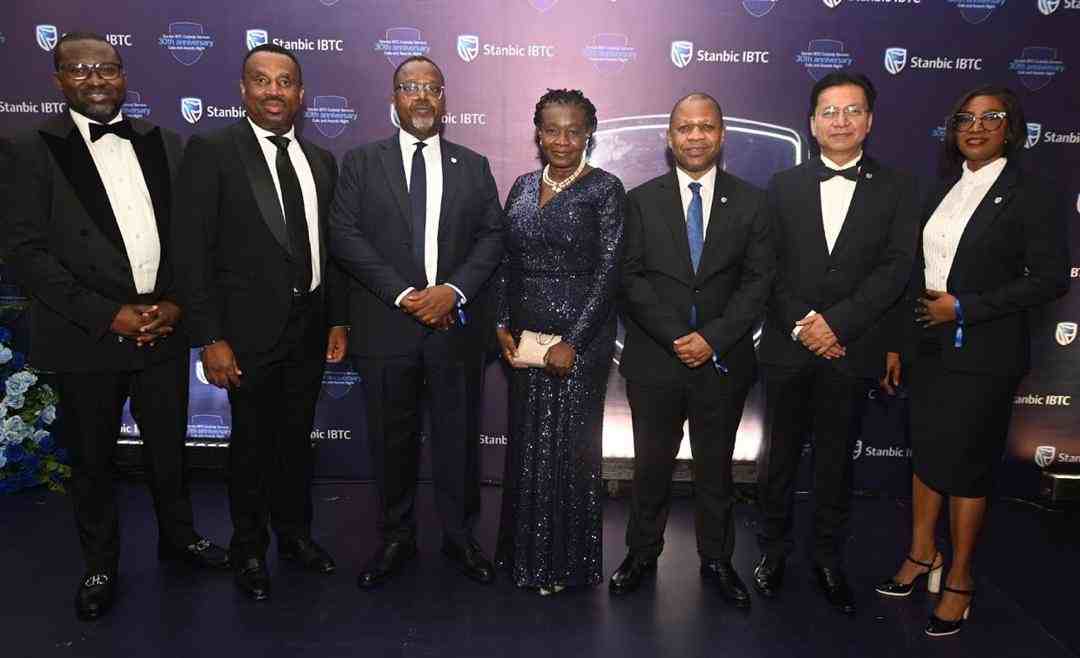
Stanbic IBTC Nominees Limited on Wednesday, February 11, 2026, celebrated its 30th anniversary with a high-profile gala in Lagos, highlighting what it described as three decades of “exceptional custodial services” in Nigeria’s financial markets. Branded under the theme “30 Years of Trust,” the event brought together regulators, clients, and capital market stakeholders in a show of corporate confidence.
Established in 1996, Stanbic IBTC Nominees has grown into one of Nigeria’s dominant custodians, providing asset safekeeping, settlement, and investment administration services to institutional investors, including pension funds, asset managers, and insurance firms. The company positions itself as a backbone of Nigeria’s capital markets.
Yet beyond the polished speeches and glowing testimonials, the anniversary also raises broader questions about the structure, competitiveness, and transparency of Nigeria’s custody business; a critical but often opaque segment of the financial system. Industry analysts note that while the custody business has expanded in scale, the broader capital market ecosystem remains shallow relative to Nigeria’s economic size. Persistent challenges, from limited retail participation to structural inefficiencies and regulatory bottlenecks, continue to constrain market depth.
At the gala, Wole Adeniyi, Chief Executive of Stanbic IBTC Bank, reaffirmed the group’s ambition to become Africa’s most innovative and trusted custody provider, promising greater investment in technology and global-standard infrastructure. “Our vision is to be Africa’s most innovative and trusted custody provider,” Adeniyi said, stressing that the next phase would combine global expertise with local insight to support Nigeria’s capital market growth.
Babatunde Majiyagbe, Chief Executive of Stanbic IBTC Nominees, described the firm’s operations as defined by “zero tolerance for operational errors” and consistent regulatory compliance. He highlighted settlement efficiency and compliance support as central to the company’s approach.
However, observers caution that the custody industry’s risk profile has evolved significantly over the past decade. With pension assets under management rising sharply and foreign portfolio flows fluctuating amid macroeconomic volatility, custodians now sit at the centre of systemic risk management. Concentration of custodial services among a handful of large financial institutions also raises concerns about market dominance and systemic exposure. In the event of operational disruptions, cyber threats, or liquidity shocks, ripple effects could be significant for institutional investors and millions of pension contributors.
Jude Chiemeka, Chief Executive Officer of Nigerian Exchange Limited, praised the partnership with Stanbic IBTC, describing it as “transformative” and citing the “peace of mind” derived from secure asset custody. Yet governance advocates argue that stronger independent performance metrics, rather than celebratory testimonials, are necessary to assess custodial effectiveness. Transparency around service benchmarks, operational risk incidents, and cost competitiveness remains limited in public discourse.
The anniversary comes at a time when Nigeria’s financial markets are grappling with currency volatility, inflationary pressures, and cautious foreign investor sentiment. Custodians, as gatekeepers of cross-border investment flows, play a pivotal role in maintaining investor confidence. But confidence ultimately depends on systemic stability, regulatory predictability, and market liquidity factors that extend beyond individual corporate milestones.
Stanbic IBTC Nominees reaffirmed its commitment to investing in technology and human capital, pledging to expand service offerings to meet evolving investor needs. Still, the real test for custodians in the coming decade may lie less in gala celebrations and more in measurable improvements to market resilience, digital transformation, and cost efficiency.
Three decades after its founding, Stanbic IBTC Nominees stands as one of the most prominent players in Nigeria’s custody space. But as the institution celebrates longevity, stakeholders are asking tougher questions: Has the custody industry done enough to modernise Nigeria’s capital market infrastructure? Are investors receiving globally competitive services at transparent costs? And can the sector withstand the shocks of an increasingly volatile global financial system?
For now, the anniversary marks a symbolic milestone. Whether it represents substantive progress for Nigeria’s broader financial architecture remains a debate that extends well beyond the ballroom.
By Kehinde Ibrahim, Lagos

