
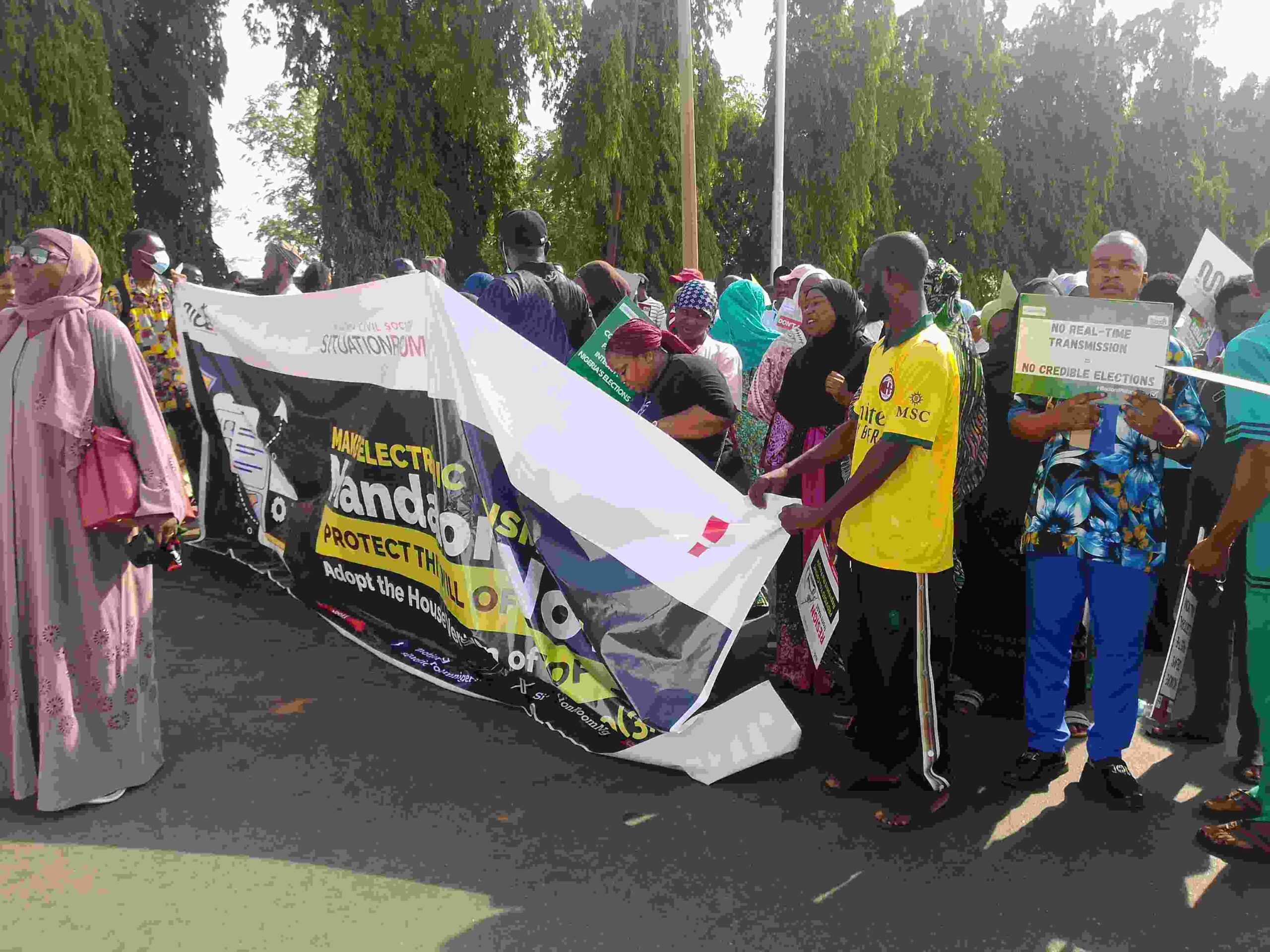
For the second time in recent weeks, protesters on Monday converged on the National Assembly in Abuja, demanding that the Electoral Act (Amendment) Bill, 2026 include mandatory real-time electronic transmission of election results.
The demonstrators, drawn from civil society organisations such as ActionAid Nigeria, the Movement for the Transformation of Nigeria (MOTION), and the Nigeria Civil Society Situation Room, insisted that manual collation of results must be eliminated, arguing that it creates opportunities for manipulation. Security operatives barricaded entrances to the National Assembly Complex, forcing the protesters to demonstrate outside the gates.
Andrew Mamedu, Country Director for ActionAid Nigeria, criticised the Senate’s version of the Electoral Act (Amendment) Bill 2025, describing it as weakened and a departure from earlier stakeholder agreements. He warned that removing provisions mandating real-time electronic transmission of results could undermine the credibility of the 2027 General Elections.
Mamedu stressed that compulsory electronic transmission is vital for transparency, reducing malpractice, and restoring public trust. He cited the 2023 General Elections, where the absence of mandatory real-time transmission contributed to disputes, prolonged litigation, and widespread dissatisfaction. He urged the harmonisation committee to adopt the House of Representatives’ position, which retains real-time electronic transmission.
The coalition also faulted the proposed reduction of the Notice of Elections timeline. While the Electoral Act 2022 provides for a 360-day notice period, the Senate reduced it to 180 days, and the House proposed 300 days. Civil society groups argued that the 360-day timeframe allows the Independent National Electoral Commission (INEC) sufficient time for voter registration, logistics planning, procurement, voter education, and training of ad-hoc staff. Shortening the timeline, they warned, could disrupt party primaries, heighten disputes, and strain preparations.
The organisations stressed that while the Conference (Harmonisation) Committee is a legitimate legislative process, it should not dilute key electoral safeguards already achieved. Protesters vowed to continue mounting pressure until mandatory real-time electronic transmission is clearly enshrined in law, insisting that reliance on manual collation is unjustifiable given existing budgetary allocations for election technology
By Palma Ileye, Abuja

