
By Ngozi Nwankwo
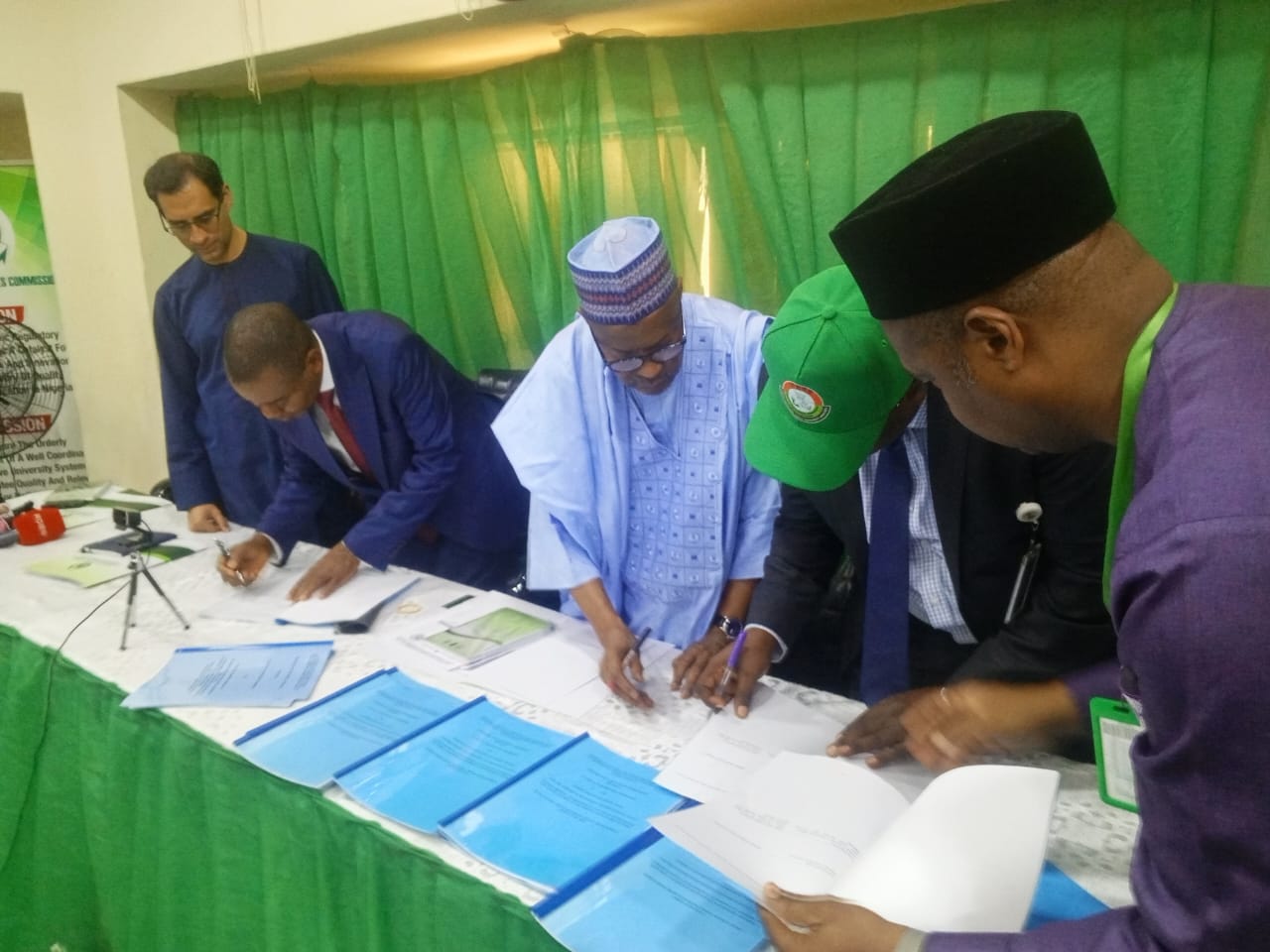
Vice-Chancellors of six Nigerian universities have signed new Performance Contracts for the Sustainable Procurement, Environmental and Social Standards Enhancement,SPESSE,Project, marking the beginning of an expanded phase of the initiative aimed at strengthening public sector and higher education capacity in Nigeria.
The National Universities Commission said the new agreements signal a more ambitious stage for one of the country’s strategic education and institutional development projects.
Speaking during the signing ceremony, the Executive Secretary of the National Universities Commission, Abdullahi Yusufu Ribadu, described the development as “a new chapter in our collective journey to strengthen Nigeria’s capacity in procurement, environmental, and social standards.”
The SPESSE Project recently secured an additional $65 million financing package from the World Bank, bringing the total funding portfolio to $145 million. The new funding extends implementation of the project to June 2029.
According to Ribadu, the additional financing is expected to consolidate previous gains while expanding training, institutional infrastructure, and professional certification systems nationwide.
He said the project was also gaining international recognition, noting that some of the Centres had already enrolled foreign students as part of efforts to internationalise education within the Nigerian university system.
Ribadu further disclosed that the SPESSE Centres had established over 68 international partnerships to strengthen collaboration in teaching, research, and professional development.
The NUC boss said professionalisation had become a major focus of the initiative, explaining that certification portals for procurement, environmental, and social standards practitioners were activated in 2025 by the Bureau of Public Procurement, the Federal Ministry of Environment, and the Federal Ministry of Women Affairs to improve practitioner authentication and quality assurance.
He added that the new phase would focus on deepening institutional ownership, expanding online and distance learning opportunities, strengthening collaborations with industry and international partners, and ensuring the Centres become self-sustaining beyond external funding.
“I am particularly pleased that the sustainability plans developed by the Centres under the first phase of the Project address critical areas such as the commencement of PhD programmes,” Ribadu said.
He disclosed that two of the six Centres had already commenced PhD programmes, while other sustainability measures included integrating the Centres into university structures, mobilising resources, and strengthening partnership frameworks.
Under the additional financing phase, the Centres are expected to collectively produce at least 60 PhD graduates, enrol no fewer than 60 foreign students, facilitate 18 staff internships, and support at least 60 student exchange programmes with foreign institutions.
The universities are also expected to establish or upgrade Open and Distance Learning facilities and deploy stronger Management Information Systems to improve institutional efficiency and long-term sustainability.
“These targets reflect our vision to ensure that SPESSE evolves into a transformative platform for sustainable human capital development, capable of sustaining its relevance and impact well beyond the World Bank’s support,” Ribadu added.
Providing further insight into the project, the National Project Coordinator, Joshua Atah, said all SPESSE programmes had undergone resource verification and accreditation by the National Universities Commission, while the Joint Admissions and Matriculation Board and the National Youth Service Corps had been formally notified.
According to him, some participating universities have established new departments and faculties for the programmes, while others are converting the Centres into full-fledged institutes.
Atah also highlighted the project’s integration of technology into learning delivery through investments in virtual classrooms, Learning Management Systems, live-streaming platforms, and High-Performance Computing infrastructure.
He noted that private sector organisations were increasingly supporting internships, field visits, and staff training under the initiative, helping to bridge the gap between academic training and industry needs.
He added that dedicated resources had also been committed to promoting female participation and supporting vulnerable groups within the programme.
Atah explained that the new phase would focus on scaling up training across programme tracks, strengthening professional certification systems, and improving institutional sustainability.
He further disclosed that a new performance-based condition tied to digital procurement reform through the Electronic Government Procurement system had been introduced.
According to him, implementation would increasingly target high-spending Ministries, Departments, and Agencies at federal and state levels, while disbursements would remain tied to independently verified performance benchmarks under the project’s results-based financing framework.
The SPESSE Project, initially designed to address skills gaps in procurement, environmental, and social standards, is gradually evolving into a broader institutional reform platform aimed at strengthening universities, professionalising public sector practice, expanding international collaboration, and positioning Nigeria as a regional hub for specialised knowledge and sustainable development expertise.

