
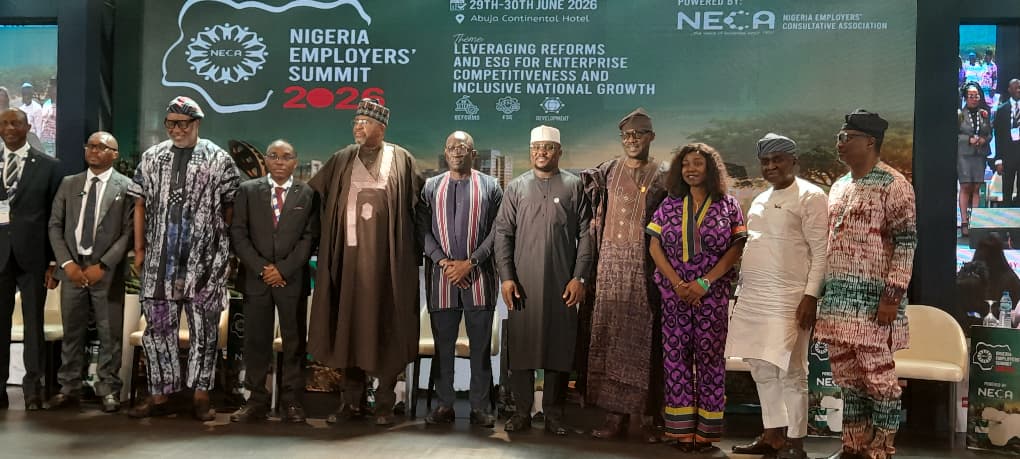
*FG assures businesses of improved operating environment
By Michael Oche
Businesses across Nigeria continue to grapple with high energy costs, persistent inflation, multiple taxation and other economic challenges despite ongoing government reforms, the Nigeria Employers’ Consultative Association (NECA) has said.
Speaking at the opening of the 5th Nigeria Employers’ Summit in Abuja on Monday, President of NECA, Dr Ifeanyi Okoye said that while the Federal Government’s economic reform agenda was aimed at addressing longstanding structural challenges and laying the foundation for sustainable growth, many enterprises were still struggling to cope with the realities of the operating environment.
Dr Okoye, who was represented by Mr Richard Ayibiowu, NECA’s Treasurer, acknowledged the government’s “bold and far-reaching reforms,” including the removal of fuel subsidies, foreign exchange market reforms, ongoing tax reforms, initiatives to improve the ease of doing business and efforts to stimulate industrial development.
He said the reforms reflected a deliberate effort to strengthen fiscal sustainability, improve public finance management, boost revenue generation and position the Nigerian economy for long-term growth and competitiveness.
However, the NECA president stressed that the true measure of any reform programme lies in its impact on businesses and citizens, noting that three years into the reform process, it was necessary to assess how the policies had affected enterprise growth, investment, employment generation, productivity and overall economic welfare.
“While there have been positive developments in certain macroeconomic indicators, businesses continue to operate in a challenging environment,” he said.
According to him, high energy costs, persistent inflationary pressures, exchange rate volatility, multiple taxation, infrastructure deficits, logistics constraints, regulatory complexities and weakened consumer purchasing power as major factors undermining business performance across sectors.
He added that the adjustment burden had been particularly severe for Micro, Small and Medium Enterprises (MSMEs), many of which continue to face significant operational and financial pressures.
Okoye said this year’s Employers’ Summit, themed around reviewing Nigeria’s economic reform journey, would provide an opportunity for stakeholders to evaluate progress made so far, identify outstanding challenges and develop practical recommendations for improving policy implementation and enhancing business competitiveness.
In his welcome address, NECA Director-General, Adewale Smart Oyerinde, said the organised private sector had consistently advocated for the removal of the fuel subsidy long before its implementation, describing it as one of the association’s longstanding policy recommendations.
“One of the key recommendations consistently made by the organised private sector over the years was the removal of the fuel subsidy. Every Annual General Meeting address by successive Presidents of NECA reinforced that position. Today, the subsidy has been removed, and we are all living with the realities of that decision,” he said.
Oyerinde noted that while the private sector recognises that the ongoing reforms were necessary to put the economy on a sustainable path, government must also respond to the challenges businesses are facing by making policy adjustments that improve enterprise competitiveness.
“Our responsibility is to ensure that government also understands where businesses are experiencing challenges and what policy adjustments are required to improve enterprise competitiveness. This summit provides that platform. It ensures that the voice of employers is heard and that policies are informed by practical business realities,” he added.
The NECA Director-General also announced that the Nigeria Employers’ Summit would be upgraded to an International Employers’ Summit from 2027, citing the organisation’s partnerships across more than 50 African countries and its affiliation with the International Labour Organization (ILO).
According to him, the expanded summit will serve as a global platform for dialogue on investment, labour migration, enterprise development and economic transformation, bringing together stakeholders from across Africa and the wider international business community.
He stressed that the summit was designed to be “practical, solution-driven and evidence-based,” with discussions focusing on the implementation of economic reforms, industrial policy, environmental, social and governance (ESG) principles, regulatory reforms and Nigeria’s tax reforms.
Delivering the keynote address, Vice President Kashim Shettima, said the President Tinubu administration was aware of the challenges confronting businesses but insisted that the reforms were necessary to rebuild the economy on a sustainable footing.
Vice President who was represented by the Deputy Chief of Staff to the President (Office of the Vice President), Senator Ibrahim Hassan Hadejia, Nigeria’s economy had been weighed down by deep structural problems, including an unsustainable fuel subsidy regime, a fragmented foreign exchange market, weak government revenue and declining investor confidence, making difficult reforms inevitable.
“The reforms have been difficult, but their purpose is to correct the foundations so that growth becomes real, durable and inclusive,” the Vice President said.
He noted that while businesses had legitimate concerns over production costs, access to credit, taxation, exchange rates and infrastructure, the government’s fiscal, tax and foreign exchange reforms were designed to create a more predictable business environment.
On taxation, Shettima said businesses were not opposed to paying taxes but were concerned about multiple taxation and cumbersome regulatory processes.
“Businesses do not reject taxation. They reject multiple taxation, harassment and systems that punish compliance while rewarding informality,” he said, adding that the administration’s tax reforms seek to harmonise tax administration, reduce the number of taxes, support small businesses and broaden the tax base.
The Vice President also said ongoing reforms in the power sector, gas development and the Presidential Compressed Natural Gas (CNG) Initiative were aimed at reducing energy costs for businesses and households, while investments in infrastructure, logistics and digital government services would lower the cost of doing business and improve Nigeria’s competitiveness.
He urged the private sector to leverage the opportunities created by the reforms, stressing that government alone could not drive economic transformation.
“Government designs policy, but businesses build the factories, farms, services and innovations that create jobs and prosperity,” he said, while calling for continued dialogue between government and employers to ensure that reforms translate into sustainable economic growth.

