
By Patrick Wemambu
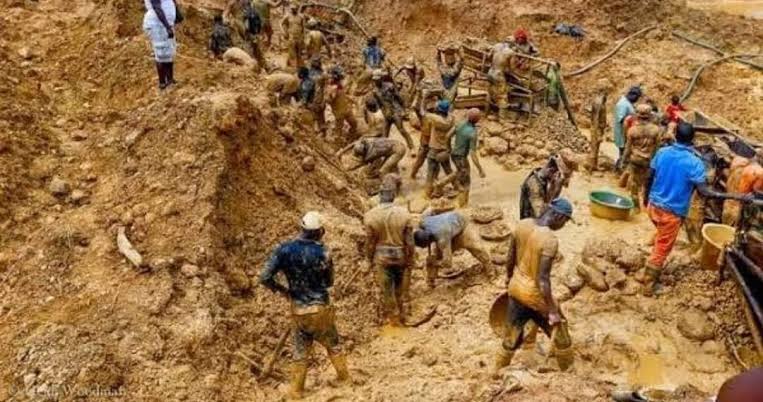
Economic and Financial Crimes Commission (EFCC) has vowed to intensify its crackdown on illegal mining by targeting financiers, mineral buyers, compromised public officials and other members of criminal networks benefiting from the theft of Nigeria’s mineral resources.
This was disclosed in a statement issued Tuesday by the Commission where the EFCC Chairman, Ola Olukoyede, maintained that illegal mining was sustained by sophisticated syndicates involving local and international players. He warned that arresting miners at excavation sites alone would not address the problem.
The statement went further to say that Olukoyede spoke on Tuesday while delivering a keynote address at a public lecture and capacity-building workshop organised by the Michael Imoudu National Institute for Labour Studies and the Human and Environmental Development Agenda in Ilorin, Kwara State.
He was quoted as saying that the networks behind illegal mining comprised individuals who provided funding, facilitated transportation and documentation, purchased illegally extracted minerals and protected the operations.
“Therefore, dealing with illegal mining involves breaking an impregnable chain of fraudulent actors: young men carrying shovels, their financiers, buyers of the minerals, compromised officials facilitating the operation, beneficiaries from the proceeds and other actors,” the EFCC chairman stated in the released statement.
He added that the commission’s enforcement strategy would focus on tracing the proceeds of illegal mining and identifying those who financed and benefited from the operations.
The anti-graft agency’s chairman disclosed that the commission recorded 52 illegal mining cases between October 2023 and July 2026 and secured the forfeiture of 102 tonnes of solid minerals.
He clarified that the EFCC was not the regulatory authority for the mining sector and had no responsibility for issuing mining licences, explaining that its intervention covered suspected corruption, fraud, money laundering, illicit financial flows and proceeds of criminal activities.
According to him, financial investigations remained crucial because illegally extracted minerals eventually generated proceeds that moved through bank accounts, businesses, payments and asset acquisitions.
Olukoyede also linked illegal mining to Nigeria’s security challenges, warning that unregulated mineral extraction and trading created opportunities for criminal networks to engage in extortion, smuggling, violence and territorial disputes.

