
*tasks govt on policies that promote youth employment
By MICHAEL OCHE
The Public Services International (PSI) and the Non-Academic Staff Union of Educational and Associated Institutions (NASU) has intensified efforts to prepare young workers in Africa and the Arab region for future leadership positions in trade unions, warning that growing threats, including privatisation, shrinking membership and attacks on workers’ rights, could undermine the labour movement if urgent steps are not taken to renew its leadership.
The organisation said deliberate investment in the education, mentorship and capacity development of young workers was necessary to build a new generation of trade union leaders capable of defending workers’ interests and quality public services.
In his message to the conference, PSI General Secretary Daniel Bertossa stressed that austerity, privatisation, outsourcing and insecure employment are threatening young workers’ futures and weakening public services.
He called on young trade unionists to organise, build collective power and take up leadership roles in their unions.
“The renewal of our labour movement depends on this work,” he said.
Also speaking, Comrade Peters Adeyemi, the General Secretary of the Non-Academic Staff Union of Educational and Associated Institutions and PSI Vice President for Africa and Arab countries in his welcome address, called on African governments and employers to prioritise youth employment, warning that prolonged recruitment freezes in public institutions were worsening unemployment among graduates.
Comrade Adeyemi said government policies that restricted recruitment in public agencies and establishments were working against the interests of young people, particularly as thousands of graduates continued to leave universities and other tertiary institutions without corresponding employment opportunities.
He criticised employment schemes that offered young people poorly paid jobs under the guise of empowerment, insisting that governments must focus on providing decent and sustainable employment rather than opportunities that could not guarantee a decent standard of living.
“You pay people salaries that cannot take them home, and you call that empowerment,” he said, adding that prolonged youth unemployment could worsen insecurity by making vulnerable young people susceptible to recruitment into criminal activities.
He urged governments across Africa to provide gainful employment as part of efforts to address unemployment and insecurity.
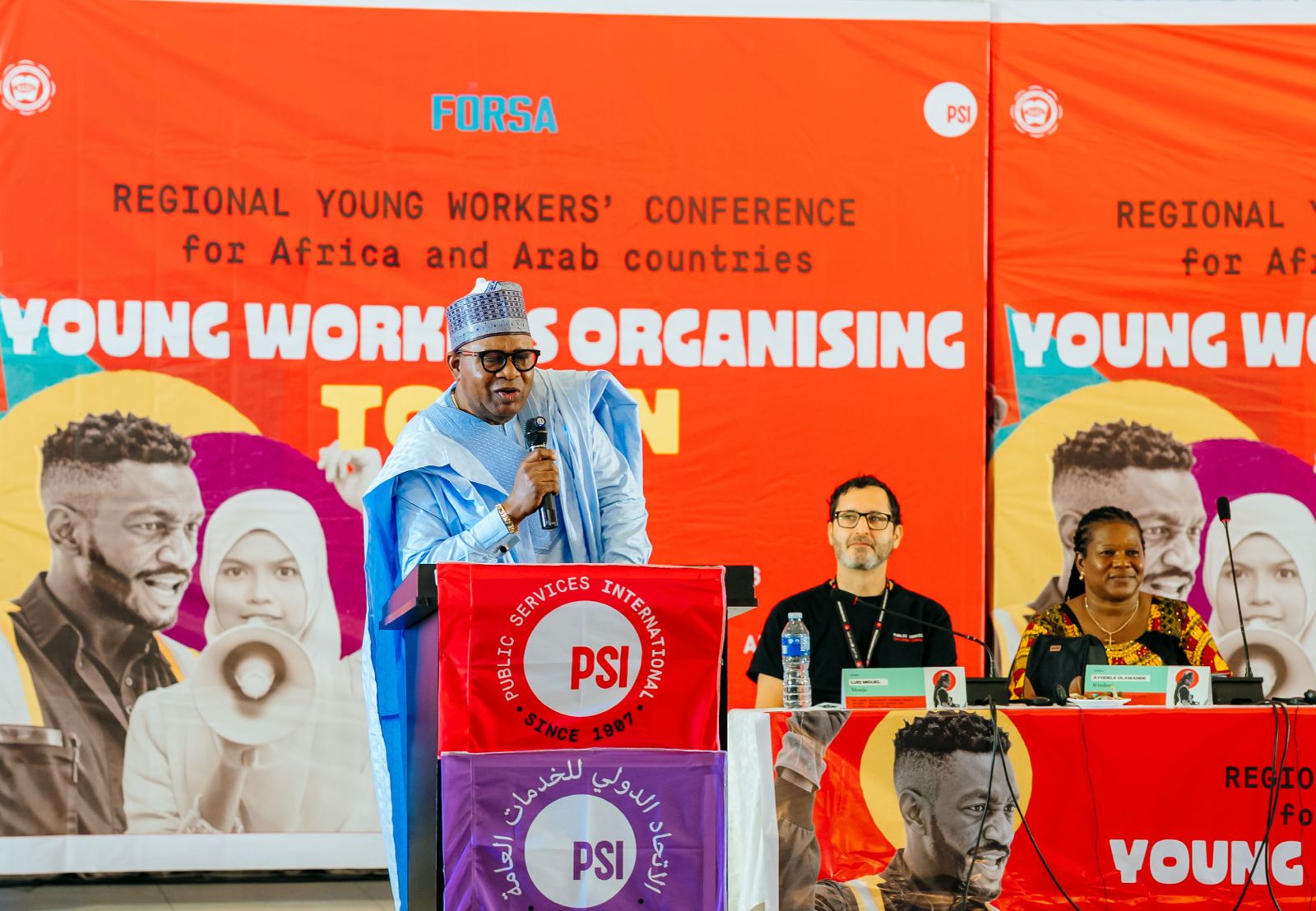
The PSI Regional Secretary for Africa and Arab Countries, Daniel Oberko, disclosed this in Abuja at the opening of the Regional Young Workers Conference for Africa and Arab Countries, with the theme, “Young Workers Organising to Win”.
Oberko said PSI established its Young Workers Education and Mentorship Programme in 2024 as a five-year initiative to prepare young public service workers for leadership positions within trade unions across the region.
He explained that the programme was designed to ensure that emerging union leaders acquired the knowledge, experience and organisational skills required to assume responsibilities as Presidents, General Secretaries and other elected officials.
He said while experience remained an important component of leadership development, deliberate education and capacity building were equally essential to preparing young workers for future responsibilities.
“We know that experience counts a lot, and it is actually one of the most important tools for training and preparation. But we also know that a deliberate and very intentional effort to educate and build capacity, coupled with experience, is superior,” he said.
Oberko identified attacks on trade union leaders, privatisation of public services and austerity measures that restrict government investment in essential services as some of the major threats confronting the labour movement.
He said PSI was preparing young workers to confront these challenges while equipping them with a better understanding of the importance of defending quality public services as a means of reducing poverty and addressing inequalities in society.
“We believe that we need to prepare the next force and the next soldiers to be able to confront those attacks. And that is why this programme is holding,” he said.
On the need to attract more young people into trade unions, Oberko said the movement must address the challenge of unemployment while returning to traditional practices of organising, education and mentorship.
He argued that young people must first have access to employment before trade unions could effectively recruit and organise them.
“First and foremost, they must be employed before they can recruit them. And so, our commitment to push the government to employ is number one,” he said.
Oberko added that unions must deliberately establish education and mentorship structures to retain young members and prepare them for leadership responsibilities.
He further disclosed that PSI was developing a regional model to guide its affiliates in establishing young workers’ committees at national levels.
The model, he said, would provide a platform for identifying relevant subjects for training young workers, strengthening their participation in union activities and improving recruitment and organising strategies.
He explained that the framework would be cascaded to national affiliates to help them strengthen their organising efforts and develop young workers’ leadership capacity.
Also speaking, PSI Project Officer and Policy Officer for Education Support and Cultural Workers, Luis Monje, warned that trade unions risked losing their relevance and existence if they failed to address the declining participation of young workers.
Monje said the organisation was prioritising leadership renewal through a sustained programme that would equip emerging union leaders with a better understanding of labour issues, the changing world of work and the responsibilities of trade union leadership.
He identified privatisation, declining union membership and attacks on trade unions as growing challenges that required new approaches to organising and mobilising workers.
According to him, many unions are also confronted with a demographic challenge, as their leadership structures continue to age without sufficient numbers of young workers coming into the movement.
“If we don’t identify a methodology to organise, mobilise and train these workers, many unions will disappear. Many unions will not exist anymore in a few years because there is a demographic problem in many unions,” he warned.
Monje stressed that leadership renewal must go beyond occasional training programmes to include deliberate strategies for bringing young workers into active union participation and attracting new members.
He also called on governments to prioritise employment creation, particularly in the public sector, noting that decent employment was fundamental to strengthening trade union membership.
He explained that PSI’s campaign for a New Social Contract rested on four pillars: social protection, labour rights, social dialogue and employment creation.
Monje lamented that employment creation was often neglected in government policies, despite the public sector’s importance as a major employer in many countries.
“Governments are forgetting employment policies. In many cases, when we speak about employment policies, this affects the public service. The public service in many countries is the biggest employer,” he said.
He urged governments to invest more resources in public services and pursue employment policies that guarantee decent work, arguing that privatisation was reducing employment opportunities in the sector.
Monje said expanding decent employment in public services would create opportunities for trade unions to recruit, organise and empower young workers.
He added that creating more public sector jobs was essential to building stronger unions and ensuring the continued relevance of the labour movement.
The Minister of Youth Development, Mr Ayodele Olawande, in his address reiterated the Federal Government’s commitment to creating employment opportunities for young Nigerians and expanding their participation in governance and decision-making processes.
Olawande, who was represented by Mrs Ojeaburu Arinola Grace an assistant director in the Ministry, said the government recognised the importance of young people in national development and remained committed to creating an enabling environment for them to contribute meaningfully to the country’s economic and political progress.
“We remain committed to promoting policies and initiatives that empower young people and improve their prospects for productive and dignified lives.
“Trade unions have a critical role to play in this process. They remain important institutions for protecting workers’ rights, promoting collective bargaining and advancing social justice. For the trade union movement to remain strong and relevant, young workers must be given meaningful opportunities to participate in decision-making and assume leadership responsibilities” he said.
He commended Public Services International (PSI) and NASU for their commitment to developing the leadership skills and capacities of young workers, describing such initiatives as important to preparing a new generation of leaders for the labour movement and society.
The minister noted that investing in young people’s leadership development would strengthen their ability to take up responsibilities, contribute to policy discussions and participate actively in shaping the future of their organisations and the country.

