
By Olugbenga Salami
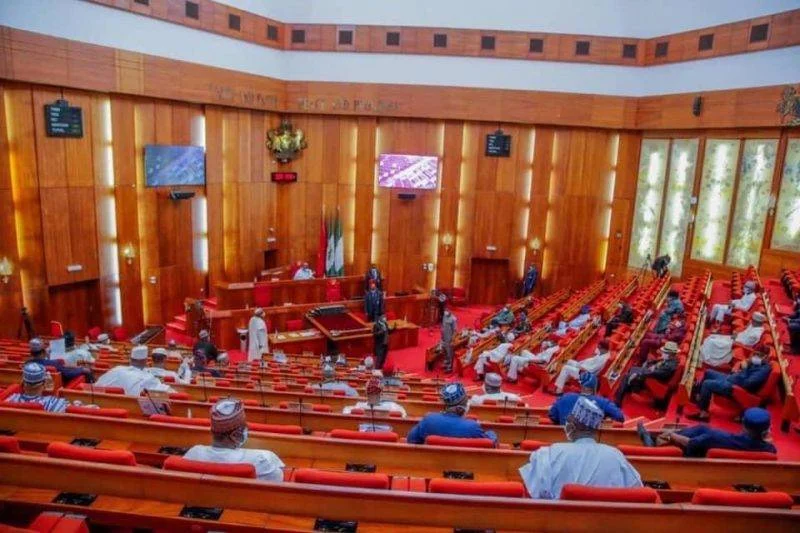
The Senate on Tuesday fast-tracked consideration of President Bola Tinubu’s revised 2026 Appropriation Bill, passing the repeal and re-enactment proposal for second reading, while approving an additional N10.79 trillion external borrowing to finance the budget deficit.
The red chamber also approved the Federal Government’s 2026–2027 Supplementary External Borrowing Rolling Plans of $20.52 billion and €1.045 billion, further deepening the administration’s reliance on borrowing to finance its fiscal commitments.
The revised appropriation proposal reduces the 2026 budget from the N68.3 trillion originally approved by the National Assembly to N66.1 trillion, while retaining the N31.4 trillion deficit and the N29.2 trillion borrowing plan.
To accelerate the legislative process, the Senate temporarily suspended its rules, considered the presidential request and subsequently adjourned plenary until December 1 to enable the Committee on Appropriations to complete its work and present its report.
Senate President Godswill Akpabio consequently urged senators, particularly members of the Appropriations Committee, to suspend their campaign activities and concentrate on the urgent legislative assignment.
The decision followed a motion by Senate Leader Opeyemi Bamidele, who sought the cooperation of his colleagues for the accelerated consideration of the presidential request after a closed-door session lasting about 30 minutes.
Bamidele argued that the urgency of the revised budget required expeditious legislative action to enable the Federal Government to address outstanding fiscal obligations and implement the appropriation before the expiration of the 2026 financial year on December 31.
The Senate subsequently adopted the motion and proceeded with the consideration of the bill for second reading, with Akpabio underscoring the importance of completing the legislative process within the available timeframe and urging lawmakers to prioritise the budgetary assignment over political campaigns.
The Senate’s action followed a presidential communication formally transmitted to the National Assembly, seeking the repeal and re-enactment of the 2026 Appropriation Act, alongside legislative approval of a revised Federal Government Fiscal Framework.
In the communication read by Akpabio during plenary, Tinubu explained that the proposed adjustments were designed to align the budget with existing government obligations and available resources, strengthen the credibility of the capital expenditure component and improve implementation.
Under the revised framework, aggregate federal expenditure is projected at N66.1 trillion, against estimated revenue of N33.7 trillion, including receipts from government-owned enterprises, while capital expenditure is projected at N26.2 trillion.
The fiscal deficit including projected loans, remains at N31.4 trillion, representing 5.6 per cent of the country’s Gross Domestic Product, while the proposed borrowing programme also remains unchanged at N29.2 trillion, comprising N18.4 trillion in domestic borrowing and N10.7 trillion in foreign borrowing.
Tinubu explained that the proposed $7.7 billion external borrowing, equivalent to approximately N10.3 trillion at an exchange rate of N1,346.50 to the dollar, was intended to finance existing foreign borrowing provisions and would not increase the approved borrowing envelope.
According to the President, the adjustments were necessary to regularise certain expenditures incurred by the Nigerian National Petroleum Company Limited (NNPCL) on behalf of the Federation, address under-provided debt-service obligations and recognise issued capital warrants and supplementary commitments.
Seeking the Senate’s cooperation, Tinubu said the adjustments were designed to prioritise existing commitments, strengthen the credibility of the capital budget and improve implementation without undermining fiscal discipline.
He said: “I therefore request the kind cooperation of the Senate for expeditious consideration and passage of the bill to facilitate early implementation of the revised budget and settlement of existing obligations.”
Meanwhile, the Senate’s approval of the $20.52 billion and €1.045 billion external borrowing programme followed the consideration and adoption of the report of its Committee on Local and Foreign Debts, chaired by Senator Aliyu Wamakko and presented by the committee’s Vice Chairman, Senator Tokunbo Abiru, while the lawmakers also approved the Federal Government’s request for additional external borrowing of N10,790,360,835,481 to finance the deficit in the 2026 Appropriation Act.
Defending the borrowing proposals, Deputy Senate President Jibrin Barau argued that Nigeria’s debt profile remained within internationally recognised sustainability limits, putting the current debt-to-GDP ratio at approximately 35 per cent, which he said could rise to about 42 per cent following the proposed borrowing, still below the internationally recognised threshold of 70 per cent.
He also clarified that the $20.52 billion and €1.045 billion borrowing plan was not intended for immediate disbursement, explaining that access to the facilities would depend on the fulfilment of stipulated requirements and their alignment with national development priorities, and that the arrangement accommodated the financing requirements of state governments in addition to those of the Federal Government.

