By Palma Ileye
Federal Government has intensified efforts to sanitise Nigeria’s scrap metal industry through a proposed regulatory framework aimed at curbing infrastructure vandalism, promoting responsible recycling and strengthening the country’s steel manufacturing sector.
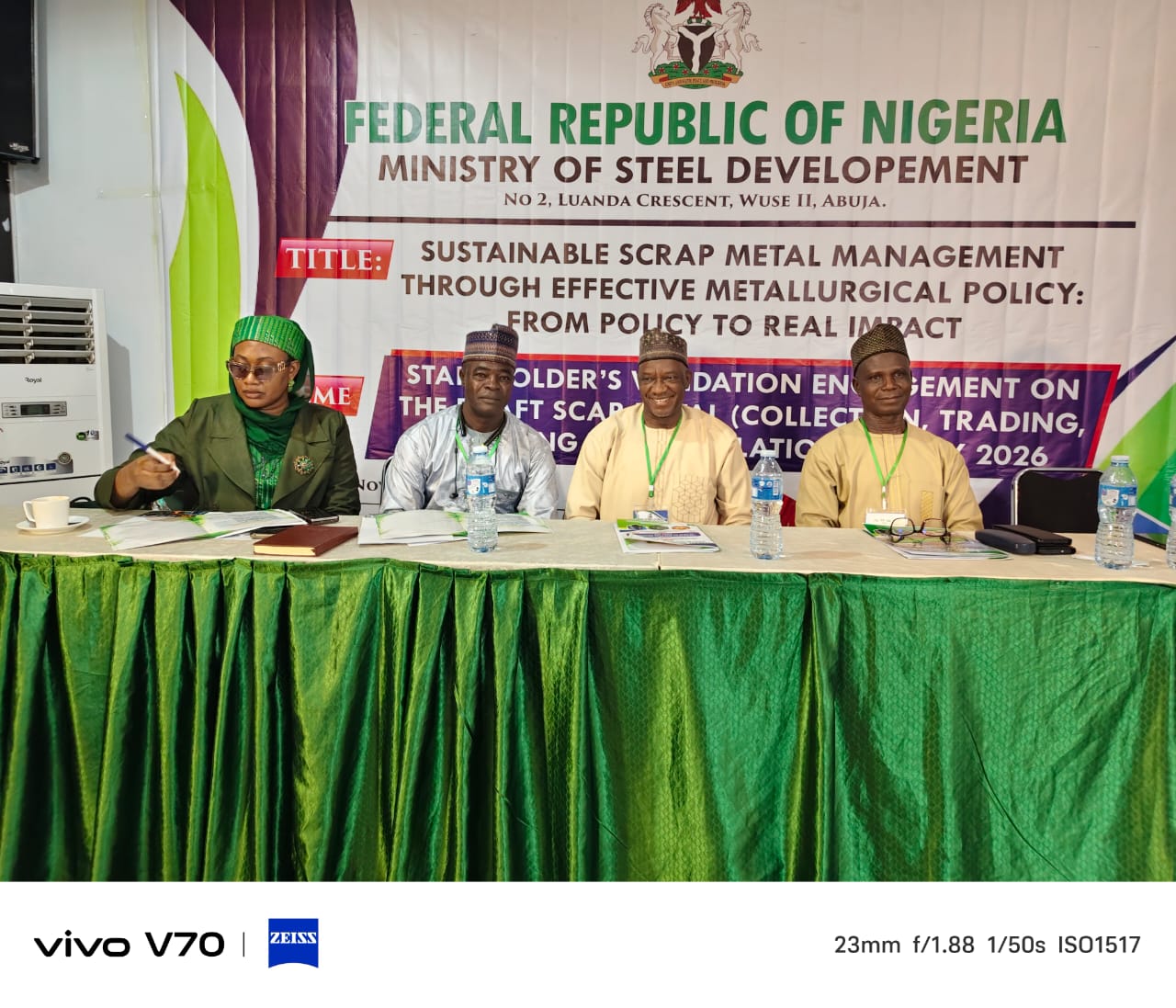
In a press release signed by Maureen Tine-lulun, Head of Press and Public Relations, Ministry of Steel Development, the Minister of Steel Development, Prince Shuaibu Abubakar Audu, disclosed this on Tuesday in Kano during the second phase of the stakeholders’ engagement on the validation of the Draft Scrap Metal (Collection, Trading, Recycling and Regulation) Regulations Policy 2026.
Audu, who was represented by the Director of Steel and Non-ferrous Metals Department, Alhaji Umar Tsoho, said the proposed regulations would establish a structured system for licensing and supervising operators, ensuring traceability of transactions, promoting environmental and occupational safety, and strengthening monitoring and enforcement.
Speaking on the theme, “Sustainable Scrap Metal Management through Effective Metallurgical Regulation: From Policy to Real Impact,” the Minister described scrap metal as a critical resource for Nigeria’s industrial development, noting that its effective recovery and recycling could support steel production, foundry operations, employment generation and the development of a circular economy.
He, however, warned that an inadequately regulated industry could encourage the theft and vandalism of public infrastructure, unsafe dismantling practices, environmental degradation and significant economic losses.
The Minister stressed that the proposed regulations were not intended to suppress legitimate businesses or undermine the livelihoods of Nigerians engaged in scrap metal collection and trading, but to create an orderly business environment where lawful operators could thrive while criminal activities were tackled.
He also called for a regulatory framework that would accommodate small-scale operators through practical formalisation processes and requirements proportionate to the size and risks of their businesses, while ensuring that large-scale aggregation, processing and recycling facilities complied with appropriate standards.
Audu expressed concern over the illegal acquisition and trading of metallic materials sourced from public infrastructure, industrial facilities and other protected assets.
He identified the theft of electrical cables, railway components, manhole covers and other metallic installations as a major threat to public safety and infrastructure development, noting that such activities disrupt essential services, increase maintenance costs and undermine national development efforts.
According to him, the first phase of the stakeholders’ engagement, held in Lagos from November 9 to 10, 2026, provided valuable recommendations on licensing, operator classification, traceability, collection and sorting facilities, environmental compliance, occupational safety, security and enforcement.
He explained that the Kano engagement was designed to broaden consultations and incorporate regional and operational perspectives, particularly the experiences of stakeholders in Northern Nigeria.
The Steel Minister urged participants to make practical recommendations that would address implementation challenges and strengthen the proposed regulations, assuring them that submissions from both engagements would be documented, reviewed and harmonised.
He reaffirmed the Ministry’s commitment to collaborating with relevant government institutions, industry operators, environmental agencies and security organisations to ensure effective implementation of the regulatory framework.
In his remarks, the Permanent Secretary of the Ministry, Amb. Nura Abba Rimi, represented by the Director of Metallurgical Inspectorate and Environmental Protection Department, Mr. Christopher Wanje, said the proposed regulations would address challenges across the scrap metal value chain through appropriate licensing, improved traceability, environmental protection and occupational safety standards.
He urged stakeholders to make constructive contributions, particularly on licensing arrangements, classification of operators, operational standards, security, environmental protection, inter-agency collaboration and enforcement.
Rimi assured participants that the Ministry would carefully consider their recommendations to produce a clear, legally sound and implementable regulatory framework.
Similarly, the Acting Executive Secretary of the National Steel Council, Mr. Aminu Shehu, represented by the Head of Planning, Research and Statistics, Dr. Nana Firdausi Muhammad, expressed support for the Ministry’s efforts to establish a transparent and sustainable scrap metal industry.
He said the Council remained committed to supporting the effective implementation of the policy as a catalyst for economic growth, national development and employment generation.
Also speaking, the Kano State Commandant of the Nigeria Security and Civil Defence Corps, Mohammed Hassan Agalama, who represented the Commandant General, Prof. Ahmed Abubakar Audi, commended the Ministry for initiating the regulatory framework.
Agalama said effective regulation of the scrap metal industry was necessary to curb the theft and vandalism of critical national assets, including electrical installations, pipelines, railway facilities and other government properties.
He reaffirmed the NSCDC’s commitment to working with the Ministry and other stakeholders, in line with its statutory responsibilities, to ensure the successful implementation of the proposed policy.

