
*Call for enforcement of ILO Convention 190 to end workplace violence, harassment
By Michael Oche, Abuja
A coalition of labour unions, civil society organisations and human rights advocates has called on the Federal Government to strengthen legal and social protections for informal workers while ensuring the full implementation of the International Labour Organization (ILO) Convention 190 on Violence and Harassment in the World of Work.
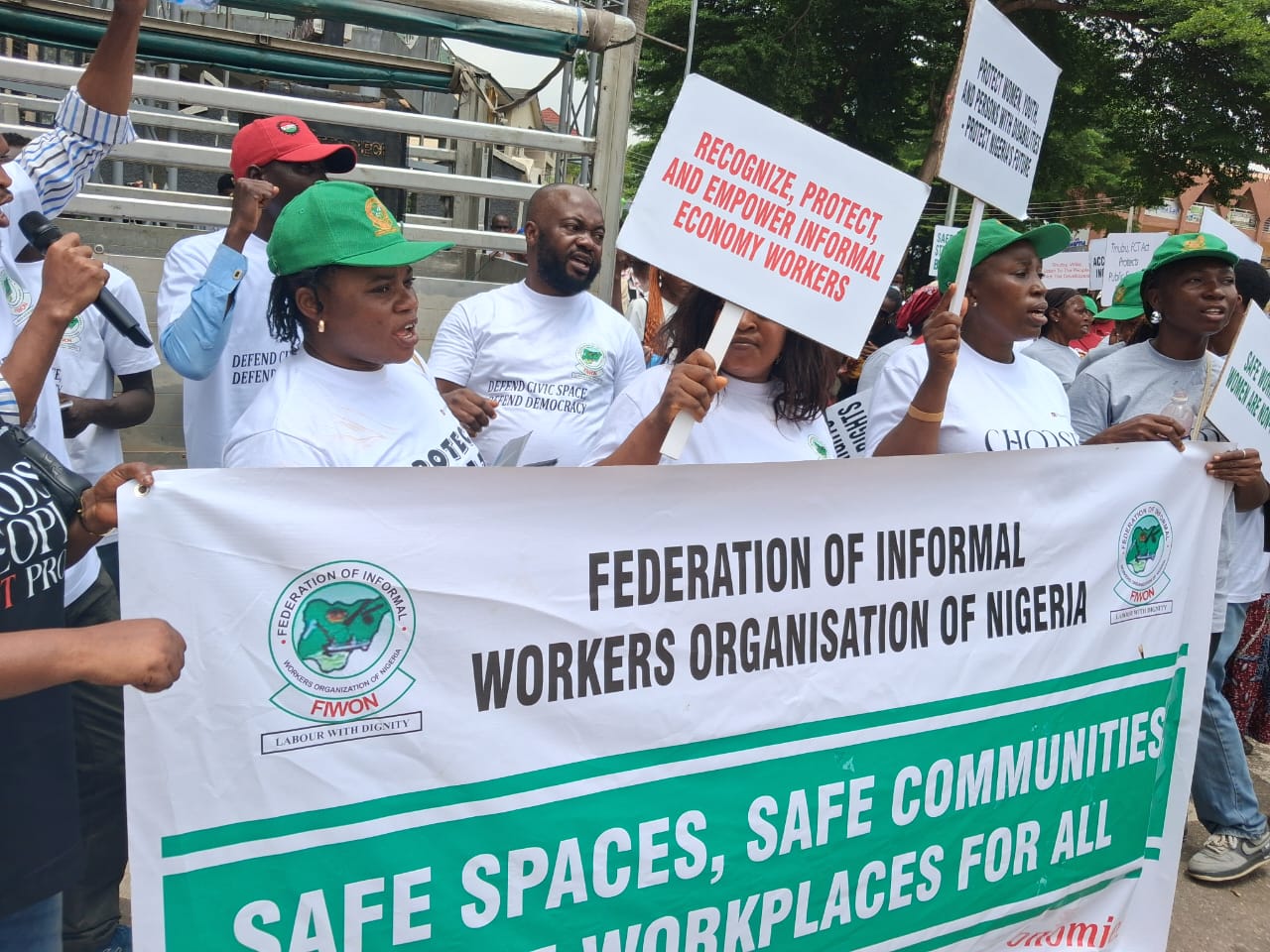
The coalition made the demand during a public awareness march in Abuja, stressing that millions of Nigerians in the informal economy remain vulnerable to workplace violence, harassment, forced displacement and inadequate social protection.
The campaign was jointly organised by the Nigeria Anti-Violence and Harassment Alliance in collaboration with the Federation of Informal Workers of Nigeria (FIWON), Accountability Lab, Civil Society Group for Social Protection, Campaign for Transformative Governance (CFTG), the International Federation of Women Lawyers (FIDA), and the International Lawyers Assisting Workers (ILAW).
The peaceful procession began at Jabi Lake Park and ended at the Federal Capital Territory Administration (FCTA), where participants displayed placards with inscriptions including, “Ratification Is Not Enough – Implement ILO C190 Now,” “Safe Spaces, Safe Communities, Safe Workplaces for All,” “Protect Labour Rights, Defend Civic Rights,” and “Workers Have a Right to Organize.”
According to the organisers, the demonstration was aimed at drawing national attention to the growing challenges facing informal workers and other vulnerable groups, including women, young people and persons with disabilities.
They argued that guaranteeing safe workplaces and protecting civic space are essential to sustainable development and democratic governance.
Nigerian Pilot reports that Jabi Lake Park has, in recent months, attracted widespread public concern following demolition and fencing activities that reportedly began in March 2026.
Civil society groups said hundreds of informal workers, including food vendors, artisans, traders, tennis instructors and other small business operators were forced to vacate the area with little or no formal notice, leaving many without sources of livelihood.
Speaking on behalf of the General Secretary of the Federation of Informal Workers of Nigeria (FIWON), Comrade Gbenga Komolafe, the FCT Chapter representative, Comrade Blessing Yusuf, said democracy extends beyond periodic elections to protecting citizens’ rights and livelihoods.
She said, “Democracy is about respecting the fundamental rights to human dignity and ensuring that citizens participate in decisions affecting their livelihoods and communities, as guaranteed under the African Charter on Human and Peoples’ Rights (Ratification and Enforcement) Act. It also requires adherence to the principles of administrative fairness, transparency, and public participation, which are the foundation of lawful public administration in a democratic society.”
The coalition expressed concern over what it described as the increasing displacement of informal workers through demolition exercises across the Federal Capital Territory and other parts of the country without adequate consultation, notice or social protection measures.
It therefore called on government authorities to provide immediate, fair and adequate compensation for traders, artisans, small business owners and service providers whose livelihoods have been disrupted by demolition exercises.
The groups also demanded comprehensive resettlement programmes and stronger social protection mechanisms for affected workers and their families.
The coalition further urged the Federal Government to move beyond the ratification of ILO Convention 190 by ensuring its effective domestication, implementation, and enforcement across both the formal and informal sectors.
According to the organisers, ending violence and harassment in the world of work requires stronger legal protections, respect for trade union rights, protection of civic freedoms, and policies that guarantee decent work for all Nigerians.
They maintained that protecting labour rights, promoting civic participation, and ensuring the rule of law are indispensable pillars of Nigeria’s democracy and essential for building an inclusive society where every citizen can work and live with dignity.

