
By Ngozi Nwankwo
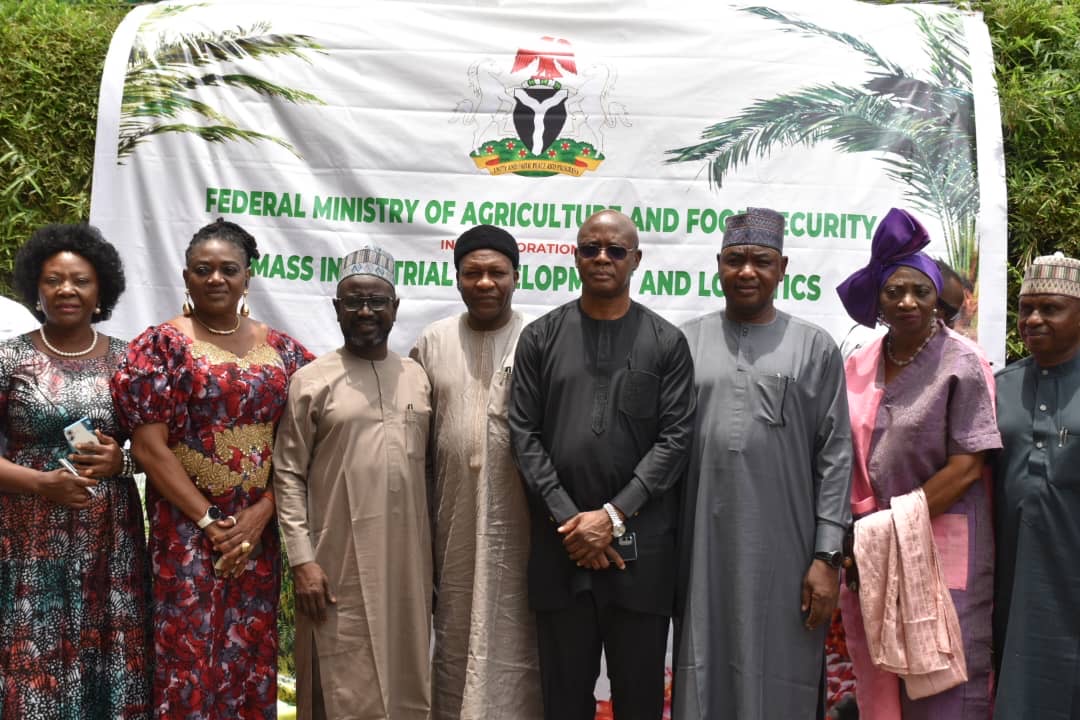
Federal Ministry of Agriculture and Food Security in collaboration with the Mass Industrial Development and Logistics Limited and other relevant Stakeholders in palm oil sub sector has convened a workshop aimed at reviving the palm oil ecosystem through states and investors partnership for industrial growth, job creation, and import reduction
The Initiative would target $500m in annual import savings, revive palm oil sub sector and achieve food sovereignty.
Speaking during the National Stakeholders’ Meeting for Joint Development of Nigeria’s Palm Oil Production Capacity, held in Abuja on Thursday, the Minister of Agriculture and Food Security, Sen. Abubakar Kyari said that the programme would operate as a Public-Private Partnership, with the Ministry providing institutional, policy and regulatory backing without recourse to public sector borrowing.
The Minister who was represented by his Senior Technical Assistant, Engr. Ibrahim Alkali pointed out that the sector’s success would depend on stakeholders’ commitment to collaboration. “It is time to move from intention to implementation, Nigeria must take bold and deliberate steps to reposition agriculture as a driver of economic growth’’.
Kyari revealed that the nation led global palm oil supply in the 1960s with over 40 percent market share but now produces approximately 1.4 million metric tonnes yearly against domestic demand exceeding 2.5 million metric tonnes.
“The result is a deficit of more than 1 million metric tonnes every year — one that compels us to spend between 500 and 600 million dollars annually on imports, What this means is simple: we are exporting opportunities and importing what we have the capacity to produce,” he said.
The Minister stated that the initiative aligns with the Renewed Hope Agenda of President Bola Ahmed Tinubu, and the Ministry’s recently validated National Oil Palm Development Strategy designed to expand production, improve yields, strengthen processing capacity, and integrate smallholders into structured value chains.
He noted that State Governments, in particular, have a critical role to play in access to land, enabling policies, infrastructure development and community engagement.
According to him, ‘’Under the Mass Industrial proposal, the phase one will establish seven integrated oil palm estates of 10,000 hectares each across participating states. The estates are conceived as complete economic ecosystems combining primary production with modern milling and refining facilities, storage and distribution infrastructure, as well as residential communities for over 2,000 families per estate, including housing, schools and healthcare facilities.
Phase two will drive agro-industrial expansion through downstream processing and manufacturing of palm-based products to capture value across the entire chain and position Nigeria competitively in domestic and export markets.
He further revealed that financial projections for the model indicate internal rates of return ranging between 18 and 25 percent, with payback periods estimated at five to seven years, noting that the existing domestic supply gap of over 1 million metric tonnes annually ensures immediate market demand, alongside access to regional and international markets.
The Minister said that “Nigeria has over 3 million hectares of land suitable for oil palm cultivation, much of which remains underutilized ,Existing plantations operate below optimal productivity level due to ageing trees and limited access to improved inputs” Nigeria has the land, climate, market, and people. What we need now is decisive investment and coordinated action.”
He added that by supporting the initiative, States stand to benefit from increased investment inflows, expanded economic activity, higher internally generated revenue, and improved livelihoods for their people.
Kyari appealed to states, investors and development partners to key into the model, citing strong market fundamentals and clear government backing.
The Minister noted that ‘’the opportunity is clear, the fundamentals are strong, and the returns are compelling. He called on stakeholders to unlock the sector’s full potential and build an industry that creates jobs, generates wealth, and restores Nigeria’s global market position. Together, we can turn potential into productivity, and vision into reality,”
In his welcome address, the Permanent Secretary, FMAFS, Dr. Marcus Olaniyi Ogunbiyi, represented by the Director, Farm Input Support Services, Engr. Abba Waziri revealed that the project was set in motion following the Minister’s approval of the Mass Industrial proposal as a national initiative.
He pointed out that the Ministry recently validated the National Oil Palm Development Strategy after extensive stakeholder consultations to harmonize diverse inputs and perspectives.
Ogunbiyi commended Engr. Emmanuel Obiorah Anyaralu, Managing Director/CEO of Mass Industrial Development and Logistics, for initiating the joint development programme through Public-Private Partnership.
“This public-private partnership project on a joint development of Nigeria’s Palm Oil capacity is so timely and necessary as we work to adequately prepare Nigeria’s Oil industry for productivity, value addition, job creation, and global competitiveness.”
During his presentation, the Chief Executive Officer, Mass Industrial Development and Logistics, Engr. Emmanuel Obiorah Anyaralu stated that the programme would be game changer in the palm oil ecosystem which is in line with the renewed hope agenda of President Bola Ahmed Tinubu in the agricultural sector.
He added that the initiative would enhance higher internally generated revenue, and improved livelihoods of farmers in the oil palm value chain.
The stakeholders’ meeting was convened to secure the buy-in of state governments, particularly palm oil producing states, and all actors in the palm oil value chain — including state commissioners of agriculture, research bodies, development partners, investors, consultants among others.

