
By Michael Oche
The Nigeria Labour Congress (NLC) and the International Labour Organisation (ILO) have called for stronger protection measures, including reskilling and upskilling for workers whose jobs may be threatened by the global transition away from fossil fuels.
Nigeria Pilot reports that across Nigeria and the wider African region, communities are already grappling with severe livelihood losses caused by extreme weather events, while the ongoing energy transition is disrupting key sectors such as agriculture, transport, construction, and energy, leaving many workers vulnerable to job displacement and economic uncertainty.
The NLC also called on the Federal Government, to without compromise, officially ratify, approve and adopt the Just Transition Guideline and Action Plan (JT-GAP) which has been validated by climate change stakeholders.
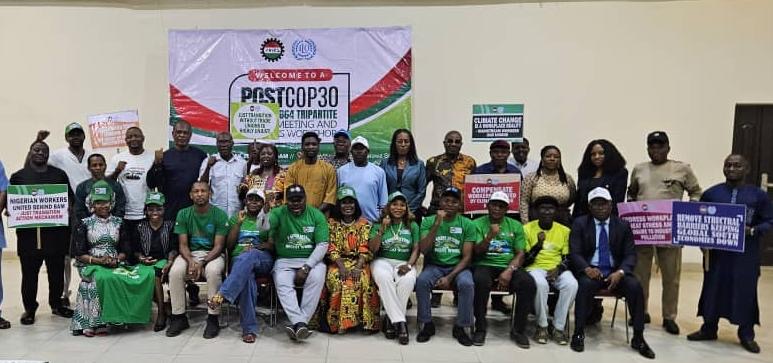
Speaking at the opening of the two-day Post-COP30 and Pre-SB64 Tripartite Review Meeting in Keffi, Nasarawa State, NLC General Secretary, Emmanuel Ugboaja, said workers must not be abandoned in the transition to a green economy.
The meeting was organised by the NLC with support from under the International Labour Organization.
Ugboaja, who was represented by Comrade Eche Asuzu, the NLC Climate Change national coordinator, said every worker whose job is threatened by the green transition must receive “a legally grounded pathway to alternative employment, not just a one-off severance package or retraining scheme.”
He added that workers and trade unions must play an active role in the operationalisation of the Just Transition Mechanism (JTM) adopted at COP30 in Belem, Brazil.
“We demand that trade unions take up an active stakeholder role in the JTM, especially through holding formal decision-making power,” he said.
According to him, funding under the JTM should support workplace climate measures, including evidence gathering, skills development, social protection, occupational safety and health, protection of informal workers, and compensation for workers impacted by climate change.
Ugboaja commended the National Council on Climate Change (NCCC) for placing Just Transition at the centre of Nigeria’s Nationally Determined Contribution (NDC) 3.0, but insisted that implementation must be inclusive and expedited.
“We demand that the JT-GAP, which all stakeholders have validated, is officially ratified, approved and adopted without compromise by the Federal Government,” he said.
He further warned that Africa must not become a victim of exploitative green mineral extraction as global attention shifts from fossil fuels to critical minerals.
According to him, the current mining model across Africa still mirrors colonial patterns where raw minerals are extracted from the continent while African communities are left with pollution, child labour, poor wages and conflicts.
Looking forward to the next COP, Ugboaja said, “just as trade unions birthed the Just Transition movement, we must ensure that this baby grows into maturity through active negotiation, lobbying, and action at SB 64, COP 31, and other global, regional, and national climate engagements.”
In her keynote address, Inviolata Chinyangarara, the Senior Technical Specialist for Workers’ Activities (ACTRAV) at the ILO, said climate change has become a labour market reality, affecting livelihoods, workplace safety and major sectors such as agriculture, transport, construction and energy.
The organisation stressed that climate policies must be aligned with employment creation, social protection and decent work principles to ensure that no worker is left behind.
She said, “just transition must deliver tangible benefits for workers, including: decent jobs creation in emerging green sectors, skills development and reskilling programmes to support labour mobility, social protection systems to cushion transition shocks, respect for fundamental principles and rights at work.
Chinyangarara also emphasised the importance of social dialogue involving government, employers and workers in designing and implementing climate policies.
She added that Nigeria has an opportunity to use the just transition agenda to drive economic diversification, youth employment, formalisation of the informal economy and gender inclusion in green jobs.
“However, the real test lies not in the commitments themselves, but in their translation into national policy and practice,” she said
Also speaking, representative of the National Council on Climate Change, Jummai Vandu, said the Council remain committed to ensuring that Nigeria’s climate goals align with Africa’s broader vision for decent work, structural transformation and sovereign development.
She stressed that the Council believes a just transition is inseparable from sustainable development and poverty eradication.
According to her, the NCCC is actively supporting key global frameworks, including the Just Transition Work Programme (JTWP), which she described as a critical multilateral platform for addressing workforce displacement, equity and social protection during the global energy transition.
Vandu added that the Council also supports the Just Transition Mechanism (JTM), which is expected to help translate climate policies into concrete actions through targeted technology transfer and specialised financing for developing economies.
She said under the leadership of the Director-General of the NCCC, Omotenioye Majekodunmi, the Council is driving inclusive green growth through domestic value-chain industrialisation and targeted workforce reskilling initiatives.
According to her, the initiatives are aimed at expanding opportunities while protecting millions of informal workers, farmers and youths affected by the transition.
Vandu further stated that job creation remains a key measure of success in Nigeria’s climate transition agenda.
“The creation of decent work is our primary metric for success. We stand in full solidarity with the Nigeria Labour Congress (NLC) to protect jobs and ensure no worker and Nigerian is left or pushed behind,” she said.
She also commended the International Labour Organization for its continued technical support towards building robust, ILO-aligned social protection systems for Nigerian workers.

