
By Temitope Adeyemi-Kayode, Ph.D
Within the space of a few days, two initiatives associated with Nigeria’s highest political offices offered different pictures of what economic opportunity can look like.
The first came through the Renewed Hope Initiative, the organisation led by First Lady Oluremi Tinubu. While discussing grants for vulnerable Nigerians, she referred to small businesses such as selling akara, roasted corn and kuli-kuli, arguing that they could be started with relatively little capital.
The second came from the presidency. President Bola Tinubu announced Power Force, a programme intended to train 5,000 young Nigerians to install smart electricity meters. The initiative is open to young people from a range of educational backgrounds and is being presented as both a youth employment intervention and a contribution to electricity sector reform.
The two programmes are different in design, scale and purpose. One provides small amounts of capital to people already operating, or hoping to enter, the informal economy. The other offers technical training, certification and possible connections to work in the power sector.
Placed side by side, they offer a revealing picture of the kinds of work the Tinubu administration presents as meaningful economic opportunity.
That picture matters at a time when many Nigerians are seeking not only income, but also stability, professional growth and a clearer sense of economic direction.
What was actually offered
Much of the controversy around the First Lady’s comments centred on the examples she chose.
Speaking after a Renewed Hope Initiative meeting in Abuja, Mrs Tinubu said beneficiaries had received grants rather than loans and mentioned akara, roasted corn and kuli-kuli as businesses that could be started without large amounts of capital. She also referred to the initiative’s work in healthcare, education, agriculture and social investment.
Her comments were widely interpreted by critics as an inadequate response to the economic difficulties facing Nigerians. Others defended them, arguing that food vending and petty trading are legitimate businesses that have supported families for generations.
Days later, Mrs Tinubu clarified that the intervention was not limited to akara sellers. She said N100 million had been provided to support 2,000 petty traders in Jigawa State, with each beneficiary receiving N50,000 to recapitalise an existing business. The intended recipients included traders selling tomatoes, pepper, vegetables and roasted plantain.
The intervention was not presented simply as advice that unemployed Nigerians should begin frying akara. In the Jigawa example, it was a recapitalisation grant for people already engaged in small-scale trade.
That does not settle every question about the programme. It remains reasonable to ask how beneficiaries were selected, how far N50,000 can go under current market conditions, what support exists beyond the initial payment and whether the businesses will become more sustainable after receiving the money.
However, those are questions about programme design and impact. They are different from dismissing petty trading as economically insignificant.
While the Renewed Hope Initiative focused on supporting existing small traders, Power Force presents a different model of economic intervention, built around technical training and access to work in the power sector.
According to the State House, the programme will train 5,000 young Nigerians to support the installation of smart electricity meters. Training will be delivered by the National Power Training Institute of Nigeria, while the Nigerian Electricity Management Services Agency will oversee certification and compliance standards. Successful trainees are expected to be connected to opportunities involving electricity distribution companies, meter providers and other industry partners.
Power Force promises training, recognised certification and pathways to employment or entrepreneurship. It does not yet establish that all 5,000 participants have been offered permanent jobs.
For that reason, the programme should initially be understood as a skills and employability initiative linked to a specific infrastructure need. Its employment value will depend on how many trainees complete the programme, obtain certification and secure paid work afterwards.
The challenge of political communication
Public programmes are judged not only by what they are designed to achieve, but also by how clearly their purpose, limits and expected outcomes are explained. When officials use broad terms such as “empowerment,” “employment,” “opportunity” and “job creation” without distinguishing among them, the public may struggle to determine what is actually being offered.
A grant may help a person sustain or restart a livelihood. Training may improve employability, while certification can provide formal recognition of a skill. A placement may offer experience or temporary work. These interventions can be valuable, but they do not necessarily amount to sustained employment.
In the case of the Renewed Hope Initiative, public attention focused heavily on the First Lady’s references to akara, roasted corn and kuli-kuli, while the wider context of grants to existing petty traders received less attention. The reaction also reflected wider concerns about the scale of economic opportunity available to Nigerians.
Power Force presents a different communication challenge. The programme has been described in terms of training, certification, employment and entrepreneurship, although the available information does not indicate that every participant is guaranteed a job. Further details about the training, certification, deployment opportunities and possible career progression would make the programme easier to assess.
More precise language would not prevent disagreement over the scale or priorities of either initiative. It would, however, help separate what the programmes currently provide from the outcomes they are expected to produce.
Is meter installation a suitable opportunity for graduates?
Power Force is designed to be inclusive. That is one of its potential strengths.
A programme that allows secondary-school graduates, vocational trainees and university graduates to acquire a practical skill may reach people who would otherwise be excluded from more narrowly designed employment schemes.
At the same time, a wide eligibility range creates different expectations.
A secondary-school graduate may view the programme as an entry into a technical trade. A vocational trainee may see it as a route to certification. An engineering graduate or National Youth Service Corps member may ask whether the programme makes meaningful use of years of higher education.
Those concerns should not be reduced to the idea that meter installation is beneath a university graduate. Meter installation is technical work. It involves safety, accuracy, regulation and direct contact with electricity infrastructure.
The more useful question is whether every participant is being offered the same narrow function or whether Power Force provides different levels of responsibility and progression.
Could engineering graduates advance into meter testing, inspection, supervision, data systems, grid maintenance or other areas of the electricity value chain? Will the certification remain useful after the current meter deployment effort? Can participants become contractors, supervisors or technical entrepreneurs?
If the programme provides only basic training for a temporary installation exercise, some graduates may reasonably regard it as limited. If it is the first stage of a wider technical pathway, the opportunity may be more substantial than its title suggests.
Small businesses are not a small part of Nigeria’s economy
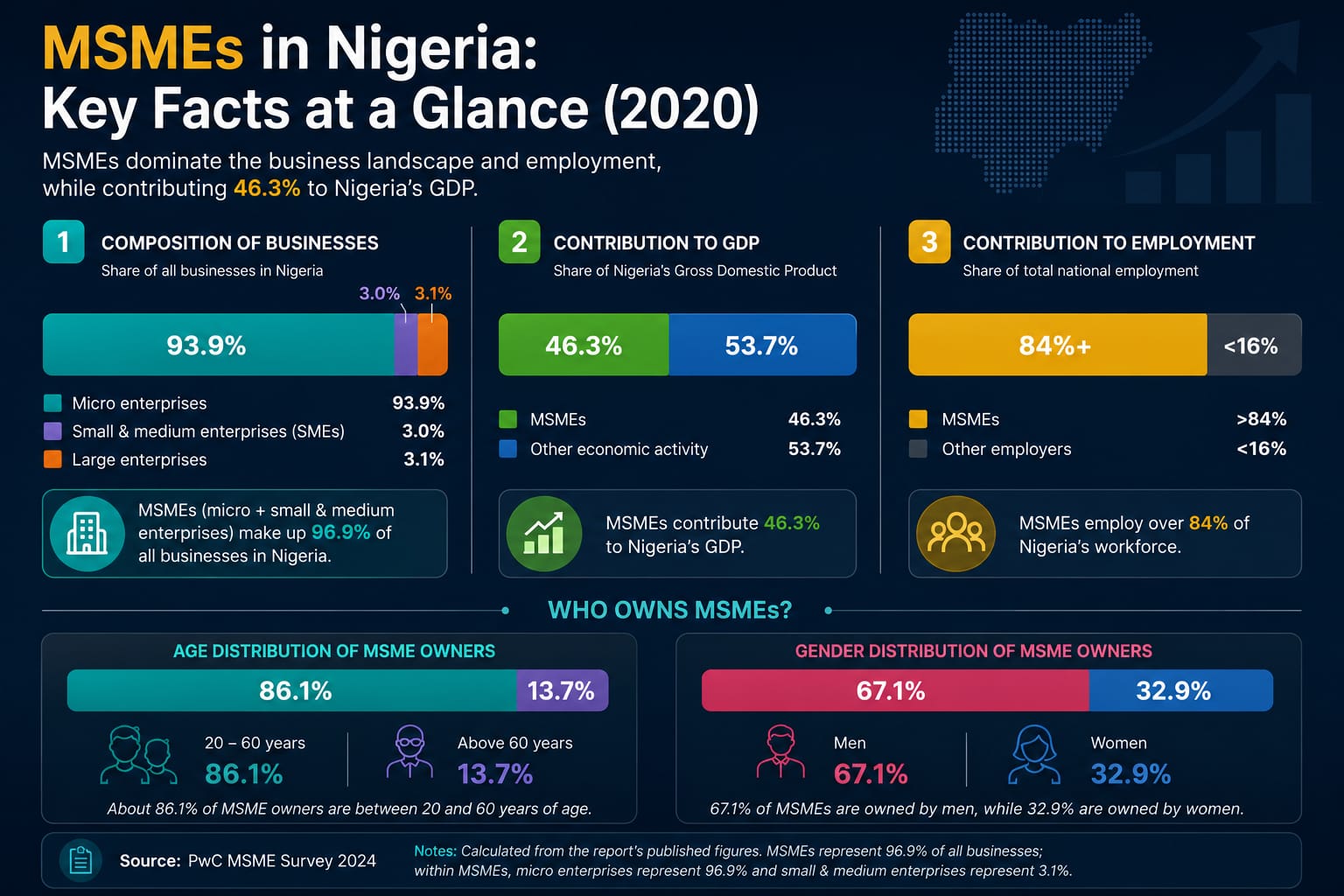
Any assessment of the First Lady’s intervention must begin with the economic importance of micro, small and medium-sized enterprises.
Figures drawn from the 2021 survey by the National Bureau of Statistics and the Small and Medium Enterprises Development Agency of Nigeria indicate that MSMEs account for 96.9 per cent of businesses, 87.9 per cent of employment and 46.32 per cent of gross domestic product. Their contribution to exports, however, was much lower, at 6.21 per cent.
These figures help explain why governments repeatedly turn to microenterprise as a tool of economic support. Small traders, food vendors, artisans and household businesses provide income for a large share of the population.
Supporting them is not inherently a distraction from economic policy. It can be part of economic policy. The harder question is what kind of support allows such businesses to become more productive and secure.
A one-time grant may help a trader replace stock, purchase ingredients or respond to a temporary shock. It may be valuable to the person receiving it. But long-term growth may also require reliable electricity, affordable transport, access to larger markets, business records, equipment, credit and protection from multiple taxes and levies.
The number of people working in microbusinesses should therefore not be confused with the quality of the opportunities those businesses provide.
A sector may employ millions because it is accessible and necessary, while many of its workers continue to face unstable income, low productivity and limited room for expansion.
This is why the debate should not be framed as a choice between respecting informal work and demanding better opportunities. Both positions can be held at the same time.
Selling akara is legitimate work. Installing meters is legitimate work. The policy question is whether government interventions help people move from fragile income to stable livelihoods, and from entry-level activity to higher skills and earnings.
What the presidency should prioritise
The visibility of these initiatives also draws attention to the presidency’s wider economic role. Targeted grants and training programmes can be useful, especially when they address a specific need or reach people excluded from conventional finance and employment channels. High-level support can also help coordinate agencies, attract partners and give a programme national reach.
Their value, however, depends on how clearly they fit into a broader employment strategy. A scheme to train 5,000 meter installers may help address a technical shortage in the power sector, while grants to petty traders may protect fragile household incomes. Neither should be presented as a substitute for the larger conditions that allow work and enterprise to expand.
Those conditions include reliable electricity, affordable transport, access to finance, stable prices, effective education, public safety and predictable regulation. They shape whether businesses can grow, whether employers can hire and whether trained workers can secure sustained income.
The strongest case for programmes such as Power Force and the Renewed Hope Initiative is therefore as targeted interventions within a larger economic system. Their purpose, limits and expected outcomes should be clearly defined, so that Nigerians can see how they complement, rather than stand in for, broader reforms.
A question of progression
The real test of these initiatives will come after the announcements, disbursements and training sessions. Public reporting should move beyond the number of people reached to show what beneficiaries were able to achieve with the support they received, how long those gains lasted and what opportunities became available afterwards. This would make it easier to distinguish between programmes that provide temporary relief and those that create lasting improvements in income, skills and economic stability.
For participants in the Renewed Hope Initiative, financial support should ideally form part of a wider process of business development. Small traders may also need training in record keeping, pricing, inventory management and access to markets. Those who demonstrate progress could be linked to larger financing, cooperatives, equipment support or formal business networks. Such measures would give beneficiaries a better chance of strengthening their businesses, increasing their earnings and moving beyond the limits of a one-time grant.
Power Force requires a similarly clear plan for progression. Meter installation may provide an accessible route into technical work, but participants should be able to understand where that route can lead. The programme could create pathways into inspection, maintenance, supervision, metering data systems, electrical safety and other roles within the wider energy sector. Information about further certification, industry partnerships and possible career advancement would help show that the programme is designed as more than a short-term response to the meter rollout.
Measuring these outcomes would also strengthen public confidence. The institutions responsible should publish information on business survival, income growth, training completion, certification, paid deployment and continued participation in the relevant sectors. Such evidence would allow successful interventions to be expanded, weaker ones to be adjusted and future programmes to benefit from what has already been learned.
The Tinubu administration’s definition of work appears broad enough to include informal enterprise, vocational activity and technical participation in national infrastructure. The task now is to ensure that these opportunities do more than bring people into economic activity. They should give beneficiaries credible pathways towards greater stability, higher earnings, stronger skills and continued growth.

