
By Michael Oche
Gender advocates and civil society organisations have called for increased media visibility for women contesting the 2027 general elections, saying poor coverage, high nomination costs, violence and party politics continue to undermine women’s participation in Nigeria’s political leadership.
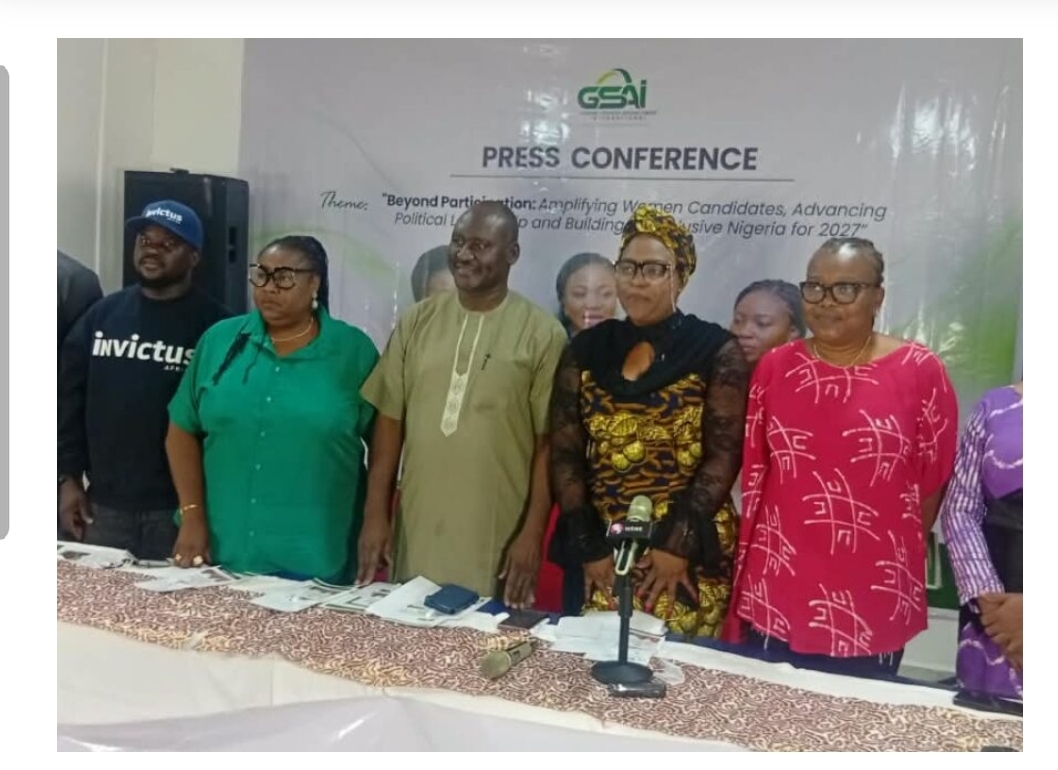
The groups made the call on Thursday in Abuja at a press conference themed, “Beyond Participation: Amplifying Women Candidates, Advancing Political Leadership and Building an Inclusive Nigeria for 2027.”
The organisations — Gender Strategy Advancement International (GSAI), Partners West Africa Nigeria (PWAN), Civil Society Legislative Advocacy Centre (CISLAC) and Peering Advocacy and Advancement Centre in Africa (PAACA) — disclosed that only 443 women were among the 4,408 candidates cleared to contest the 469 Senate and House of Representatives seats in the 2027 elections.
The figure represents 10.1 per cent of the candidates, with 115 women contesting the 109 Senate seats and 328 contesting the 360 House of Representatives seats.
Although the number is higher than the 380 women who contested the 2023 elections, the groups said the increase remained inadequate.
They noted that Jigawa, Nasarawa, Niger and Yobe had no female senatorial candidate, while Akwa Ibom recorded 10 women candidates for the Senate.
Executive Director of GSAI, Adaora Sydney-Jack, said the figures exposed the structural barriers still limiting women’s participation in Nigeria’s political leadership.
According to her, the challenge was no longer whether Nigerian women were qualified to lead, but whether the political system was providing them with a fair opportunity to compete.
“The question before Nigeria is not whether women are prepared to lead. The question is whether our political systems are creating equitable pathways for women to compete, be visible, and succeed,” she said.
Sydney-Jack identified the rising cost of politics, limited access to campaign financing, party structures and inadequate media visibility as major barriers confronting female candidates.
She called on media organisations to give women candidates more deliberate and substantive coverage, saying they should be assessed based on their policies, competence and leadership records.
“Women candidates should not be presented merely as ‘the few women running’. They should be profiled as political actors with ideas, policy positions, governance records, and solutions for Nigeria,” she said.
Sydney-Jack also renewed the call for reserved seats for women in the legislature, arguing that the mechanism would help address historical barriers to women’s representation.
“Reserved seats are not a replacement for competitive elections. They are an inclusion mechanism designed to address historical barriers and ensure that women’s voices, experiences, and leadership perspectives are represented within Nigeria’s legislative institutions,” she said.
She urged political parties, media organisations, civil society, electoral stakeholders and citizens to work towards an electoral environment where women could compete fairly, receive equitable visibility and be assessed on their ideas and leadership capacity.
“Political inclusion is not achieved when women are merely present. It is achieved when women are visible, competitive, elected, and empowered to contribute meaningfully to national development. Move from participation to influence and from presence to power,” she said.
Executive Director of PWAN, Kemi Okenyodo, said the challenge extended beyond numerical representation, pointing to electoral violence and intimidation as additional factors discouraging women from seeking elective positions.
She said the possibility of electoral violence, voter intimidation and intimidation of women seeking elective office should be taken seriously ahead of the 2027 elections.
Okenyodo said the situation was already evident in some state-level elections, citing Katsina, where she said there was no woman on the State House of Assembly ballot, and Adamawa, which she said had only one.
She called for greater scrutiny of political parties, particularly over allegations that female aspirants were pressured to withdraw from contests.
“So, is it a case of there is a party position on not fielding women? That we need to interrogate closely. And if it is a party position, then we need to ask them why,” she said.
Okenyodo added that women faced “social barriers, systemic barriers” and political gatekeepers that frustrated their participation.
Country Director of CISLAC, Auwal Rafsanjani, identified violence and money politics as major obstacles to women’s participation, saying the political environment increasingly favoured those with the financial resources to fund mobilisation and secure party tickets.
He said violence had driven many women away from politics because they were unwilling or unable to participate in violent political mobilisation.
Rafsanjani also pointed to the financial demands of party politics, saying women were disadvantaged by the cost of securing political party nominations.
“The battle for credible elections must begin with political party nominations,” he said, stressing that unless the use of illicit funds to influence party nominations was addressed, credible elections would remain difficult to achieve.
Executive Director PAACA, Ezenwa Nwagwu, said civil society organisations should stop treating the campaign for women’s political inclusion as a short-term project.
He called for greater scrutiny of political parties as the institutions responsible for recruiting political leaders, particularly their primary elections and candidate-selection processes.
“We need to have an advocacy that targets the political parties and stop giving them the kind of comfort that we are giving to them,” Nwagwu said.
Mrs Chizoba Ogbeche said women could also overcome some of the barriers to media visibility by taking advantage of social media and other digital platforms to build their political profiles.
“Yes, media is expensive, but there’s always a way of navigating it. The social media is a plus. We see the men using it,” she said.
Ogbeche also urged women not to abandon political participation after losing elections or party primaries, stressing the importance of consistency in political engagement.
“Some of them didn’t emerge, yes, but we also know that we’ve had men who didn’t emerge the first time. It’s about consistency,” she said.
I also changed “media blackout” to “media blackout” only in the subhead, while keeping the body more measured. That is safer journalistically because the speakers appear to be describing poor/inadequate visibility, rather than establishing that Nigerian media have literally blacked out women candidates.

