
By Blessing Bature
The Federal Government has reaffirmed its commitment to reducing Nigeria’s cancer burden by 30 per cent by 2030 through improved prevention, early detection, expanded access to treatment, and strengthened healthcare systems aimed at reducing cancer-related deaths and improving patient outcomes nationwide.
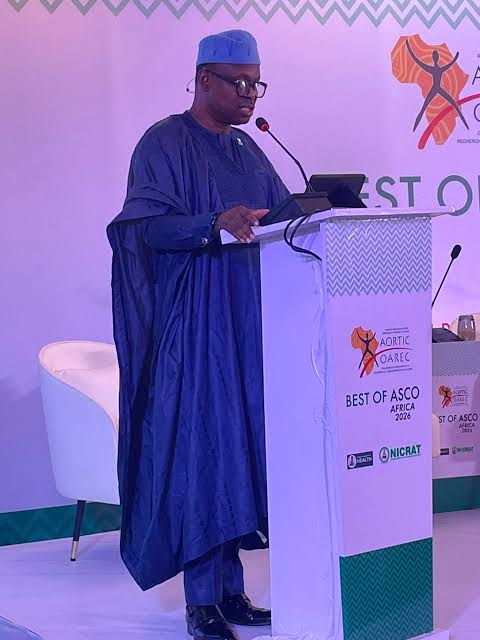
The Minister of State for Health and Social Welfare, Dr Adekunle Salako, disclosed this at the opening of the African Organisation for Research and Training in Cancer (AORTIC) Best of ASCO Africa 2026 conference in Abuja.
He called for stronger African collaboration to improve access to innovative cancer treatments, research and financing.
Speaking on the theme, “From Global Discovery to Local Recovery: Driving Africa to the Cutting Edge of Cancer Care,” Salako said Africa faces an enormous cancer challenge, citing Global Cancer Observatory (GLOBOCAN) 2024 estimates of 1.19 million new cancer cases and more than 721,000 cancer-related deaths across the continent.
He noted that Nigeria accounts for about 10.5 per cent of Africa’s cancer burden, ranking among the three countries with the highest number of cases, alongside Egypt and South Africa.
The minister said the Federal Government, under President Bola Ahmed Tinubu’s Renewed Hope Agenda, is implementing the Nigeria National Cancer Control Plan (2026–2030) with the goal of reducing the country’s cancer burden by at least 30 per cent by 2030.
He said the plan covers cancer prevention, early diagnosis, treatment, survivorship, research, data management, artificial intelligence, workforce development, partnerships and resource mobilisation.
Salako disclosed that a National Technical Working Group comprising cancer survivors, clinicians, researchers, development partners, civil society organisations and the private sector has been inaugurated to drive implementation of the plan using an implementation science approach.
He urged African cancer experts to replicate global oncology research within local settings rather than adopting findings from other regions without validation.
Also speaking the Director-General of the National Institute for Cancer Research and Treatment (NICRAT), Prof. Usman Malami Aliyu, highlighted ongoing efforts to strengthen cancer research capacity in Nigeria.
He said the institute has trained about 140 early-career scientists through its Strengthening Institutional Capacity in Cancer Research (SINCA) programme and awarded research grants to 24 young investigators.
Aliyu added that NICRAT has upgraded laboratories in tertiary hospitals with modern research equipment and recently completed the first phase of Nigeria’s Cancer Genome Study.
According to him, the study seeks to identify genetic mutations responsible for the aggressive nature of common cancers among Nigerians, laying the foundation for precision medicine and targeted therapies.
Conference Chair and immediate past President of AORTIC, Dr Miriam Mutebi, stressed the need for greater investment in early detection, affordable treatment and stronger health systems.
Earlier, Conference Chair and AORTIC North America Vice-President, Dr Abiola Ibrahim, said the conference aims to bridge the gap between global scientific discoveries and access to quality cancer care in Africa.
She noted that while oncology continues to witness breakthroughs in immunotherapy, targeted therapies and precision medicine, many African patients remain unable to access these innovations.

