
By David Odama
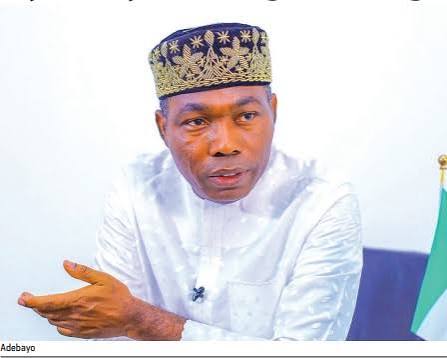
The Presidential candidate of the Social Democratic Party, SDP, Prince Adewole Adebayo is proposing a fundamental shift in the way Nigeria’s three tiers of government work together, arguing that states and local governments should become engines of development rather than depend on Abuja for direction and resources.
The proposal is contained in his 2027–2031 blueprint, Farewell to Poverty and Insecurity, which places Cooperative Federalism and Subsidiarity at the heart of his governance agenda.
Under the model, the Federal, State and Local Governments would retain their constitutionally assigned responsibilities while working together where their mandates overlap. Such cooperation would be built around joint planning, counterpart funding, shared standards, interoperable systems and performance-based partnerships.
But Adebayo’s vision is not one of a powerful Federal Government calling all the shots from Abuja.
At its core is the principle of subsidiarity: public responsibilities should be handled by the lowest level of government capable of delivering them effectively.
That would mean a Federal Government focused primarily on national standards, strategic coordination and responsibilities that require national scale, while states and local governments take greater ownership of functions they are better positioned to deliver.
The blueprint also proposes a more economically specialised federation. Rather than requiring every state to pursue the same development agenda, Nigeria’s states and regions would be encouraged to build around their comparative advantages and connect those strengths through value chains, inter-state commerce and shared infrastructure.
The goal, however, would not be a federation of disconnected regional economies.
It would be “one productive Nigerian economy”—an integrated national market in which different parts of the country contribute different strengths to a common economic system.
That approach runs through Adebayo’s wider economic programme, which seeks to move Nigeria away from dependency and towards self-reliant prosperity by 2031.
Under the proposed model, a state with an advantage in agriculture, another with industrial capacity and another with strengths in logistics, technology or services would not be expected to replicate one another. Instead, each could deepen its competitive advantage while relying on national infrastructure, markets and coordinated investment to expand its economic reach.
The result could be a significant change in the relationship between Abuja and Nigeria’s federating units.
Instead of federalism being primarily about who controls what, Adebayo’s proposal reframes the question as who is best placed to deliver what—and how can the different levels of government work together to produce better results?
In that vision, Nigeria’s federal structure becomes more than an administrative arrangement. It becomes an economic strategy: harnessing the different strengths of its states and regions, connecting them through infrastructure and commerce, and turning their combined advantages into a more productive national economy

