
By Michael Oche
Youths from across West Africa have called for the removal of legal, financial and digital barriers limiting their participation in politics and governance, including lower nomination fees, campaign spending limits and youth quotas.
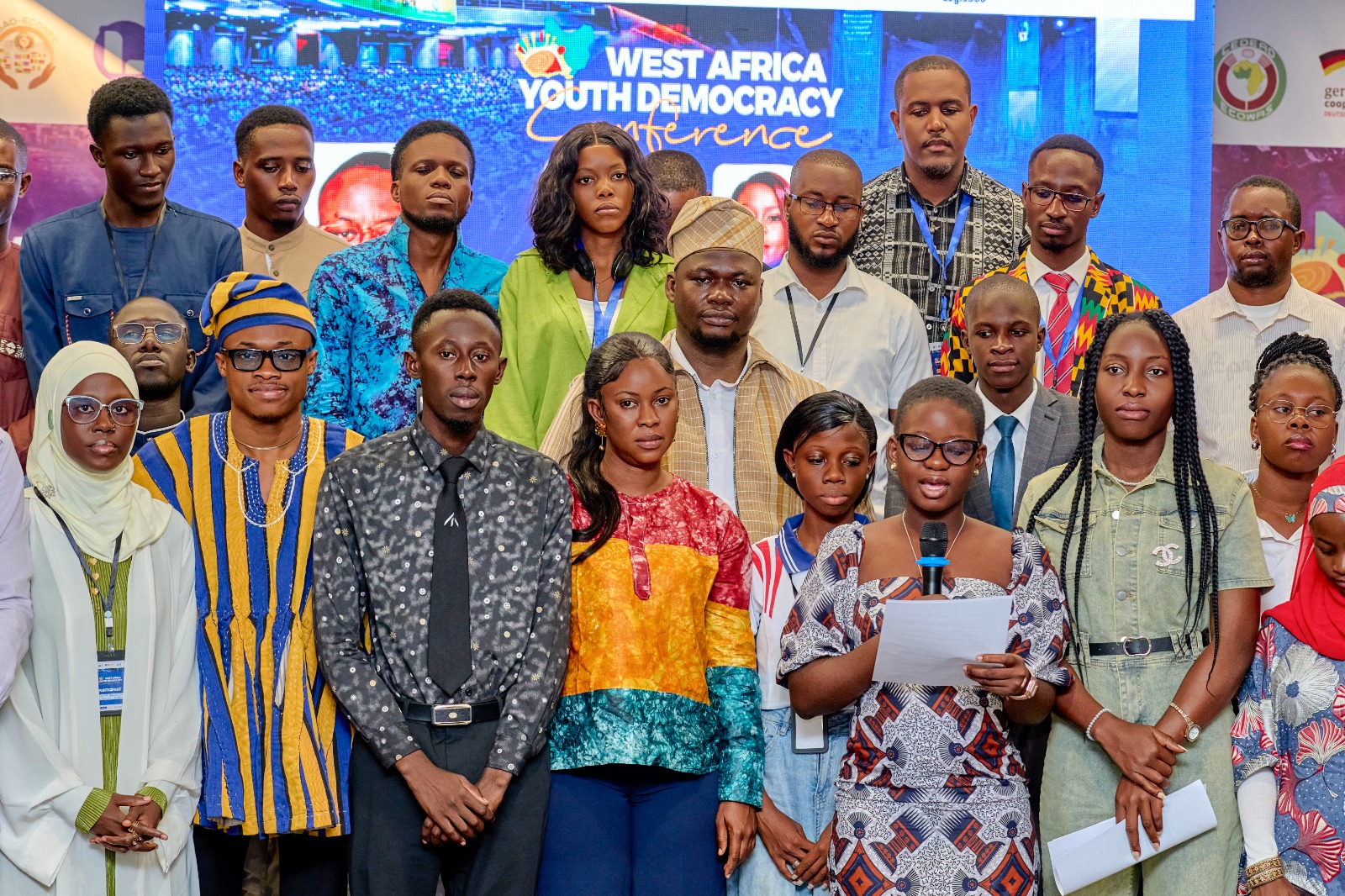
The call was contained in a communiqué adopted at the West Africa Youth Democracy Conference (WAYDC), held in Dakar, Senegal.
This Conference is supported by the EU Support to ECOWAS on Peace, Security and Governance (EPSG) project, commissioned by the German Federal Ministry for Economic Cooperation and Development (BMZ), co-funded by the European Union (EU) and the Danish Ministry of Foreign Affairs, and co-implemented by GIZ, Expertise France and FIAP.
The communiqué, signed by the founder and Executive Director of Legis360, Samuel Folorunsho, expressed concern over the absence of binding legal frameworks guaranteeing youth participation, financial barriers such as nomination fees and campaign costs, weak implementation of existing inclusion policies, and inadequate monitoring and sanction mechanisms.
The Youths urged West African governments to adopt specific legislation, including youth quotas, reduced candidacy fees and campaign spending caps, to make political participation more accessible to young people.
The communique also called for stronger monitoring and sanction mechanisms to ensure the implementation of laws promoting the inclusion of young people and women, while urging parliamentarians to strengthen oversight of the executive.
The Youths further urged political parties to democratise their internal operations, ensure transparent candidate selection processes and open their leadership structures to young people and women.
The communiqué also called on governments and development partners to invest in youth economic empowerment through employment, entrepreneurship and access to finance, noting that economic constraints could prevent young people from participating effectively in electoral processes.
The participants advocated sustained youth engagement throughout the electoral cycle, rather than limiting their participation to election periods.
They recommended mentorship and coaching programmes, capacity building, training, intergenerational dialogue, as well as early civic and voter education targeted at young people and women.
On digital democracy, the conference called on the Economic Community of West African States (ECOWAS) to finalise and operationalise a framework for the use of artificial intelligence by election management bodies.
The framework, according to the communiqué, should protect electoral integrity against disinformation, deepfakes and other forms of digital manipulation.
The participants also urged member states to invest in digital civic education to equip young people with the skills to identify false information and use social media responsibly.
They called on ECOWAS to use diplomatic channels to discourage restrictions on internet and social media access during electoral periods.
As part of the resolutions, the youths endorsed the establishment of the West Africa Youth Observers Network (WAYON) as a permanent platform for capacity building, advocacy and exchange among young election observers across the region.
The network will focus on training, election observation, data collection and information sharing among young observers across ECOWAS member states.
It will have a governance framework comprising a steering committee and focal points in each ECOWAS member state, alongside a digital platform to facilitate communication and coordination.
Its operations will be coordinated by the ECOWAS Commission in collaboration with relevant partners.

