
By Palma Ileye
Civil Society Legislative Advocacy Centre (CISLAC) has called on defence and security agencies to strengthen measures to prevent sexual and gender-based violence (SGBV), improve accountability and protect victims from harassment, exploitation and abuse of authority.
The organisation also urged security institutions to establish accessible and confidential reporting channels, strengthen internal complaint mechanisms and ensure prompt investigation of reported cases.
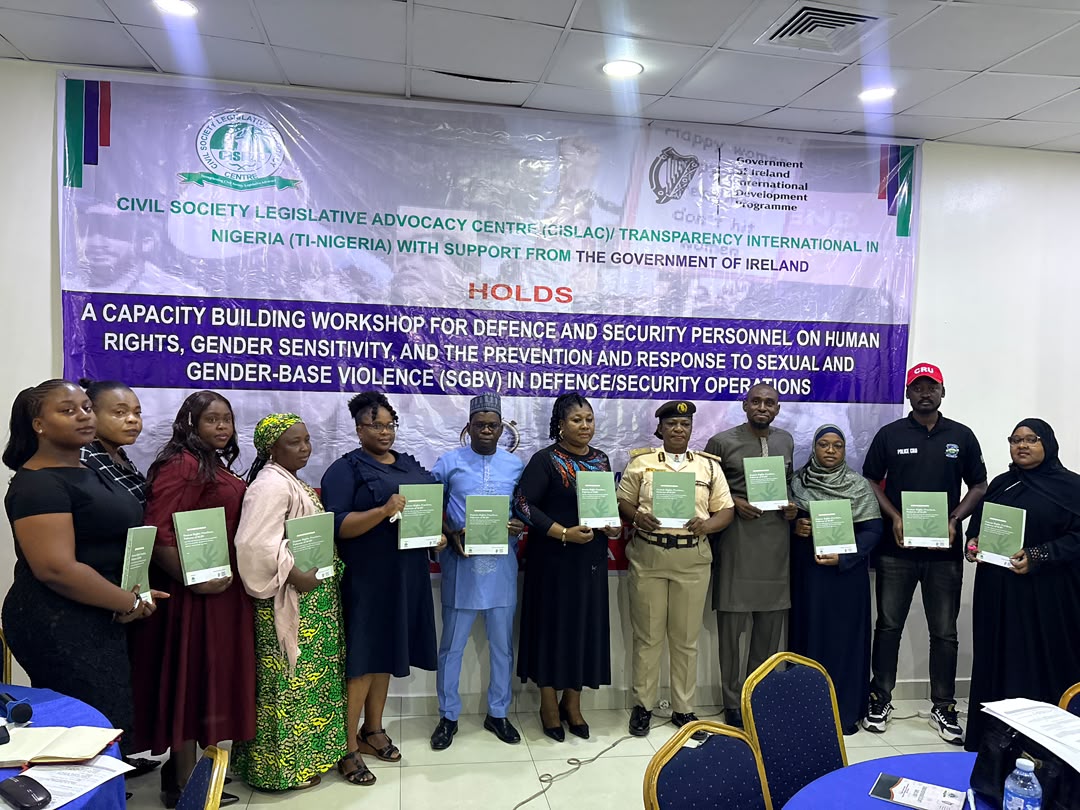
The call was contained in a communiqué issued at the end of a capacity-building workshop for defence and security personnel on human rights, gender sensitivity and SGBV prevention and response in security operations in Nigeria.
The workshop which was held in Abuja, was organised by CISLAC/Transparency International Nigeria (TI-Nigeria), with support from the Government of Ireland.
Participants, drawn from Defence and Security agencies, government Ministries, oversight institutions, Civil Society organisations, women’s rights groups and the media, identified institutional weaknesses and operational practices that could expose personnel and civilians, particularly women, to sexual harassment, exploitation and other forms of abuse.
The communiqué, signed by the Executive Director of CISLAC/TI-Nigeria, Comrade Auwal Ibrahim Musa (Rafsanjani), and Mr. Maurice Chukwu, Researcher, Amnesty International in Nigeria, noted that women continued to face barriers to equal participation, leadership appointments, promotions and career advancement within defence and security institutions.
It attributed the challenges partly to gender stereotypes, discrimination and limited awareness of gender equality, adding that unequal power relations between senior and junior officers could create opportunities for intimidation, harassment, exploitation and abuse of authority.
According to the participants, the dependence of career progression and promotion on recommendations from superior Officers could further expose Junior personnel to victimisation and misconduct.
They also identified inadequate supervision during night duties and field operations, poor accommodation arrangements, insufficient resting facilities and gender imbalances in duty assignments as factors that could create unsafe working conditions for female personnel.
The communiqué further expressed concern over inappropriate search procedures involving female civilians without the participation of female officers, warning that security checkpoints and other operational environments could become avenues for exploiting women and other vulnerable groups.
It noted that weak institutional accountability, delayed investigations and inadequate enforcement of disciplinary measures continued to undermine efforts to address SGBV within security institutions.
The participants also stressed the need to improve access to survivor support services, including psychosocial care, healthcare, legal assistance and safe accommodation, to encourage victims to report incidents and seek justice.
At the workshop, the National Human Rights Commission (NHRC) formally launched a validated baseline assessment report titled, “Human Rights Practices, Patterns of SGBV and the Effectiveness of Existing Complaint and Accountability Mechanisms Within Defence and Security Agencies.”
The report was launched by the Executive Secretary of the NHRC, Chief Anthony Okechukwu Ojukwu, represented by the Director, Women and Children Department, Mrs. Ngozi Okore.
The assessment examined human rights practices, patterns of sexual and gender-based violence and the effectiveness of existing complaint and accountability mechanisms across assessed defence and security agencies.
The launch provided an opportunity for stakeholders to examine institutional gaps and identify areas requiring policy reforms and improved accountability.
Following group discussions on women’s participation and gender mainstreaming, confidential SGBV reporting and accountability mechanisms, as well as institutional and operational risks, participants made several recommendations.
They called on Defence and security agencies to review their policies and personnel management procedures to eliminate gender-based discrimination in recruitment, appointments, promotions, training and leadership opportunities.
They also recommended increased women’s representation in leadership and decision-making structures through appropriate gender targets, affirmative measures, mentorship and professional development programmes.
The communiqué urged security institutions to appoint or strengthen Gender Advisers and Gender Focal Persons, while making gender and cultural sensitivity training compulsory for personnel, irrespective of rank.
On accountability, participants called for dedicated hotlines, official telephone numbers, email addresses, complaint boxes and secure digital platforms through which personnel and affected persons could report SGBV incidents confidentially.
They further recommended strengthening Gender Desks with trained personnel to receive, document and refer complaints, alongside clear procedures to protect survivors, complainants and witnesses from intimidation, victimisation and retaliation.
The participants urged agencies to establish timelines and standard operating procedures for prompt, impartial and professional investigations, adding that appropriate disciplinary measures should be imposed on personnel found responsible for misconduct.
They also called for suspected criminal offences to be referred to relevant law enforcement and prosecutorial authorities.
To improve transparency, the communiqué recommended periodic reviews and annual reports on complaints received, investigations conducted, cases resolved and disciplinary actions taken, without compromising the identities and confidentiality of survivors.
On operational safeguards, participants advocated regular SGBV risk assessments before, during and after security operations, as well as stronger supervision and monitoring of personnel through regular and unannounced inspections, particularly during night duties and field deployments.
They also called for gender-balanced duty arrangements and adequate separate accommodation, restrooms, changing areas and resting facilities for male and female personnel during deployments.
The communiqué stressed the need for female officers to participate in searches involving women to protect their dignity, privacy and rights.
It further urged security agencies to strengthen monitoring of checkpoints and other operational environments to prevent the exploitation and abuse of civilians.
To support survivors, participants recommended the development of referral directories containing contacts of organisations and service providers offering psychosocial support, healthcare, legal assistance, shelter and other protection services.
They also called for collaboration with the NHRC, civil society organisations, healthcare providers and relevant law enforcement agencies to ensure effective survivor-centred referrals.
The communiqué added that survivors facing threats, intimidation or further abuse should have access to temporary safe accommodation, while receiving information and assistance to pursue available legal and protection remedies, including protection orders under the Violence Against Persons (Prohibition) Act, 2015, where applicable.
For effective implementation, participants urged each defence and security institution to develop agency-specific action plans with clearly designated focal persons, responsible departments, implementation timelines and measurable indicators.
They also recommended periodic institutional assessments to monitor progress in implementing gender-responsive policies, strengthening complaint mechanisms and improving accountability for SGBV.
The participants reaffirmed that the protection of human rights, gender equality and the prevention of sexual and gender-based violence must become integral parts of the daily operations and professional conduct of defence and security personnel.
They emphasised that effective prevention requires strong institutional safeguards, accessible reporting channels, survivor-centred responses and consistent accountability for violations.

