
By Ere-ebi Agedah Imisi
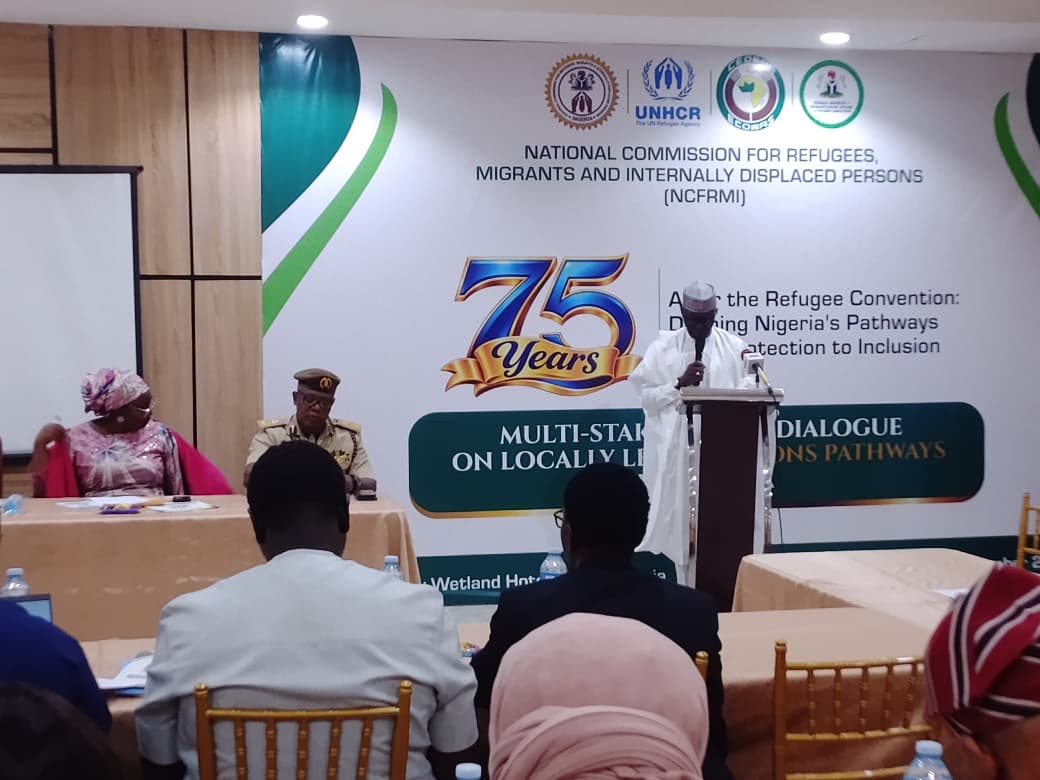
The National Commission for Refugees, Migrants and Internally Displaced Persons, NCFRMI has convened a two-day multi-stakeholder dialogue to advance locally led solutions for refugees in Nigeria, with a focus on transitioning from humanitarian protection to sustainable inclusion and integration.
With the theme, 75 Years After the Refugee Convention: Defining Nigeria’s Pathways from Protection to Inclusion, the dialogue was held in commemoration of the 1951 Refugee Convention and brings together key stakeholders to deliberate on strategies for strengthening Nigeria’s refugee response, promoting self-reliance and ensuring that refugees are included in national development frameworks.
Delivering an opening address, the Federal Commissioner and Chief Executive Officer of the National Commission for Refugees, Migrants and Internally Displaced Persons, NCFRMI, Dr Aliyu Tijani Ahmed, called for stronger pathways to local integration, self-reliance and naturalisation for refugees who have established longstanding ties with Nigeria.
Ahmed disclosed that Nigeria hosts approximately 141,688 refugees and asylum-seekers from more than 45 countries, stressing that the country must move beyond providing immediate humanitarian assistance to creating opportunities for refugees to rebuild their lives and contribute meaningfully to society.
He explained that sustainable refugee inclusion requires access to legal documentation, education, healthcare, livelihoods and economic opportunities, alongside the integration of refugees into existing national and subnational systems.
The NCFRMI boss noted that the Commission was ready to work with the Federal Ministry of Interior and other relevant authorities to guide eligible refugees seeking Nigerian citizenship through naturalisation.
He further called for stronger collaboration among government institutions, development partners, host communities and refugee-led organisations, adding that the dialogue should produce practical recommendations, measurable actions and sustainable solutions.
Additionally, Ahmed also disclosed plans to establish a multi-stakeholder technical working group, coordinated by the Commission, to ensure the implementation of recommendations emerging from the dialogue.
He however, acknowledged President Bola Tinubu’s commitment to humanitarian protection and social inclusion, while appreciating the Minister of Humanitarian Affairs and Poverty Reduction for his support in strengthening the Commission’s mandate. He also commended UNHCR, development partners and other stakeholders for their collaboration and continued efforts towards advancing sustainable solutions for refugees in Nigeria.
Also speaking, the Deputy Representative, Protection at the United Nations High Commissioner for Refugees, UNHCR, Ms Bernedette Muteshi, called for the integration of refugees into national and state development plans, budgets and social protection systems to achieve sustainable solutions in Nigeria.
Muteshi stressed that refugee protection must go beyond humanitarian assistance to include access to education, healthcare, legal documentation, employment and financial inclusion.
She noted that solutions must be locally led and government-owned, with refugees and host communities actively involved in designing and implementing programmes that promote self-reliance and shared economic opportunities.
Meanwhile, declaring the summit open, the Minister of Humanitarian Affairs and Poverty Reduction, Dr Bernard Doro stressed the need to move beyond emergency humanitarian assistance towards sustainable livelihoods and self-reliance.
The Minister represented by Director, Catherin Bulus stated that prolonged displacement required stronger collaboration between humanitarian institutions to create lasting solutions.
He explained that refugees need access to legal documentation, education, healthcare, decent employment, entrepreneurship and financial services to rebuild their lives and contribute to society.
The Minister further emphasised the importance of strengthening host communities, noting that sustainable refugee inclusion must create shared economic opportunities for both refugees and Nigerians.
He therefor urged stakeholders to develop practical recommendations and strengthen locally led interventions that would promote resilience, social cohesion and inclusive development.
A refugee from Cameroon and resident in ogoja, Ochengi Lawanson Che that has lived in Nigeria since 2018 shared with participants some challenges and lived experiences of refugees, as he urged government to priorities quality education, decent employment, access to quality health care among others for refugees.

