
By Patrick Wemambu
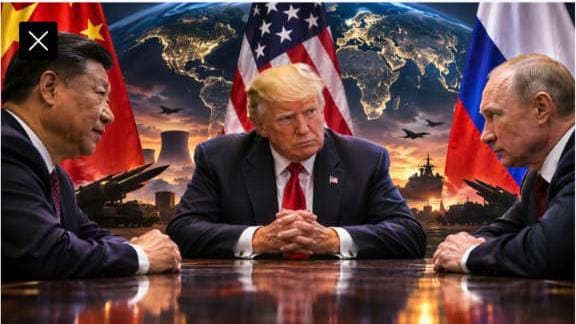
Legendary chapter in history was recorded Thursday November 19, 2026 as US President Donald Trump, China’s President Xi Jinping with Russian President Vladimir Putin sat at a round table and spoke for 90 minutes in a meeting that was once thought unthinkable.
Convened by the Chinese president, the leaders of the world’s three biggest powers were holed up in a capacious reception room within a sprawling hillside resort on the sidelines of the Asia-Pacific Economic Cooperation (APEC) meeting in Shenzhen, Guangdong province, of southern China.
According to a joint statement released after the encounter, which started two hours later than scheduled – and came after a separate bilateral summit between Xi and Trump – the three leaders had an ‘in-depth exchange of views on the current international situation’ and committed themselves to maintaining strategic stability and international security.
They agreed on four points, including a commitment to reform the United Nations and plans to increase the supply of refined petroleum products.
The leaders also said they would hold a dialogue on reducing nuclear risks and preventing the proliferation of nuclear weapons, and agreed that the International Criminal Court (ICC) and similar institutions ‘must not abuse their jurisdiction.’
Earlier in his opening remarks, Xi had noted the responsibilities that lie on the shoulders of major powers. “Their positive interaction is not optional, but a must,” he said, adding later that the three countries should maintain regular high-level engagement, keep channels of dialogue open at all levels and establish crisis communication and prevention mechanisms.
Trump, meanwhile, continued a long-running call for a reduction in nuclear weapon stockpiles and railed against ‘rogue globalist organizations,’ pointing the finger at the ICC, which his administration has been working to dismantle.
Trump also defended his enthusiasm for the three-way talks with China and Russia, which would traditionally have been considered anathema for a US president. “No peace was ever forged by declining opportunities for engagement. Together, we are choosing a different course,” he enthused.
Like the other two leaders, Putin had observed that a shared responsibility for maintaining global peace and security was sine qua non. He harped on the importance of shared interests in tackling issues like transnational crime. But top of his agenda was the war in Ukraine, which Putin said he had discussed when he met Xi and Trump separately.
What were the major takeaways from the historic gathering? Pundits would be quick to point out that the meeting was more symbolic than substantive, with no major accords reached on nuclear arms control, artificial intelligence, or active wars. There were no diplomatic breakthroughs. As regards nuclear wars, the three leaders agreed to hold ongoing talks on reducing nuclear risks and preventing proliferation. This is even as they reaffirmed that a nuclear war cannot be won and must never be fought. However, no new arms-control treaty was announced. Talking about major wars, Trump said he discussed Russia’s war in Ukraine and the conflict involving Iran with his counterparts. Unfortunately, neither war was named in the post-summit peace declaration, and no breakthrough on ending them was announced.
Focusing on energy and UN reforms, the declaration voiced support for stabilizing or increasing oil and energy supplies. Calls for reforms to the United Nations, though they did not spell out specific details were made.
Profile boosts for all three leaders? Whereas Trump touted the summit and his warm language toward Xi and Putin as historic diplomacy after a difficult stretch at home – Putin used the high-profile setting being his first APEC summit since 2017 to project major-power parity alongside the US and China. Xi on the other hand appeared to be over the moon having hosted the gathering as a centerpiece of Chinese-led diplomacy.
Just as all three leaders appeared to have gotten something out of the trilateral meeting, Beijing and Russia seem the biggest winners. For China, being the host country meant it could shape the agenda and spotlight the country’s centrality within the global order. In his concluding remarks, Xi described the talks as ‘positive, constructive and fruitful.’
No doubt, the success of the meeting must have had a positive effect on China’s international status and influence. For Putin, getting a seat at the table with China and the US is a sign to the world that Russia is a peer power – despite its growing disparities with the other two. In footage, Putin was captured telling Xi: “I don’t think anyone even expected everything to go so well.” He later reportedly told a press conference that the meeting was “open” and “very useful.” Another opportunity for the Kremlin to break out of global isolation, you might say.
As for Trump, there was apparently a desire for him to reassert US global leadership after heavy midterm losses at home. He appeared to like the optics of engaging in the three-way meeting. Which was good for the cameras.
Pray, what did the trilateral summit achieve in concrete terms? While some believe it had a stabilizing effect on an international order in turmoil, the broad consensus among analysts is that this first-of-its-kind meeting worked more as a confidence-building exercise. That is between the rival nations rather than an immediate, concrete cure to the world’s ills. Conversely, a school of thought believed it was not more than a one-off photo opportunity – given the lack of progress on thorny issues, including the wars in Ukraine and Iran. Yet, there are those who describe it as symbolism over substance.
At the risk of sounding afro-centric, what if any were the implications of the Shenzhen meeting for Africa? Not in the room, not also on the menu. Yet every aspect of the dialogue touches Africa directly.
For Africa, the declaration made to increase global refined petroleum supply because of the Iran war and Strait of Hormuz disruption matters enormously. 32 African countries collectively spent an extra $21.9 billion on imported fuel between March and August 2026 alone because of the Iran conflict. Kenya lost billions in exports; Angola faces a $4.2bn fuel subsidy burden. If the G3 actually delivers more fuel, pump prices in Nigeria, Ghana, Kenya could fall.
But the declaration has no dates, no quantities, no timetable. So, for now, it is just a promise.
Since this meeting has been roundly criticized for ending with a vague declaration, need for a follow-up cannot be overstressed. Luckily, Trump has already floated a sequel tentatively at the G20 meeting in Miami next month. Putin has been invited to attend. Perhaps it is pertinent to draw up a tentative agenda for the second meeting.
On nuclear armament, the meeting should set a 6-month deadline for negotiators to present a trilateral framework – even if China joins later with a lower cap, given it has ∼620 warheads vs 5,000+ each for US/Russia. On Iran and North Korea, who verifies their nuclear risks? And the red line? Efforts must intensify towards ending the Ukraine and Iran wars.
This is to hope that India, Africa, and Ukraine are invited as observers to the 2nd Xi-Trump-Putin Trilateral Summit in the US next month.

