
By Kehinde Ibrahim, Lagos
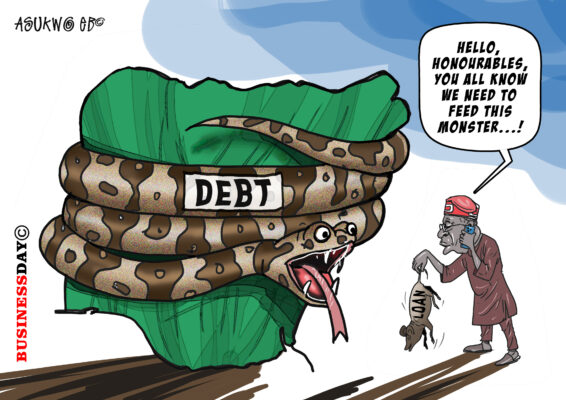
FOR years, borrowing has been an integral part of Nigeria’s fiscal management strategy, providing governments with the financial resources needed to bridge widening budget deficits, execute infrastructure projects and sustain public spending during periods of economic strain. Like many developing economies, Nigeria has relied on both domestic and external debt to cushion revenue shortfalls, stimulate economic activity and finance development priorities. Yet, what was once regarded as a necessary fiscal instrument has increasingly become one of the country’s most contentious economic issues.
The pace at which public debt has expanded in recent years has sparked renewed concern among economists, investors, manufacturers and development experts, many of whom now question whether the country’s borrowing strategy is laying the foundation for sustainable economic growth or gradually exposing Africa’s largest economy to a dangerous cycle of mounting debt obligations. While government officials insist that the loans are critical to funding infrastructure and supporting ongoing economic reforms, critics argue that the country’s dependence on debt is becoming excessive, particularly as revenue growth continues to lag behind rising expenditure.
At the centre of the debate is a simple but critical question: Is Nigeria borrowing to build future prosperity, or merely borrowing to survive the present? Increasingly, analysts believe the answer may determine the country’s economic trajectory for decades to come.
Borrowing, in itself, is not inherently harmful. Virtually every modern economy finances part of its development through debt. Countries with strong fiscal management often borrow to construct highways, expand power infrastructure, modernise transport systems and invest in projects capable of generating long-term economic returns. When properly managed, debt accelerates growth by creating assets that stimulate productivity, expand the tax base and improve living standards.
Nigeria’s challenge, however, lies not simply in the volume of borrowing but in the quality of its fiscal management and the productivity of the projects financed through borrowed funds. Many economic analysts contend that successive administrations have become increasingly dependent on debt as a substitute for comprehensive fiscal reforms aimed at strengthening government revenue and reducing recurrent expenditure.
Recent figures released by the Central Bank of Nigeria illustrate the scale of the country’s growing reliance on borrowed funds. Credit extended to the Federal Government rose by 75.6 per cent year-on-year to N40.38 trillion as of May 2026, underscoring an unprecedented increase in domestic borrowing despite persistently high interest rates.
Ordinarily, governments turn to domestic debt markets because they provide relatively quick access to funding while reducing dependence on foreign creditors. However, heavy government borrowing also creates unintended consequences for the wider economy. As public demand for credit rises, commercial banks increasingly channel available liquidity towards government securities that offer attractive returns with minimal risk. Consequently, fewer financial resources remain available for manufacturers, farmers, exporters and small businesses seeking affordable loans to expand production.
This phenomenon, commonly described by economists as the crowding-out effect, is gradually becoming more evident across Nigeria’s productive sectors. Businesses that should ordinarily be investing in new factories, acquiring equipment or expanding operations are instead postponing investment decisions because financing has become increasingly scarce and prohibitively expensive.
Manufacturers have repeatedly complained that access to credit remains one of the biggest obstacles limiting industrial growth. With Treasury bills and government bonds offering attractive yields, banks naturally prefer lending to the government rather than extending credit to private enterprises operating in a volatile economic environment characterised by inflation, exchange-rate instability and weak consumer demand.
The implications extend beyond corporate balance sheets. When businesses cannot obtain affordable financing, production slows, employment opportunities decline, investment weakens and economic growth loses momentum. The broader economy ultimately bears the cost through slower industrialisation, lower productivity and weaker household incomes.
Government borrowing has accelerated significantly within the domestic debt market. Between January and May 2026, the Federal Government reportedly issued Treasury bills valued at approximately N11.4 trillion, representing the highest issuance recorded during a similar five-month period. Data compiled by FMDQ equally indicated that outstanding Treasury bills climbed to roughly N17.4 trillion, reflecting the growing dependence on short-term domestic financing.
Although Treasury bills remain an efficient instrument for raising government funds, their increasing issuance absorbs substantial liquidity from the financial system. Banks, pension funds and institutional investors understandably gravitate towards these securities because they combine relatively high returns with virtually no credit risk. The unintended consequence, however, is that productive sectors requiring capital for expansion become increasingly crowded out of the credit market.
For thousands of Nigerian businesses, particularly small and medium-sized enterprises, this financial squeeze has become increasingly severe. SMEs account for a significant proportion of employment across the country, yet they remain among the most financially vulnerable enterprises. Many lack sufficient collateral to secure commercial loans, while others struggle to meet rising borrowing costs resulting from tight monetary conditions.
As access to affordable finance deteriorates, numerous businesses have been forced to scale back operations, postpone expansion plans or abandon investment projects altogether. This ultimately reduces job creation, weakens household purchasing power and slows overall economic activity.
Nigeria’s borrowing appetite extends well beyond domestic markets. The Federal Government continues to pursue several major external financing arrangements designed to support infrastructure development and bridge fiscal deficits. Among the most prominent proposals is a planned $5 billion bond-backed financing arrangement supported by a $1 billion facility from Citibank UK for the rehabilitation of Apapa and Tin Can Island ports. Government is also considering a $516 million facility to support construction of the Badagry-Sokoto Superhighway, alongside additional Eurobond issuances and other commercial borrowing programmes expected to push fresh external borrowing close to $10 billion during 2026.
The Debt Management Office has equally confirmed that advisers are being appointed for another Eurobond issuance under the 2026 external borrowing programme, with proceeds expected to finance budget deficits, refinance existing obligations and support infrastructure investment.
External borrowing undoubtedly provides certain advantages. Unlike domestic loans, foreign borrowing supplies much-needed foreign exchange, reduces immediate pressure on local credit markets and often supports strategic infrastructure projects requiring imported equipment and technical expertise. However, these benefits come with considerable risks, particularly for an economy grappling with exchange-rate volatility.
Every depreciation of the naira automatically increases the local currency cost of servicing foreign debt. Consequently, projects financed through external loans must generate sufficient economic returns or foreign exchange earnings capable of offsetting future repayment obligations. Where such returns fail to materialise, debt servicing gradually consumes larger portions of government revenue, reducing fiscal space for essential public services.
The recent approval of a $1.25 billion Development Policy Financing loan by the World Bank further illustrates Nigeria’s continuing dependence on concessional external financing. While multilateral loans generally carry lower interest rates and longer repayment periods than commercial borrowings, they nevertheless increase the country’s overall debt obligations and require disciplined implementation to deliver measurable economic benefits.
Increasingly, economists argue that the country’s greatest vulnerability lies not in its headline debt figures but in the relationship between debt servicing and government revenue. Although Nigeria’s debt to GDP ratio remains below internationally recognised sustainability thresholds, revenue mobilisation has consistently remained weak, leaving the government with limited fiscal capacity after meeting debt obligations.
Concerns over Nigeria’s debt profile have become more pronounced because the country’s borrowing has continued to expand against the backdrop of stubborn inflation, elevated interest rates, exchange rate volatility and persistently weak revenue generation. These conditions have combined to create an environment in which debt is becoming more expensive to service while the economy struggles to generate the level of growth needed to absorb additional financial obligations.
Economic analysts argue that the sustainability of public debt should not be measured solely by the size of outstanding borrowings but by the government’s capacity to repay those obligations without undermining economic development. In Nigeria’s case, that capacity remains constrained by one of the lowest revenue to GDP ratios in the world, leaving public finances vulnerable to even modest economic shocks.
This concern has been echoed by several financial experts who insist that the country’s debt burden is better assessed against government earnings than against the overall size of the economy. Johnson Chukwu, founder of Cowry Asset Management Limited, has repeatedly maintained that while Nigeria’s debt to GDP ratio may appear moderate by international standards, the more pressing issue is the proportion of government revenue devoted to servicing existing obligations. According to him, countries with relatively low debt levels can still experience fiscal distress when their revenues are insufficient to comfortably meet repayment commitments.
His assessment reflects a growing reality within Nigeria’s public finances. An increasing share of government revenue is now being channelled towards debt servicing, leaving fewer resources available for healthcare, education, security, agriculture and other sectors that directly influence economic productivity and human development. As debt service obligations continue to rise, governments at all levels may find themselves with less fiscal flexibility to respond to emerging economic challenges or invest in programmes capable of improving citizens’ welfare.
Research organisations have also raised caution over the country’s borrowing trajectory. SBM Intelligence recently warned that although Nigeria’s debt indicators remain within internationally accepted thresholds, policymakers should pay greater attention to the pace, structure and cost of new borrowing rather than relying solely on debt to GDP ratios as evidence of sustainability. The organisation noted that Nigeria’s previous experience with the Paris Club debt crisis demonstrates how prolonged dependence on borrowing can eventually constrain economic growth and reduce fiscal independence if not carefully managed.
The warning comes at a time when Nigeria continues to grapple with structural weaknesses that have persisted for decades. Manufacturers still contend with unstable electricity supply, poor transport infrastructure, multiple taxation, high logistics costs and rising production expenses. Farmers face insecurity, inadequate storage facilities and limited access to affordable financing, while businesses across virtually every sector continue to navigate inflationary pressures that have significantly increased operating costs.
These structural deficiencies raise an important question regarding the effectiveness of borrowed funds. If loans are primarily utilised to finance recurrent expenditure or close short-term fiscal gaps without addressing the underlying constraints limiting productivity, the economy may struggle to generate sufficient returns to justify the additional debt.
National Coordinator of the Progressive Shareholders Association of Nigeria, Boniface Okezie believes that borrowing alone cannot resolve the country’s deep-rooted economic challenges. He argues that sustainable growth requires comprehensive reforms capable of improving productivity, strengthening industrial capacity, stabilising the exchange rate and reducing inflationary pressures. Without these complementary reforms, borrowed funds may deliver only temporary fiscal relief while the structural problems undermining economic performance remain unresolved.
The private sector has consistently maintained that access to affordable credit remains one of the most significant impediments to business expansion. Across manufacturing, agriculture, technology and commerce, businesses continue to report rising financing costs that have discouraged investment and slowed production. For many firms, securing long-term credit at commercially viable rates has become increasingly difficult as government borrowing absorbs liquidity within the financial system.
Small and medium-sized enterprises have been particularly affected by these developments. As the backbone of Nigeria’s economy, SMEs account for a substantial share of employment and entrepreneurial activity. Yet many operate with limited financial reserves and depend heavily on bank loans to finance expansion. Higher lending rates, combined with stricter credit conditions, have forced numerous businesses to delay investments, reduce production or abandon growth plans entirely.
The consequences extend well beyond individual enterprises. Reduced private investment translates into fewer factories, slower industrial expansion, diminished innovation and weaker export capacity. Job creation suffers, household incomes come under pressure and economic diversification becomes more difficult to achieve. Over time, these trends can weaken the very growth prospects that government borrowing is intended to support.
Investor confidence may also be affected by persistent reliance on debt financing. Both domestic and foreign investors closely monitor a country’s fiscal position when making long-term investment decisions. An expanding debt stock, particularly if accompanied by weak revenue growth and rising debt servicing costs, may create concerns about future tax increases, macroeconomic stability and the government’s capacity to implement necessary reforms.
Many economists therefore argue that Nigeria’s long-term economic resilience will depend less on how much it borrows and more on how effectively borrowed resources are utilised. Investments in power generation, transport infrastructure, education, healthcare, technology and export-oriented industries have the potential to stimulate productivity, expand economic output and generate the revenues needed to repay debt without placing excessive pressure on future budgets.
Conversely, if borrowing continues to finance consumption rather than production, the country’s fiscal challenges are likely to deepen. New loans could increasingly be required to refinance existing obligations, creating a cycle in which debt accumulates faster than the economy’s capacity to service it. Such a scenario would gradually erode fiscal flexibility, limit development spending and expose the country to greater vulnerability during periods of economic uncertainty.
For Nigeria, the debate over borrowing is therefore no longer simply about the size of the debt stock. It has evolved into a broader conversation about fiscal discipline, economic priorities and the sustainability of the country’s development strategy. Whether current borrowing ultimately strengthens the economy or leaves future generations burdened with mounting repayment obligations will depend largely on the quality of public investment, the pace of structural reforms and the government’s ability to generate stronger, more sustainable sources of revenue.

