
By Patrick Wemambu
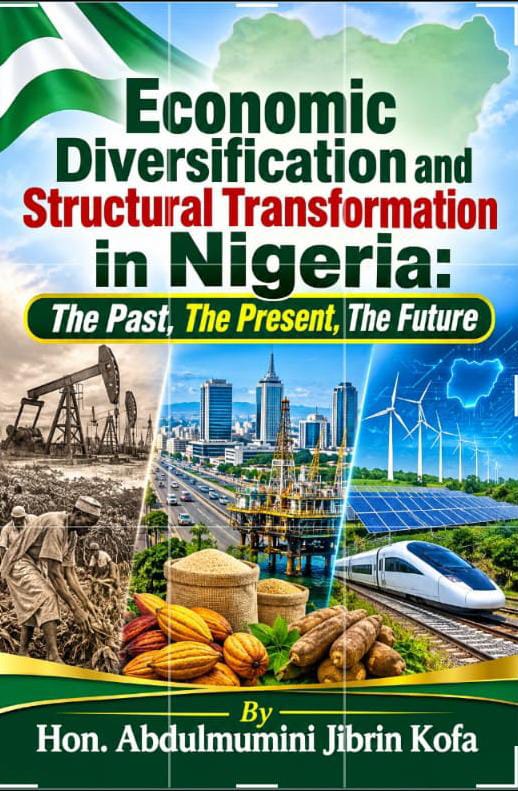
Thursday November 12 2026 witnessed the unveiling of the 526-page publication titled: “Economic Diversification and Structural Transformation in Nigeria: The Past, The Present, The Future,” at the State House Conference Centre, Abuja.
Authored by a four-term member of the House of Representatives, Hon. Abdulmumini Jibrin Kofa, the presentation drew a mammoth crowd of serving and former NASS members, party chieftains, especially from the ruling party, the academics, businessmen/contractors and the media.
Reviewing the book, ex-presidential spokesman and veteran journalist, Dr Reuben Abati, observed that the compendium offered a comprehensive examination of Nigeria’s economic history, the structural deficiencies that had undermined successive development programmes and the prospects of the Tinubu administration’s reforms.
Commenting on the long-term success of President Bola Ahmed Tinubu’s economic reforms, the reviewer asserted that it would depend on the government’s ability to translate macroeconomic stability into tangible improvements in the living conditions of ordinary Nigerians.
Notwithstanding the administration’s economic policies had recorded gains in stabilizing the economy – Abati highlighted persistent poverty, declining purchasing power, and the cost-of-living crisis as challenges under-scoring the need for a more deliberate balance between fiscal adjustments and citizens’ welfare.
Drawing attention to the author’s assessment of the Renewed Hope Agenda, the ARISE Television ace presenter declared that the central challenge confronting policymakers centered on ensuring that the economic sacrifices demanded of Nigerians did not overwhelm their capacity to survive.
According to Abati, while Kofa acknowledged the administration’s macroeconomic achievements, he also recognized that economic stabilization had yet to produce widespread prosperity.
“The basic fundamentals within the economy may be going through correction due to policy actions. Purchasing power is low. The country faces a cost-of-living crisis, and more should be done to support vulnerable Nigerians,” the special adviser on media to President Jonathan 2011-2015 said.
He maintained that the ultimate measure of economic transformation should not be restricted to improved fiscal indicators, revenue generation or the restoration of macroeconomic stability, but should also include the effect of government policies on households.
Rueing that the burden of economic adjustment must be carefully managed to prevent the erosion of public confidence – the veteran journalist noted that the book repeatedly emphasized the human consequences of structural reforms. Quoting Kofa, he said, “True reform is never free,” adding that the author also acknowledged that “reform is rarely painless.”
He explained that economic reforms inevitably produced winners and losers, with those bearing the immediate costs often more visible and vocal than those expected to benefit in the long term. According to Abati, Kofa identified sacrifice, resistance and balance as three critical elements in implementing difficult economic policies.
He said citizens must sometimes make sacrifices, while resistance could arise from organized labour, political groups and ordinary people struggling with economic hardship. The third element, he explained, was political leaders’ responsibility to restore equilibrium, rebuild public trust, and balance immediate sacrifices against anticipated long-term benefits.
Abati said the author’s argument was particularly relevant to Nigeria’s present economic circumstances, where the government was pursuing far-reaching structural adjustments amid considerable pressure on household incomes.
Speaking on the book’s criticism of poor coordination among government institutions, the erstwhile chairman of the editorial board of The Guardian newspaper described the problem as a longstanding obstacle to successful economic transformation.
According to him, Kofa argued that the absence of effective collaboration among ministries, departments and agencies, as well as between federal and state governments, had repeatedly undermined the implementation of otherwise promising economic policies.
“Where intergovernmental relationships are poorly coordinated, duplication of programmes and disputes over resources can weaken public service delivery,” Abati said, summarizing the author’s position.
He noted that questions remained about whether assessments of government agencies had translated into meaningful corrective measures, especially in sectors where underperformance and inadequate funding continued to affect service delivery.
Towards a constructive and analytical critique of the book, it suffices to note that the publication is divided into 3 parts which accommodates 29 chapters. The first part, covering 11 chapters and 208 pages, examines Nigeria’s economic history, the consequences of excessive dependence on petroleum revenue and the repeated failure of diversification initiatives.
The second part, comprising 13 chapters, focuses on the present economic environment, particularly the Renewed Hope Agenda, while the final five chapters explore Nigeria’s economic future and the sustainability of ongoing reforms.
The book also contains an epilogue examining the potentialities of the creative economy as an emerging driver of economic diversification.
Tracing the genesis of Nigeria’s economic difficulties, the book attributes the quagmire partly to the discovery of oil and the subsequent abandonment of agriculture and other productive sectors.
Nigeria’s dependence on petroleum revenue is identified as influencing the vulnerability of the giant of Africa to fluctuations in global oil prices. This is also responsible for the weakening of the manufacturing sector, and creation of limited opportunities for employment and export diversification.
Deploying the theoretical framework in research methodology, the book utilized three major economic theories – the resource curse, Dutch disease and structural change theory. All in a bid to explain why Nigeria had struggled to convert its abundant natural resources into sustained prosperity.
The publication examined successive national development plans like the Structural Adjustment Programme, the National Economic Empowerment and Development Strategy. Ditto the Vision 2020, the Seven-Point Agenda of late President Umaru Musa Yar’Adua and the Transformation Agenda of former President Goodluck Jonathan.
Central questions interrogated in the compendium revolved around what successive governments planned, which policies succeeded, why others failed, and what lessons could guide future economic decision-making.
Laudable as the justification for the treatise appears, it goes without saying that it has yet to receive adequate peer-reviewed academic criticism in the press. That in itself is a critical drawback. Being an astute politician who doubles as party chieftain more than an academic economist could make Hon. Kofa to be liable to be accused of Author Bias. That is akin to a scenario of one participating in an economic debate both as debater and member of the impartial panel of judges.
Having spent some considerable years in the NASS and participating in Finance and Appropriations Committees’ meetings, he was part of the system that approved budgets that failed to diversify the economy. Can the honourable legislator objectively criticize past failures when he was one of the approvers of those failures? The book risks becoming self-justification, not analysis.
Since 1960 – from the Willink Commission to NEEDS, Vision 20:2020, ERGP, and now Renewed Hope Agenda – Nigeria has been preaching the gospel of diversification from oil. But has there been any real transformation? The book’s “Past, Present, Future” structure repeats what we already know. Oil is volatile, agriculture is neglected, manufacturing is weak. It offers little new empirical data, no original modelling, and no new fieldwork from the 36 states.
As regards weak treatment of structural transformation, the book focuses less on constituents of the informal sector like Okada/Keke riders, the Akara/Roasted yam/Boli seller, POS operator and others who actually sustain the economy on a daily basis. Though the publication is useful as a politician’s insider account of why Nigeria has failed to diversify, it is weak as a scholarly work.
Nonetheless, the author needs commendation for the efforts in traversing the nation’s economic trajectory. The book deserves attention from policymakers, students of political economy, economic historians and Nigerians interested in the country’s development. Apologies to Dr. Reuben Abati.

