
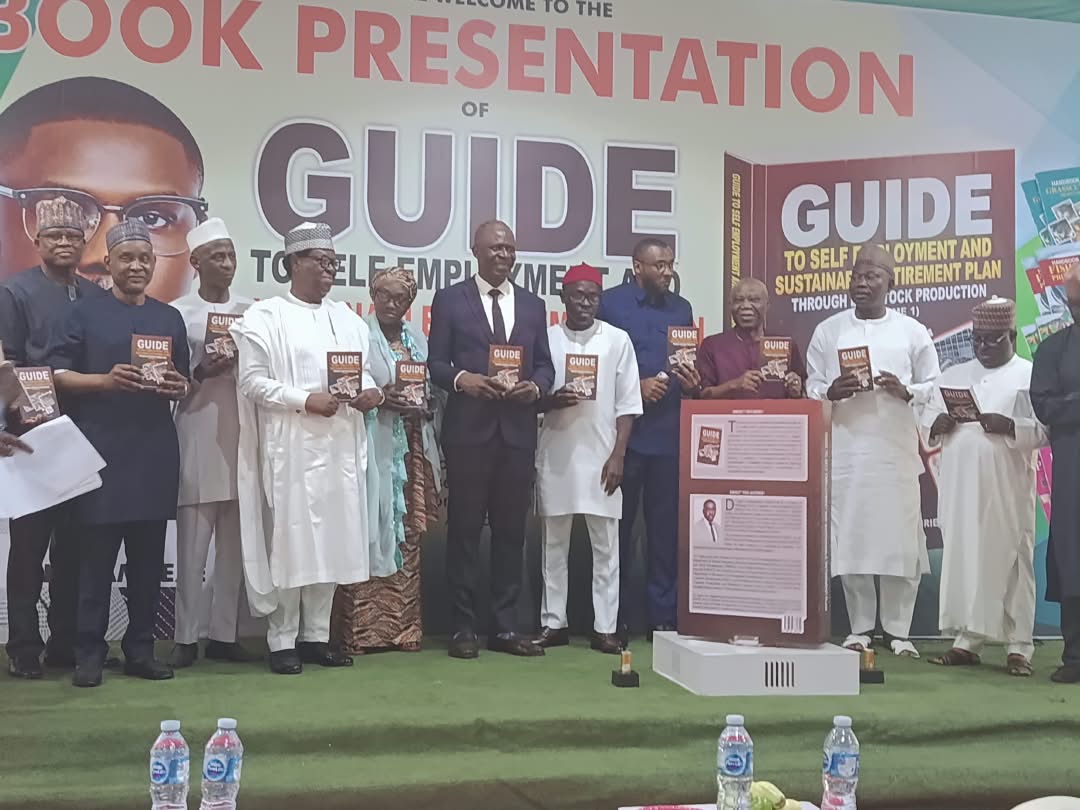
*Don unveils book on self-employment, sustainable retirement through livestock
By Michael Oche
The Federal Government has set a target of growing Nigeria’s livestock sector from its current estimated value of $32 billion to $92 billion within the next five years.
The government said the move is part of efforts to expand the sector’s contribution to employment, investment and national.
The Minister of Livestock Development, Idi Mukhtar-Maiha, stated this during the weekend in Abuja at the presentation of a book titled, Guide to Self-Employment and Sustainable Retirement Plan Through Livestock Production, written by Dr. Gabriel Ugwu, and the launch of his knowledge platform.
The minister, who was represented by his Special Adviser, Prof Eustace Iyayi, said the Federal Government was seeking to position livestock as a major economic sector while encouraging Nigerians to explore opportunities across its value chain.
He said the creation of the Federal Ministry of Livestock Development by President Bola Tinubu had provided a dedicated institutional focus for the sector and opened up opportunities in production, processing, marketing and other areas.
He said, “We want to grow the sector from the current $32 billion to about $92 billion in the next five years. This means we need to generate a lot of activities within the sector that will help us have a mark on this.
“We can actually grow the sector to contribute up to about 10 per cent to the GDP of the national economy.”
Iyayi said the ministry was driving the transformation through the Nigerian Livestock Growth Acceleration Strategy, which had been approved by the National Economic Council.
He listed the strategy’s 10 pillars as production and market access; animal health and disease control; feed and fodder; water resources; infrastructure; peace-building; youth and women; finance and insurance; and data and information management, among others.
He added that the government had also digitalised the 417 grazing reserves in the country and launched a ranching policy as part of efforts to modernise the livestock sector.
Describing livestock as a sector with enormous opportunities for retirees, Iyayi urged people still in active service to begin preparing for retirement by investing in productive ventures.
He said retirement from formal employment should not amount to retirement from economic productivity, stressing that livestock could provide additional income and economic security for retirees.
Seaking, the Task Team Leader of the Livestock Productivity and Resilience Support Project (L-PRES) at the World Bank, Chigozie Anyiro, said Nigeria’s livestock sector was a sleeping economic giant with significant potential for wealth creation and employment.
Anyiro said the sector contributed more than $32 billion annually to the national economy and supported the livelihoods of more than 30 million Nigerians.
He cited Nigeria’s livestock inventory as including more than 58 million cattle, 64 million sheep, 124 million goats and 660 million poultry birds.
He said the book was timely because it provided practical guidance for young graduates, professionals, farmers and retirees seeking to establish sustainable livelihoods through livestock production.
According to him, the accompanying knowledge platform would provide an independent research hub capable of bridging the gap between scientific knowledge and practical challenges faced by farmers.
The permanent secretary in the Office of the Head of the Civil Service of the Federation, Dr. Ishaku Musa Muhammad, said retirement planning should begin from the point of entry into public service.
Muhammad, who commended Ugwu for his passion for livestock development and knowledge dissemination, said Nigerians must increasingly prepare to become employers of labour rather than depend solely on formal employment.
He said the initiative aligned with the government’s efforts to build the capacity of Nigerians to generate wealth and contribute to the country’s economic growth.
The former Executive Secretary of the Tertiary Education Trust Fund (TETFund), Prof. Suleiman Bogoro, also described the livestock sector as critical to Nigeria’s ambition of building a $1 trillion economy by 2030.
Bogoro called for increased investment in research and development, saying innovation, entrepreneurship and stronger research institutions were essential to unlocking the full potential of livestock and other productive sectors.
He advocated increased funding to rehabilitate grazing reserves and develop infrastructure that would support modern livestock production.
Chairman of the occasion, Dr. Sanusi Abubakar, who was represented by L-PRES Technical Operations Manager, Adeoye Wasiu, said livestock production offered diverse opportunities for enterprise development, wealth creation and sustainable livelihoods.
He urged Nigerians to apply the knowledge contained in Ugwu’s book to develop productive enterprises rather than allowing it to remain merely on bookshelves.
Ugwu said the book was written to provide non-professionals seeking to establish livelihoods through livestock production with basic knowledge required to start.
He said the knowledge platform was established to conduct independent research into challenges confronting livestock production and provide practical answers to farmers and members of the public.

