
By Ngozi Nwankwo
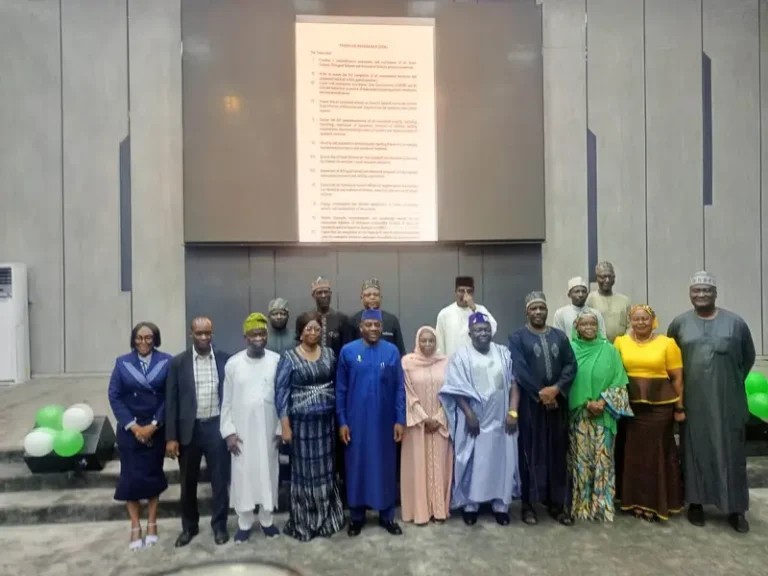
Federal Government has inaugurated a Ministerial Implementation and Monitoring Committee to ensure the full operationalisation of Universal Basic Education Commission,UBEC, Smart Schools, Bilingual Schools and Alternative Schools across the country.
Inaugurating the committee on Tuesday in Abuja, the Minister of Education, Dr. Maruf Olatunji Alausa, said its mandate was to transform completed school infrastructure into functional learning centres where children receive quality education.
He noted that although UBEC had invested significant public resources in the three school models, many projects remained incomplete, while several completed schools had yet to be handed over to state governments or opened for academic activities.
“Every day a completed school remains locked represents lost opportunities for thousands of Nigerian children. Every abandoned project represents resources not yielding their intended educational value,” the minister said.
Alausa explained that the Smart Schools were established to promote technology-driven learning, the Bilingual Schools to foster linguistic inclusion and national integration, while the Alternative Schools were designed to provide education for vulnerable children, girls, out-of-school children and other underserved groups.
He charged the committee to ensure the completion of outstanding construction works, provision of furniture and equipment, and installation of electricity, water supply and internet connectivity in the affected schools.
The minister also directed members to work closely with state governments and State Universal Basic Education Boards (SUBEBs) to facilitate teacher deployment, complete handover processes and ensure student enrolment.
“The success of this committee will not be measured by the number of meetings held or inspection reports produced. It will be measured by one question: How many schools have become operational and are educating Nigerian children?” he said.
According to him, the committee’s mandate spans the entire project cycle, from construction and handover to staffing, enrolment and measurable learning outcomes.
Alausa said the Federal Ministry of Education and UBEC would provide all necessary support to ensure the committee delivers on its assignment.
He assured Nigerians that no educational infrastructure funded with public resources would remain abandoned, idle or underutilised under the administration of President Bola Tinubu, describing the initiative as part of efforts to strengthen accountability under the Renewed Hope Agenda.
Earlier, the Executive Secretary of UBEC, Dr. Aisha Garba, said the three school models represent some of the Federal Government’s most significant investments in basic education aimed at expanding access, promoting digital learning and improving educational opportunities for vulnerable and out-of-school children.
Garba disclosed that 37 Smart Schools had been established nationwide, with 24 already operational, while the remaining schools were at various stages of completion, furnishing and readiness for commissioning.
She added that under the UBEC-Islamic Development Bank Bilingual Education Programme, 30 schools had been established across nine states. Three boarding schools have been completed and commissioned, while four others have reached substantial completion and are being prepared for commissioning.
According to her, significant progress has also been recorded in curriculum development, teacher training, textbook production and the procurement of ICT and Technical and Vocational Education and Training (TVET) equipment, alongside ongoing collaboration with states on staffing and sustainability.
Garba said the Alternative Schools Programme is expanding access to education for out-of-school children through flexible and inclusive learning models.

