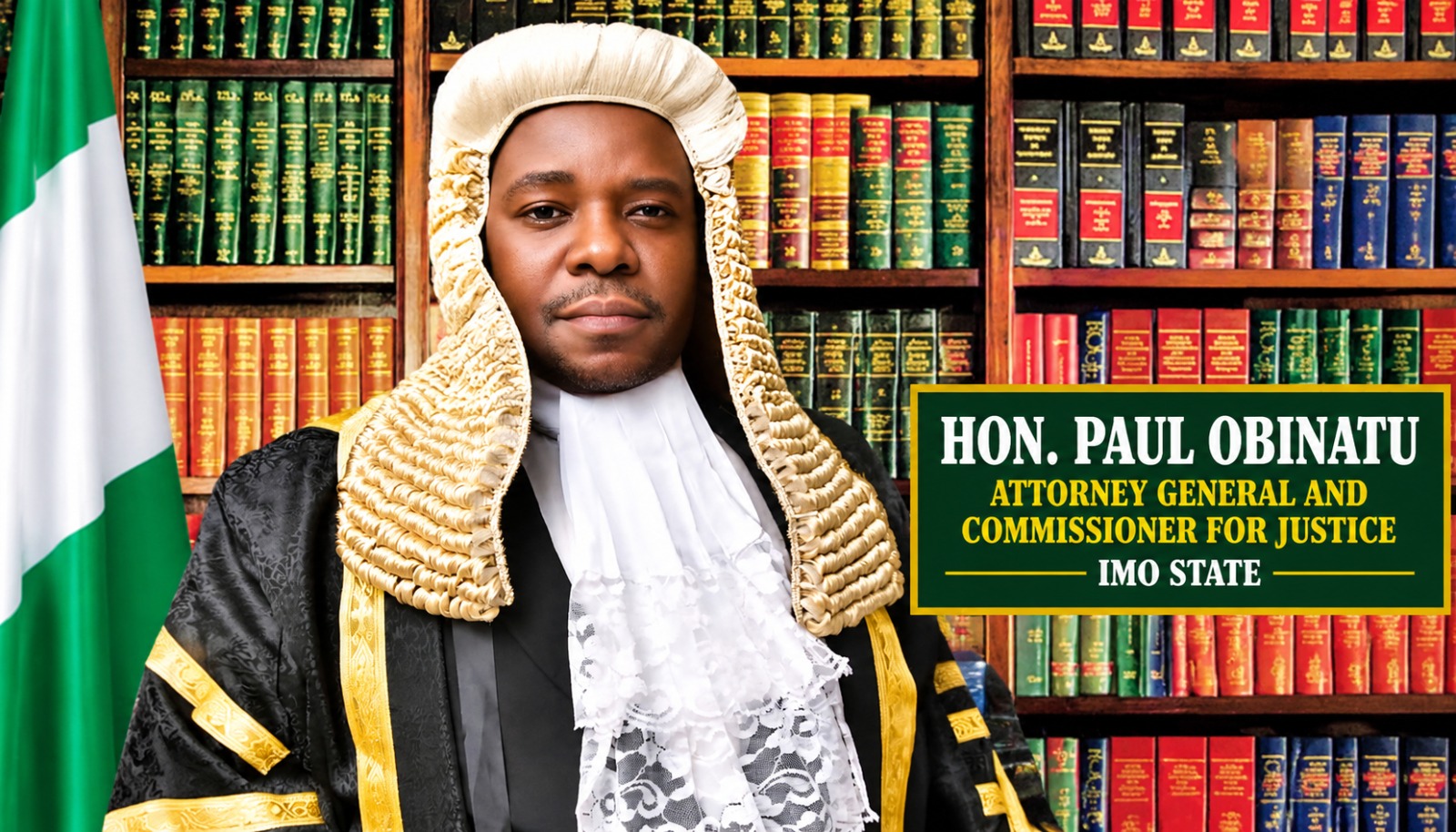

Imo Attorney-General argues that NJC directive may conflict with constitutional independence of State Judicial Service Commission
The Imo State Attorney-General and Commissioner for Justice, Hon. Paul Obinatu, has questioned the constitutional basis of a directive reportedly issued by the National Judicial Council (NJC) to the Imo State Judicial Service Commission (JSC) over the selection of a candidate for appointment as the state’s substantive Chief Judge.
Obinatu, in a statement dated November 6, 2026, argued that the directive could interfere with the constitutionally recognised independence of the State Judicial Service Commission, particularly its responsibility to assess and advise on suitable candidates for the judicial position.
The dispute reportedly followed a decision taken at the NJC’s 112th meeting on November 3, 2026, concerning the ongoing process for appointing a substantive Chief Judge of Imo State.
The Attorney-General maintained that although the NJC has the constitutional responsibility to recommend a candidate to the Governor, that power should not be interpreted as authority to dictate the candidate the State JSC must consider or submit.
Attorney-General cites constitutional safeguards
Central to Obinatu’s argument is Section 202 of the 1999 Constitution, as amended, which provides that a State Judicial Service Commission shall not be subject to the direction or control of any other authority or person in exercising its constitutional functions.
He argued that the provision protects the Commission’s independence and limits external interference in the discharge of its responsibilities.
According to him, any directive that requires the State JSC to submit a particular candidate, or predetermines the outcome of its assessment, could raise constitutional questions about the extent of the NJC’s authority.
Different constitutional responsibilities
The Attorney-General also referred to Section 271(1) and relevant provisions of the Third Schedule to the Constitution to support his position.
Paragraph 6(a) of Part II of the Third Schedule assigns the State Judicial Service Commission the responsibility of advising the NJC on suitable persons for nomination as Chief Judge.
Similarly, Paragraph 21(c) of Part I of the Third Schedule empowers the NJC to recommend a candidate to the Governor from among the persons submitted by the State Commission.
Section 271(1) provides that the Governor appoints the Chief Judge on the recommendation of the NJC, subject to confirmation by the State House of Assembly.
Obinatu argued that these provisions establish separate responsibilities for the State JSC, the NJC, the Governor and the State House of Assembly.
He maintained that the State Commission should be allowed to perform its assessment and advisory functions, while the NJC exercises its recommendation powers within the framework established by the Constitution.
NJC guidelines also questioned
On the NJC’s Guidelines and Procedural Rules for the Appointment of Judicial Officers, the Attorney-General acknowledged the Council’s role in prescribing procedures for judicial appointments.
However, he argued that administrative guidelines must operate within constitutional limits and should not be interpreted as granting the NJC powers beyond those expressly provided by law.
He maintained that the Council’s responsibility to supervise compliance with judicial appointment procedures should be exercised without undermining the constitutional functions of the State Commission.
Court decisions cited
In support of his position, Obinatu cited several judicial decisions which, according to him, address constitutional boundaries, judicial administration and the independence of public institutions.
The cases include Elelu-Habeeb & Anor. v. Attorney-General of the Federation & Ors. (2012) LPELR-15515(SC); Kano State Public Complaints and Anti-Corruption Commission & Anor. v. Salisu & Ors. (2019) LPELR-47107(CA); and Bamisile v. National Judicial Council & Ors. (2012) LPELR-8381(CA).
Others are FRN v. Nganjiwa (2022) LPELR-58066(SC); NJC & Ors. v. Senlong & Ors. (2010) LPELR-4582(CA); and Attorney-General of the Federation v. Attorney-General of Abia State & Ors. (2024) LPELR-62576(SC).
The Attorney-General argued that the decisions support the principle that constitutional institutions must exercise their powers within the limits prescribed by law.
Need for constitutional compliance
Obinatu said the disagreement should not be viewed as a contest for institutional supremacy between the NJC and the Imo State JSC, but as a question of respecting the responsibilities assigned to each institution by the Constitution.
He warned that any process perceived to undermine the independence of the State Commission could raise concerns about the integrity of the judicial appointment process.
He therefore called for the appointment of a substantive Chief Judge to follow the constitutional procedure, with each institution exercising its assigned responsibilities.
However, the NJC’s full position on the Attorney-General’s interpretation of its reported directive was not contained in the statement provided.
The constitutional question at the centre of the disagreement is the extent to which the NJC can regulate the appointment process while respecting the independence and statutory responsibilities of the State Judicial Service Commission.
Imo CJ Appointment: Attorney-General Questions NJC’s Authority Over State JSC