
By Olugbenga Salami
The National Assembly and relevant stakeholders, have urged Nigerian women to lead the crusade against drug abuse, saying the country cannot effectively tackle the menace without leveraging their role in families and communities.
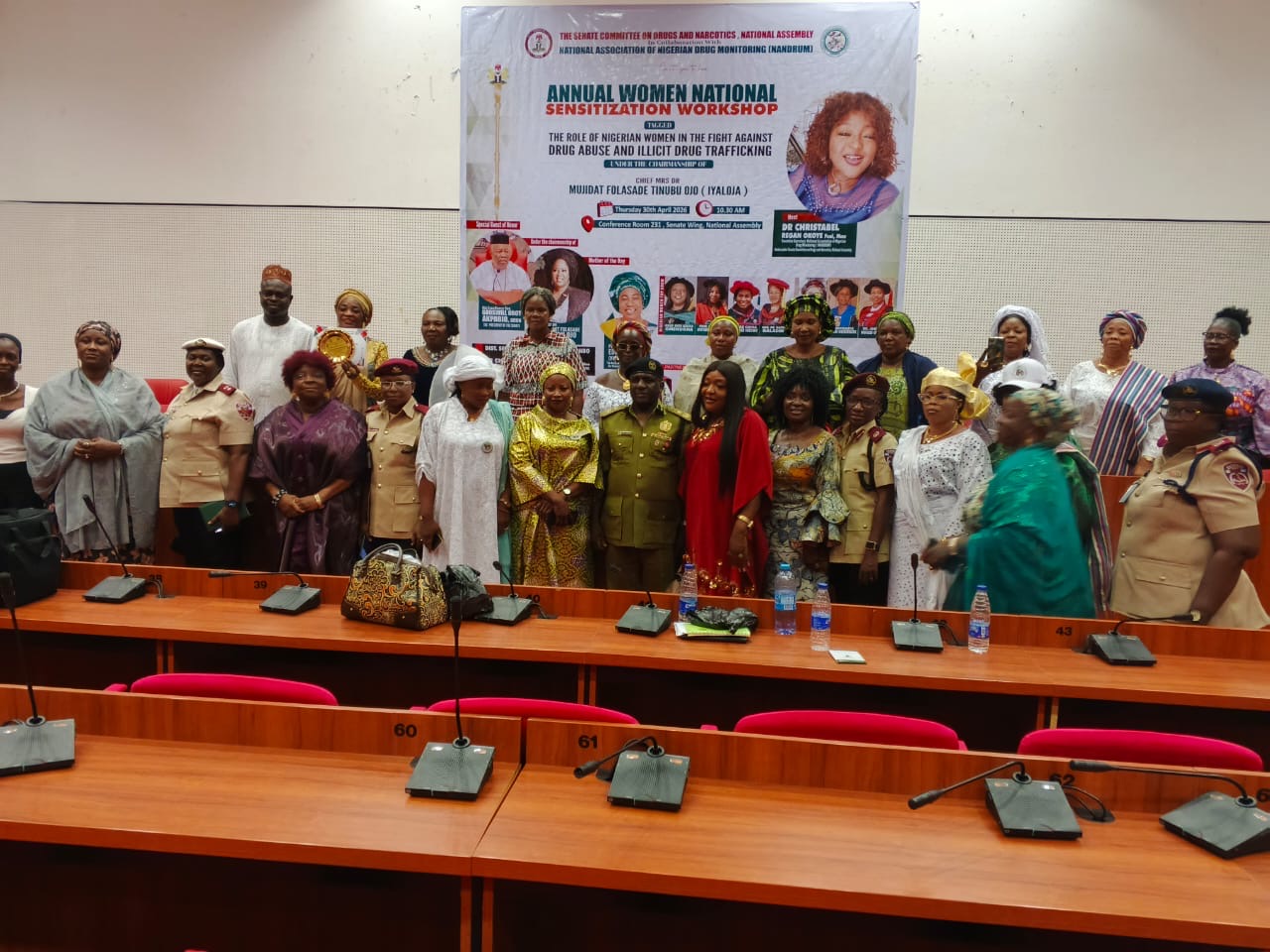
The call was made at a workshop themed: “Role of Nigerian Women in the Fight Against Drug Abuse and Illegal Drug Trafficking” held in Abuja, the Federal Capital Territory, FCT.
Chairman of the Senate Committee on Drugs and Narcotics, Senator Ibrahim Dankwambo (PDP Gombe South), represented by the Committee Clerk, Isah Garba, said a comprehensive, community‑driven approach was the sustainable solution, with women at the forefront of prevention efforts.
He noted that women, as custodians of the home and first educators of children, are uniquely positioned to detect early signs of drug use and instill values that protect young people from substance abuse.
“Beyond the home, women also play critical roles in civil society, healthcare, education, and governance, where they influence policy and drive advocacy. Empowering women with knowledge, resources, and platforms is not optional — it is necessary,” he said.
Dankwambo added that when women lead prevention efforts, challenge stigma, and support rehabilitation and reintegration, entire communities become stronger and more aware.
He said the Senate and the National Assembly are committed to supporting legislative frameworks that place women at the forefront of drug abuse prevention, control, treatment, and rehabilitation services.
“But legislation alone is not enough. We need grassroots action, cultural shifts, and sustained public awareness, and Nigerian women are central to all the mitigating measures.
“I, therefore, call on all women present here today to see yourselves not just as beneficiaries of this fight, but as leaders of it. Let us work together — government, civil society and communities — to build a Nigeria where our children are free from the grip of drugs,” he said.
Speaker of the House of Representatives, Tajudeen Abbas, represented by the Chairman, House Committee on Drugs and Narcotics, Abass Adigun, said the war on drug abuse cannot be won by law enforcement alone.
“It can only be won through prevention, education, family support systems, economic empowerment, and community resilience,” he said.
The Speaker assured that the House of Representatives remains fully committed to measures to mitigate drug abuse in Nigeria.
Abbas noted that the House had continued to support interventions in governance review and institutional accountability, and that the National Assembly had made significant efforts to ensure public funds are appropriated for the fight against drug abuse.
“We have ensured improved funding, legal backing and inter‑agency collaboration for institutions tackling trafficking syndicates, money laundering, organised crime and cross‑border smuggling. We continue to advocate greater participation in policymaking, community data use, school management systems, and security efforts,” he said.
He stressed that no fight against drug abuse could succeed without the active leadership of women in community development, social protection schemes, and social investment initiatives.
Earlier, convener of the workshop and Executive Secretary, National Association of Nigerian Drug Monitoring, Dr Christabel Okoye, said the presence of women associations reflects a shared national commitment to addressing drug abuse.
She described drug abuse as one of the most pressing social challenges confronting the nation, saying it continues to threaten public health, family stability, community safety, and national development.
“Women as mothers, caretakers, professionals and community influencers occupy a unique and strategic position in shaping values, guiding behaviors, and safeguarding the future of society,” Okoye said.
According to her, the workshop was designed to harness the strength of Nigerian women in promoting prevention, advocacy, early intervention, and community‑based solutions.
“Through collective engagement, we can amplify awareness, challenge harmful norms, and build resilience,” she said.
She encouraged participants to actively engage in discussions, contribute ideas, and explore practical strategies that can be implemented within their reach.
“Together, we can make a meaningful impact in reducing drug abuse and curbing illicit drug trafficking in Nigeria,” she added.
The workshop drew participants and representatives from the Nigeria Police Force, Federal Road Safety Commission, National Drug Law Enforcement Agency, academia, and civil society organisations working on drug abuse prevention, among others.

