
By Imam Mashood Dagbo, PhD
Islam is a religion founded on the preservation of human dignity, security, and public welfare. The objectives of the Sharī’ah (Maqāṣid al-Sharī’ah) seek to protect religion, life, intellect, lineage, and property. This makes the safety of society a collective responsibility, not the sole duty of government. Therefore, every believer is expected to contribute according to his or her ability to create an environment free from fear, danger, and hardship. Allah says: “Indeed, Allah commands justice, excellence, and giving to relatives, and forbids immorality, wrongdoing and oppression.” (Qur’an 16:90). Likewise, Allah says: “…and cooperate in righteousness and piety, but do not cooperate in sin and aggression.” (Qur’an 5:2). These verses establish that protecting people from harm and promoting public peace are essential expressions of faith.
Indeed, the Prophet (SAW) translated these Qur’anic teachings into practical conduct in his Ahadith by teaching that every beneficial deed performed sincerely for Allah carries immense reward. Eminent scholars have consistently explained that removing harm from public places is among the manifestations of preserving life and public interest (maṣlaḥah).
For instance, Imam al-Nawawi, while commenting on this narration, demonstrates the excellence of removing anything harmful from people’s paths. He notes that such acts, though apparently small, become great through sincerity (Sharḥ Ṣaḥīḥ Muslim, Vol. 13, p. 36).
Similarly, Ibn Hajar al-‘Asqalani explains that removing harm is one of the branches of faith because it protects people’s welfare and reflects genuine concern for the community (Fatḥ al-Bārī, Vol. 1, p. 500).
Also, Imam al-Ghazali emphasizes that serving creation for the sake of Allah is among the noblest acts of worship, since Allah loves those who bring benefit to His servants (Iḥyā’ ‘Ulūm al-Dīn, Vol. 2, pp. 315–316).
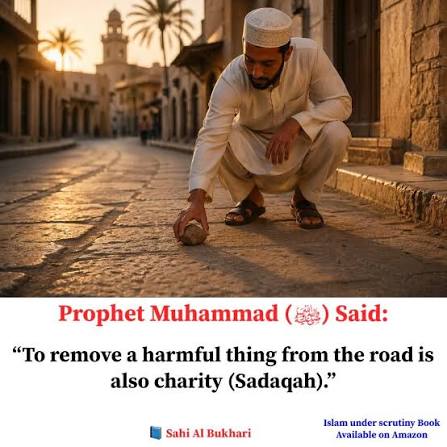
Linking this weekly piece to the Prophetic tradition, it is appropriate to recall the narration of Abu Hurayrah (RA). He reported that Allah’s Messenger (SAW) said he saw a man enjoying the bliss of Paradise because he cut down a tree that had been causing inconvenience to people on the road (Ṣaḥīḥ Muslim:1914d). This profound narration reminds believers that no sincere effort aimed at safeguarding society is insignificant before Allah. The Hadith is further clarified to deepen our understanding as follows:
1. Security for all: Islam aims at making life secure and harmless. Even a seemingly small act of kindness, like removing injurious things from the road, can become a cause of entering Paradise when done sincerely for the sake of Allah.
2. An act of charity: Removing harm from public places is considered an act of charity (Sadaqah).
3. Value of public welfare: Islam values public welfare and encourages every believer to contribute to the safety and comfort of society.
4. No deed is small: No righteous deed should be considered insignificant, for Allah rewards both great and small acts
5. Power of sincerity: Sincerity (Ikhlāṣ) gives immense value to ordinary actions.
6. Service as worship: Service to humanity is among the noble forms of worship.
7. Path to Paradise: Paradise may be attained through consistent good deeds coupled with Allah’s mercy.
8. Proactive responsibility: individuals and government should be proactive in solving community and citizens’ problems rather than waiting to escalate
9. Preventing harm first: Preventing harm is often given precedence over acquiring personal benefit, in accordance with the Islamic legal maxim.
Prayer:
O Allah, as we witness the fourth Jumu‘ah of Muharram 1448 AH, grant us security of lives and properties, forgive our sins, ease our hardships, guide our leaders to justice, alleviate poverty, and save us from bad governance. Protect Muslims in troubled lands, and restore Nigeria and the world from corruption, insecurity, hunger, banditry, kidnapping, war, and all social evils. Amin.
@Imam Yusuf Mashood Dagbo, PhD
Chief Imam, GGDSS Central Mosque, Okesuna, Ilorin, Kwara State & Director, YUMAD Consults specializing in consultancy services in education and culture, public presentation, counselling, column writing, etc.

