
By Lanre Oloyede
Nigerians have been urged to make quality, merit, integrity and adherence to standards central to their personal, professional and institutional activities to drive sustainable national development.
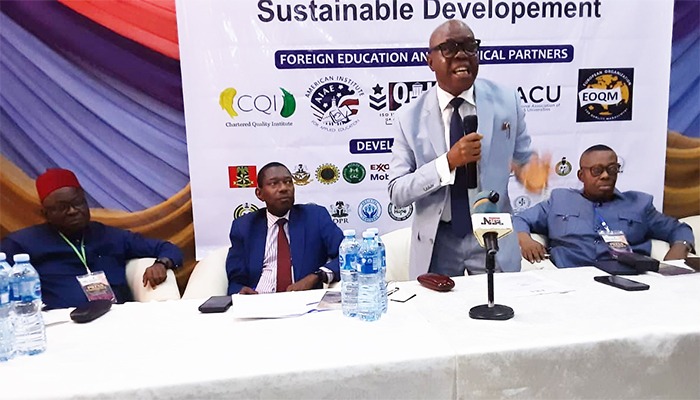
The call was made at an International Press Conference organised by the Institute of Quality Assurance of Nigeria (IQAN) in Abuja, with the theme, “The Vision of Quality for Nigeria: A Presidential Pathway for Sustainable Development.”
Delivering the keynote address, the Senior Special Assistant to the Senate President on Legal Matters, Dr. Monday Onyekachi, SAN, stressed the importance of promoting standards and merit in relationships and professional engagements.
Onyekachi said the culture of quality must extend beyond products and services to cover the way Nigerians conduct themselves and interact with one another.
The Chairman of IQAN, Prof. Victor Akpan, said the institute was established to deepen public understanding of quality assurance and make it applicable to all sectors of society.
According to him, quality assurance should not be viewed as an issue limited to corporate organisations but as a principle that should guide Nigerians’ dealings, conversations, behaviour and responsibilities.
Akpan said IQAN had continued to develop professional capacity through training and certification programmes in quality assurance and quality management.
He noted that the institute offers programmes ranging from basic certificates to advanced certificates, diplomas and higher degree programmes, while also collaborating with international quality organisations.
Also speaking, the President of the African University of Science and Technology (AUST), Abuja, and Pro-Chancellor and Chairman of Council of Chukwuemeka Odumegwu Ojukwu University, Anambra State, Prof. Azikiwe Peter Onwualu, called for a national commitment to excellence, integrity and innovation.
Onwualu said quality should be regarded as a culture rather than merely a process of inspection, accreditation or certification.
He explained that sustainable development would remain difficult to achieve if quality was not incorporated into Nigeria’s institutions, policies, systems and everyday practices.
According to him, Nigerians must create an environment where “quality is expected, excellence is pursued, integrity is valued, innovation is encouraged and sustainable development is achieved.”
The Chairman of the FCT Association of Nigerian Exporters, Godfrey Ajayi Sund, who represented the association’s Director-General, Prince Idiong Joseph, described quality as a critical factor in Nigeria’s ability to compete in international markets.
Sund linked poor standards to some of the challenges confronting the country, arguing that the fight against corruption should be accompanied by efforts to improve quality and accountability.
He urged Nigerians to take personal responsibility for their actions instead of blaming government for every societal problem.
Sund said Nigeria’s export sector in particular required stronger quality control, certification and testing infrastructure to enable local products to compete successfully abroad.
He identified high certification and laboratory testing costs, as well as inadequate testing facilities, as some of the challenges facing exporters.
He called for increased investment in laboratories and testing centres to support the export of agricultural, manufacturing and mineral products.
According to him, commodities such as yam, cassava, cocoa and sesame have significant export potential, but improved quality control and value addition are necessary to maximise their contribution to the economy.
Sund further called for a coordinated partnership involving government, regulators, standard-setting bodies, the private sector and development partners to make quality a shared national responsibility.
The stakeholders urged IQAN and other relevant institutions to strengthen public awareness, professional training and advocacy for improved standards, stressing that a culture of quality and merit would enhance Nigeria’s competitiveness and support long-term national development.

