…demands accountability over monies allocated to security, others
By Aaron Ossai
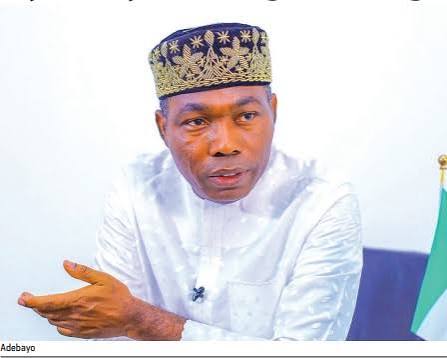
The presidential candidate of the Social Democratic Party (SDP), Prince Adewole Adebayo, has challenged President Bola Tinubu to a public debate, demanding accountability over trillions of naira allocated to security, energy and economic reforms.
Adebayo issued the challenge yesterday while unveiling his 2027–2031 policy blueprints, Farewell to Poverty and Insecurity: Governance and Accelerated Development, in which he outlined an ambitious programme to transform the Nigerian economy and improve living standards.
He questioned the government’s management of revenue saved from fuel subsidy removal and funds allocated to tackling insecurity and improving electricity supply.
“Where have you been in the past four years? What have you been doing? Where is the money? Where is the money you saved from subsidy? Where are the trillions for security? Where is the CNG? Where is electricity?” he asked.
Adebayo said Nigerians should not be asked to renew the mandate of any administration without examining its performance and determining whether it had delivered on its promises.
“Anyone who wants to keep his job should be able to answer his bosses,” he said, insisting that four years was sufficient time for a determined government to produce measurable results.
Central to Adebayo’s blueprint is a plan to increase Nigeria’s electricity generation capacity to 75,000 megawatts within four years, using the country’s available energy resources.
He also proposed the revival of four public refineries and the establishment of 36 modular refineries, alongside policies to encourage private-sector investment in refining and petroleum-product exports.
The SDP candidate argued that Nigeria’s continued dependence on imported refined petroleum products was exposing the economy to international price shocks and the effects of naira depreciation.
He said greater domestic refining capacity could substantially reduce the cost of petrol, projecting that pump prices could fall to about ₦200 per litre under an SDP administration.
On security, Adebayo pledged to defeat terrorism, banditry and other forms of violent crime within his first four years in office.
He argued that insecurity could not be addressed solely through military operations, saying unemployment, poverty, food insecurity, poor education and lack of economic opportunities were also contributing factors.
His blueprint therefore links security with economic development and improved access to basic necessities, including food, water, healthcare, housing, education, employment, transportation, energy and justice.
Adebayo described the document as a working policy framework rather than a conventional campaign manifesto.
He urged Nigerians, political opponents, professionals, economists and civil society organisations to scrutinise the proposals and offer suggestions for improvement.
“This policy has been given to Nigerians to start a conversation, not to end it,” he said.
He maintained that sound policies should not be rejected simply because they originated from an opposition party, arguing that any government capable of implementing workable ideas should adopt them for the benefit of Nigerians.
A major component of the blueprint is a proposal to make Chapter II of the 1999 Constitution a practical guide for governance.
Adebayo said the Fundamental Objectives and Directive Principles of State Policy should move beyond being largely aspirational provisions and become a framework for government planning, budgeting and performance measurement.
Under his proposed system, ministries, departments and agencies would be required to connect their major programmes to specific constitutional objectives and publish measurable results.
The blueprint also proposes stronger mechanisms for monitoring government spending and allowing citizens to track the implementation of public programmes.
Adebayo cited the achievements of former Lagos State governor, the late Lateef Jakande, particularly in education, housing and transportation, as evidence that governments can deliver significant development within a single term when leadership is focused.
He argued that Nigeria’s major challenge was not a lack of resources or capable citizens, but the failure to effectively organise and deploy those resources.
The SDP candidate consequently urged voters to make the 2027 election a contest based on ideas, competence and measurable performance rather than ethnicity, personality or political connections.
He warned that without political power to implement the proposals, the blueprint could remain “another piece of paper”.
“The only way it will cease to be just an idea or a piece of paper is for us to be in government,” he said.
Adebayo said the unveiling marked the beginning of a political movement focused on making Nigeria’s independence meaningful through effective governance, economic self-reliance and improved security.
“This is the beginning of a government that works. This is the beginning of us taking control of our country,” he declared.

