
By Michael Oche
The Resource Justice Network Nigeria has unveiled a new strategic direction aimed at ensuring that Nigeria’s natural resources are managed in a fair, inclusive and sustainable manner, while promoting economic development, social justice and environmental protection.
The move marks the group’s transition from the long-standing Publish What You Pay Nigeria to a broader platform focused on resource justice and environmental sustainability.
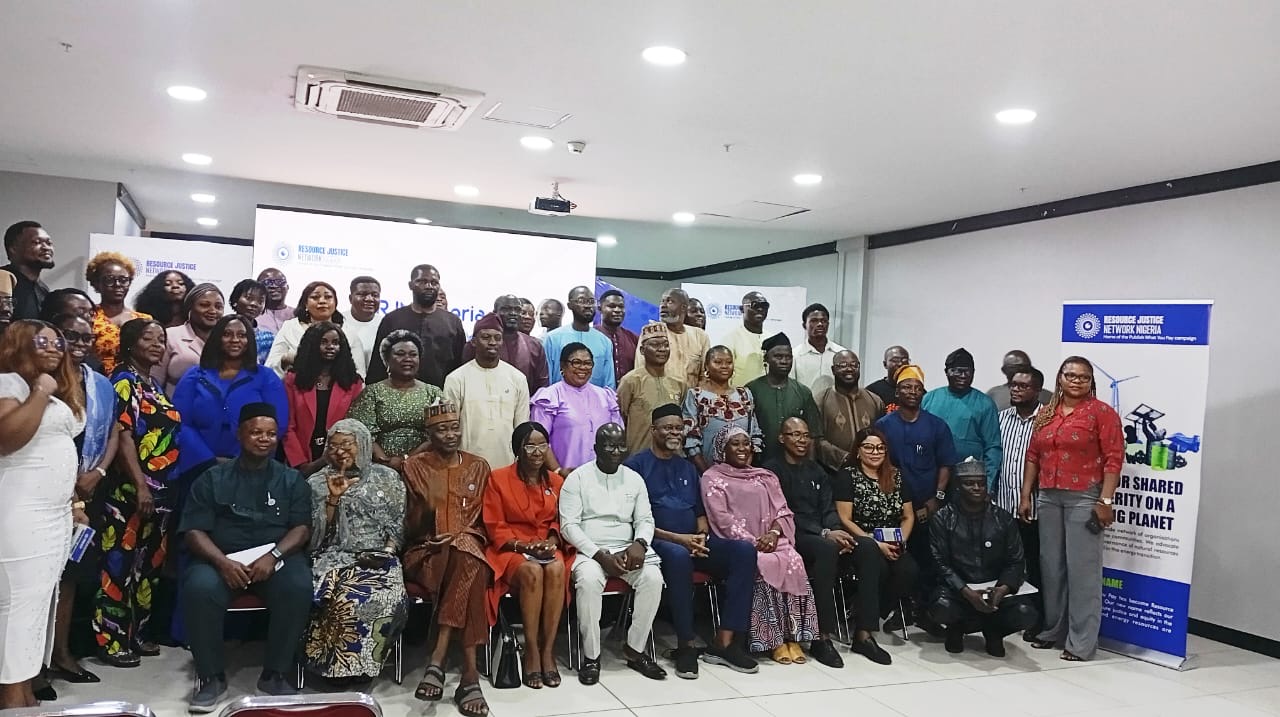
Speaking at the strategy launch and partners’ roundtable in Abuja, National Coordinator of RJN Nigeria, Erisa Danladi described the moment as both “an ending and a new beginning”.
This she said was after more than two decades of advocacy in Nigeria’s extractive sector.
According to her, we formally draw the curtains on over two decades of impactful work under Publish What You Pay Nigeria, and proudly begin a new chapter as Resource Justice Network Nigeria.
Danladi highlighted the coalition’s legacy under Publish What You Pay Nigeria, noting its role in advancing transparency and accountability across the oil, gas, and mining industries.
“For more than 20 years, under Publish What You Pay Nigeria, we worked tirelessly to promote transparency and accountability in Nigeria’s extractive sector”.
She said the group was instrumental in supporting the institutionalisation of the Nigeria Extractive Industries Transparency Initiative by addressing discrepancies in company payments and government revenues and advocating reforms that culminated in the Petroleum Industry Act (PIA).
The National Coordinator added that the coalition contributed to the recovery of millions of dollars in previously unaccounted funds and strengthened citizen participation in natural resource governance.
She said that under its new identity, RJN Nigeria would implement its Strategic Plan 2025–2028, aligned with a global Vision 2030 framework.
Danladi added that the organisation aims to adopt an ecosystem approach that goes beyond policy advocacy to building a broad-based movement for equitable and sustainable resource management.
She outlined key priorities for the network to include promoting accountability in both government and corporate institutions, strengthening protections for frontline activists and supporting community participation in decision-making.
In his remarks, Rev. David Ugor, Executive Director, Africa Network for Environment and Economic Justice (ANEEJ) called for a decisive shift from transparency-focused reforms to a broader resource justice framework.
This he said is as Nigeria seeks to address persistent inequalities in the management of its natural wealth.
Ugor spoke in his capacity as the founding National Coordinator of the Publish What You Pay Campaign in Nigeria.
He described the moment as both significant and reflective, noting that the Publish What You Pay campaign in Nigeria was built on the core principles of transparency, accountability and citizen participation in natural resource governance.
“We believed then, as we still do now, that Nigeria’s resource wealth, if properly managed, could serve as a foundation for sustainable development and shared prosperity,” he said.
In a goodwill message, Executive Director, Civil Society Legislative Advocacy Centre (CISLAC)
Awalu Rafsanjani, said that Nigeria was richly endowed with natural resources yet, the benefits of these resources have not translated into equitable development.
He said that resource justice was not only about how resources were extracted but was fundamentally about how they were governed and who benefits, and how decisions were made.
In a keynote address, Dr Otive Igbuzor, Founding Executive Director of the African Centre for Leadership, Strategy and Development Centre LSD said Nigeria’s energy transition must go beyond the argument of a technical shift from fossil fuels to renewable energy.
“Rather, it must be understood as a profound socio-economic and political transformation.
“At its core, it is a question of justice—resource justice, environmental justice, and social justice”.
Igbuzor called for commitment to building a future where our resources serve the many and not the few, where development is inclusive and sustainable, and where justice is at the heart of our energy transition.

