
By Aaron Ossai
Civil Society Organisations have called on the National Assembly to undertake a comprehensive review of policies, legislation and programmes affecting Nigerian children, expressing concern over the alleged growing influence of foreign interests in the country’s education and family-related policies.
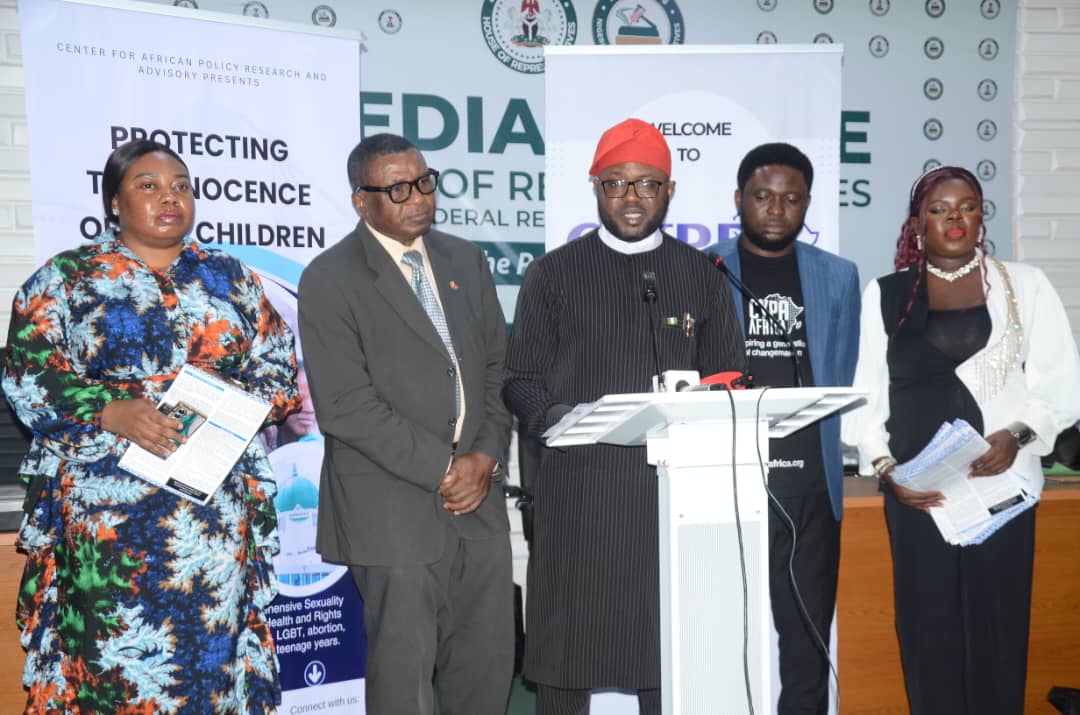
The groups, led by the Centre for African Policy Research and Advisory (CAFPRA), made the demand in Abuja during a media engagement on Children, Education, Family Values and Public Policy.
They urged lawmakers to examine not only individual bills but also the broader policy frameworks, funding arrangements, partnerships and educational materials underpinning programmes targeted at children and young people.
CAFPRA Executive Director, Dr. Segun Adebayo, said policies adopted in Nigeria must reflect the country’s social, cultural and institutional realities.
“We are dedicated to policies of the land, to be sure that the policies of government in Africa are consistent with the realities of Africa,” Adebayo said.
He expressed concern over the adoption of policy frameworks without adequate consultation with Nigerians, urging the National Assembly to provide opportunities for parents, educators, civil society groups, community leaders and child-rights advocates to participate in policy development.
The organisation called for closer scrutiny of international frameworks touching on children’s education, reproductive health, personal autonomy and gender, insisting that their relevance to Nigeria should be established before adoption.
It specifically urged policymakers to carefully examine terms such as “bodily autonomy”, “sexual rights” and “gender identity” when they appear in legislation, government policies or educational materials intended for children.
According to CAFPRA, the debate should focus on determining what is age-appropriate and consistent with Nigeria’s laws, culture and family structures rather than being reduced to ideological arguments.
Human rights lawyer and public affairs analyst, Sonnie Ekwowusi, said public opinion could play a decisive role in determining the fate of controversial policies and proposed legislation.
“Public opinion change is currently where they are going, because if public opinion does not change, it will never be passed as a law,” he said.
Ekwowusi said advocacy was increasingly extending beyond government institutions and legislative chambers to the wider public, whose support or opposition could influence the outcome of proposed laws.
CAFPRA disclosed that it had written to the Presidency and National Assembly leadership over its concerns and planned further engagements with relevant legislative committees.
Policy researcher and media personality, Gold Boms, said the organisation was reviewing proposed legislation and government policies to determine whether they were compatible with Nigeria’s social environment.
“We are making sure that all the bills being passed, we are looking at them and saying, look, this is not aligned with our social reality,” Boms said.
The groups also demanded greater transparency from government agencies and development partners involved in programmes affecting children, particularly regarding their objectives, sources of funding, partnerships, and content and implementation arrangements.
Chris Yama, a representative of CYFPRA, said the issue deserved wider public attention because of its implications for families and future generations.
“It is a very important conversation. It is on a topic that affects your children and your grandchildren. It is comprehensive sexuality education,” Yama said.
He called for greater participation by parents and communities in decisions concerning educational programmes designed for children.
A child-rights advocate with InnerCity Missions for Children, Jane Chukwu, said policies on child protection must also address the socio-economic conditions exposing millions of children to vulnerability.
She said her organisation’s work with children in difficult circumstances had demonstrated the need for practical interventions addressing poverty, family breakdown, limited access to education and inadequate child protection.
“We are a solution-based organisation. We don’t theorise about child protection. We believe it is every day; our team walks to the streets of Nigerian cities. We pick up children who already lost what today’s briefing is talking about,” Chukwu said.
She disclosed that the organisation was establishing a free school in Abuja for vulnerable children, alongside educational and vocational initiatives designed to help young people rebuild their lives.
CAFPRA also cited developments in countries such as Liberia and Zimbabwe, alleging that some programmes relating to education, reproductive health and family issues had received external support.
The organisation therefore urged Nigerian lawmakers to investigate the origins, funding sources, partnerships and implementation structures of similar programmes operating in the country.
As part of its advocacy campaign, CAFPRA said it planned to present an African Charter on Family Values and Sovereignty to the National Assembly.
Adebayo said the proposed charter would provide an additional framework for discussions on family values, national sovereignty and policies suited to African circumstances.
“We are going to bring that charter to our National Assembly,” he said.
The CSOs also called on the media to strengthen investigative reporting on policies and programmes affecting children, particularly by examining who develops funds and implements such initiatives.
They maintained that greater transparency and public participation were necessary to ensure that decisions concerning Nigerian children were subjected to rigorous scrutiny and reflected the country’s laws, cultural values and socio-economic realities.

