
By Itodo A. Itodo
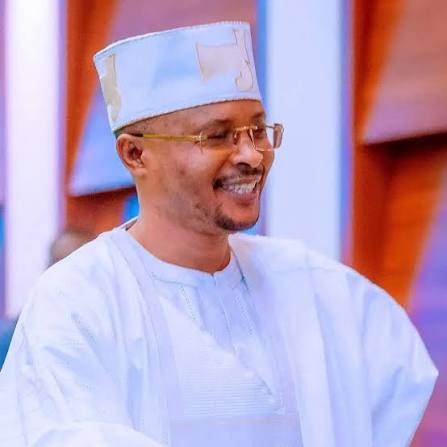
There are politicians who support a political candidate because circumstances demand it, and there are those whose loyalty survives changes in political platforms, calculations and alliances. Hon. Leke Joseph Abejide belongs to the latter category. For him, the support for President Bola Ahmed Tinubu is not merely another item on the political calendar. It is a conviction that has grown over time and, judging by the energy with which he has pursued it, appears to run deep in his political veins.
Abejide’s journey with the Tinubu project is particularly interesting because it did not begin from the comfort of belonging to the All Progressives Congress (APC). He was elected to the House of Representatives in 2019 on the platform of the African Democratic Congress (ADC), becoming the only member of the 9th National Assembly elected under that Party. Yet, while many would have considered party loyalty an insurmountable barrier, Abejide openly threw his weight behind Tinubu’s presidential ambition. His argument was that the Tinubu project, in his view, was bigger than party labels.
Long before Tinubu became President, Hon. Abejide had developed a strong admiration for the former Lagos State governor. He saw in Tinubu a political strategist whose greatest strength was not merely winning elections but identifying, nurturing and producing leaders. The relationship between Tinubu and his political protégés, particularly those who later rose to positions of influence, convinced Abejide that the Asiwaju phenomenon was about building people and institutions rather than simply pursuing personal power.
His connection to James Faleke, whom he regards as an elder brother, also strengthened that conviction. Abejide has repeatedly explained that Faleke’s political development under Tinubu gave him another window through which to appreciate the former Lagos governor’s leadership style. In his reasoning, anyone who had invested so much in the growth of someone he considered a brother had also indirectly influenced him. It was therefore hardly surprising that when the Tinubu presidential project gathered momentum, Abejide became one of its most vocal champions.
What makes Abejide’s loyalty even more remarkable is the extent to which he personally invested in the campaign. As National Coordinator and Convener of the Asiwaju Confluence Campaign Organisation, he has gone beyond speeches and media appearances. He has committed resources towards campaign structures across Kogi State, including vehicles for coordinators, buses for local government mobilisation and the establishment of a campaign office in Lokoja. These are not gestures of a politician merely trying to be noticed; they demonstrate the seriousness with which he is approaching the project.
When he was still a member of the ADC, Abejide’s support inevitably generated questions about party loyalty. How could an ADC lawmaker openly campaign for the presidential candidate of another party? His response was that Tinubu’s candidacy had assumed a national character that could not be confined to the APC. In his estimation, the presidential contest required a coalition wider than the machinery of one political party. He therefore saw his involvement not as betrayal, but as an effort to bring people across political boundaries together behind a candidate he believed could address Nigeria’s problems.
There is also a history behind Abejide’s departure from the APC. He had been an active member of the Party in Kogi and was part of the political struggle that produced a strong opposition challenge in the state. But, according to his account, internal disagreements and the sidelining of people who had laboured for the Party eventually pushed him and many supporters towards the ADC. His decision to operate under another platform, therefore, did not extinguish his admiration for Tinubu. If anything, it demonstrated that, for Abejide, political party and personal political conviction could exist on two different planes.
That conviction has continued into the present political season. Abejide has remained outspoken in his belief that Tinubu deserves another term to govern Nigeria. He points to the administration’s economic reforms, infrastructure programme and efforts in the security sector as reasons for his confidence. Whether one agrees entirely with his assessment or not, there is little doubt that he has chosen to defend the administration with unusual consistency.
His description of Tinubu as the kind of leader Nigeria needs has, at times, attracted controversy. Political support of this intensity naturally invites criticism, particularly in an environment where every presidential policy is fiercely contested. But Abejide has not appeared easily intimidated by the backlash. He has continued to make his case, arguing that difficult reforms should be judged not only by the discomfort they create in the present but also by the institutional and economic foundations they are capable of establishing for the future.
Perhaps the most revealing aspect of Abejide’s political commitment is that his Tinubu advocacy is intertwined with his understanding of public service. Before entering the National Assembly, he had built a reputation as a businessman and community benefactor. Through his foundation and personal initiatives, he has supported education, widows, young people, the elderly and community infrastructure. His interventions include assistance to students, support for schools, community security projects and employment opportunities. For him, politics appears to be an extension of a philosophy of service that predates his election to parliament.
That background also helps explain why he speaks about leadership in terms of its impact on ordinary people. Representing Yagba Federal Constituency, Abejide has established himself as a legislator whose constituency projects and interventions remain central to his public identity. His rise from private enterprise to parliament, followed by his emergence as a prominent voice in national politics, has given him a platform from which he now seeks to influence the wider political direction of the country.
The recent support shown to Tinubu by political coalitions outside the APC has further strengthened the argument Abejide has made for years, that support for the President is no longer necessarily limited to the membership register of the ruling Party. The recognition given to Abejide by the North Central Rainbow Network as its Grand Patron, alongside the group’s endorsement of Tinubu, reflect the growing effort by political actors and advocacy groups to build broader regional coalitions ahead of 2027. For Abejide, this is familiar territory. He has long argued that Tinubu’s appeal can travel beyond conventional party boundaries.
Ultimately, Leke Abejide’s story is one of political conviction that has refused to be imprisoned by party colours. From the ADC to his present association with the APC led political establishment, his support for Bola Ahmed Tinubu has remained remarkably visible and vigorous. His critics may question his judgment, his methods or even the policies he defends, but it would be difficult to question the depth of his commitment.
For Abejide, Asiwaju is more than a candidate, more than a party leader and more than a political ally. He represents a leadership possibility in which he has placed considerable faith. And if his past conduct is any indication, that faith is not something he intends to abandon easily.
Itodo wrote this piece from Makurdi, Benue State.

