
By Patrick Wemambu
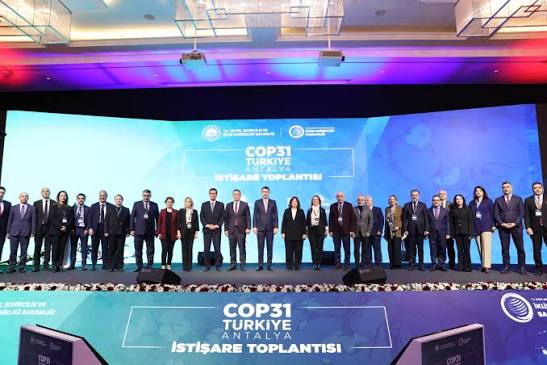
Global leaders, government delegates, scientists, businessmen and women, civil society organizations and the media from 197 countries with the European Union are currently in Antalya, Türkiye attending the 31st Annual Meeting of the Conference of the Parties (COP31) to the UN Framework Convention on Climate Change (UNFCCC).
Hosted by Türkiye which registered the largest delegation of 2,950 attendees (with Murat Kurum as COP31 President) and Australia serving as the President of Negotiations – Brazil and Nigeria have 1,506 delegates each while China and Indonesia bring up the rear. The meeting has 10 core thematic areas. First is cutting methane emissions from waste, scaling up circular economy policies, and reducing food loss.
Second is protecting coastal and marine ecosystems, integrating ocean-based solutions, and expanding blue carbon initiatives. Third is transforming agricultural systems and addressing water scarcity and drought. Fourth is promoting resilient urban infrastructure, green building standards, and sustainable risk insurance.
Fifth is building bankable, investable project pools and strengthening climate finance structures. Sixth is boosting climate literacy, mobilizing young people, and creating green jobs. Seventh is supporting low-carbon industrial pathways that balance economic competitiveness with a just transition.
Eighth is accelerating electrification, grid optimization, sustainable cooling, and clean cooking access. Ninth is aligning climate action with biodiversity protection and carbon sink preservation across UN environmental conventions. Tenth is building climate-resilient health infrastructure, improving early warning systems, and protecting public health from air pollution.
Delivering his speech at what may be his final attendance at the COP meetings as UN Secretary-General, Antonio Guterres, said for nearly ten years he had tried to speak the truth about climate change. Sometimes that truth had been uncomfortable, unwelcome, he noted.
“Facts are facts. And the fact is climate change does not stay in its lane. It drives hunger and displacement around the world. It wipes out development gains built over decades. It pushes countries deeper into debt. It aggravates competition for land and water. It fuels instability. And, increasingly, it threatens the very existence of communities and countries.
“Climate action is central to every aspect of the work of the United Nations. You cannot build peace on a burning planet. You cannot eradicate poverty when climate disasters keep throwing people back into it.,” Guterres declared.
Lamenting that fossil fuels are driving the climate crisis, as its dependence leaves countries exposed to price shocks, geopolitical turmoil and instability – the diplomatic envoy told the gathering that there was no credible path to a safe climate without moving away from hydrocarbon deposits.
His bombshell: “And the science has delivered another hard truth that makes all this even more imperative. An overshoot of 1.5 degrees is now inevitable. And our responsibility is to keep it as small as possible, for as short a time as possible, and bring temperatures back below 1.5 degrees as quickly as we can. But that requires immediate and drastic emissions cuts, on the order of 6 per cent every year over the next few years.
“But on the basis of current commitments of national determined contributions, the countries’ climate plans, we are heading for an overshoot as far as the eye can see – with temperatures above 2.5 degrees by the end of the century. And that is a recipe for catastrophe. Even a limited, temporary overshoot will intensify the devastating impacts we are already seeing.”
Beautiful speech. An ominous warning. Yet, is anyone out there listening? This is déjà vu all over again. How so? Because the COP meetings are held annually to assess global climate progress. Parties negotiate rules, set targets to cut greenhouse effects. Climate impacts are supposed to be addressed. Not so. Instead, these meetings have turned into traditional rituals akin to jamborees.
Developed nations who bear the major historical responsibility for fossil fuel emissions attend to make commitments but fail to deliver pledged finances. These are required to assist developing nations mitigate consequences of anthropogenic pollutants.
Which was why previous COPs have not succeeded in turning climate commitments into real projects. For instance, COP30 in Belém, Brazil, fell short of delivering binding and urgent climate actions due to deep geopolitical divides, strong opposition from fossil-fuel-producing nations, missing major emitters, and inadequate financial commitments from wealthy countries.
The final global package omitted any explicit mention, binding roadmap, or target to phase out oil, gas, and coal. Resistance from oil-dependent states and OPEC members – led by Saudi Arabia and Russia – blocked the proposals backed by over 80 countries and the European Union.
As regards geopolitical vacuums, the United States sent no official national delegation (relying instead on subnational and local representatives), and major leaders like China’s president did not attend. This left a leadership vacuum that stalled consensus-driven negotiations.
Delayed and insufficient climate finance for the umpteenth time reared its ugly face here. Wealthy nations resisted binding financial targets. The goal to triple adaptation funding was pushed back to 2035 instead of the critical 2030 deadline, falling far short of the estimated $300 billion per year needed by developing and vulnerable nations.
Talking about weakened implementation, because UN climate talks operate by consensus, individual countries wield veto power. Major emitters and fossil-fuel-producing states weakened the Global Mutirão text into a re-statement of past pledges rather than enforceable mandates.
Civil society groups and indigenous delegates further reported heavy marginalization, noting that industry lobbyists heavily outnumbered frontline and indigenous representatives inside the main negotiating spaces.
Enough of the lamentations. Time to chart the way forward. What preventive measures exist to guide against past failures of the Annual Meeting of the Conference of the Parties (COPs) to the UN Framework Convention on Climate Change (UNFCCC)?
Are there strategic and process-oriented terms capable of eliciting agreement from all participating nations with a view to balancing diverse economic and regional interests? Towards consensus-based negotiations and binding agreements, how do we move from dialogue to actionable actions at COP 31?
For starters, nations at COP31 in Antalya, Türkiye can move from dialogue to concrete actionable actions by combining binding accountability mechanisms, targeted sectoral targets, and innovative climate finance.
Next, commitments must be tied to explicit delivery tools, measurable results, and transparent tracking so responsibility for progress or failure can be clearly identified. Subsequently, practical implementation through tangible targets, such as increasing the share of electricity in global final energy consumption to 35% should be driven.
After that, specific action agenda goals ought to be advanced, including cutting the increase in waste generation by 50% alongside targeted methane and emissions reductions.
Then, COP31 would do well to mobilize capital through instruments like debt-for-climate swaps, green and blue bonds, and blended finance. This might be backed by stronger project preparation to turn pledges into investment-ready local programs.
Afterwards, the need to implement social and employment roadmaps – such as national just transition strategies – cannot be overstressed. This is even if it is to protect workers, build green skills, and support affected communities during economic shifts.
Corollary to that is the imperative for connecting formal UNFCCC state decisions (Blue Zone) with voluntary initiatives from cities, businesses, and civil society (Green Zone and Nazca portal). This should enable embedding climate goals into everyday industry and urban systems.

