
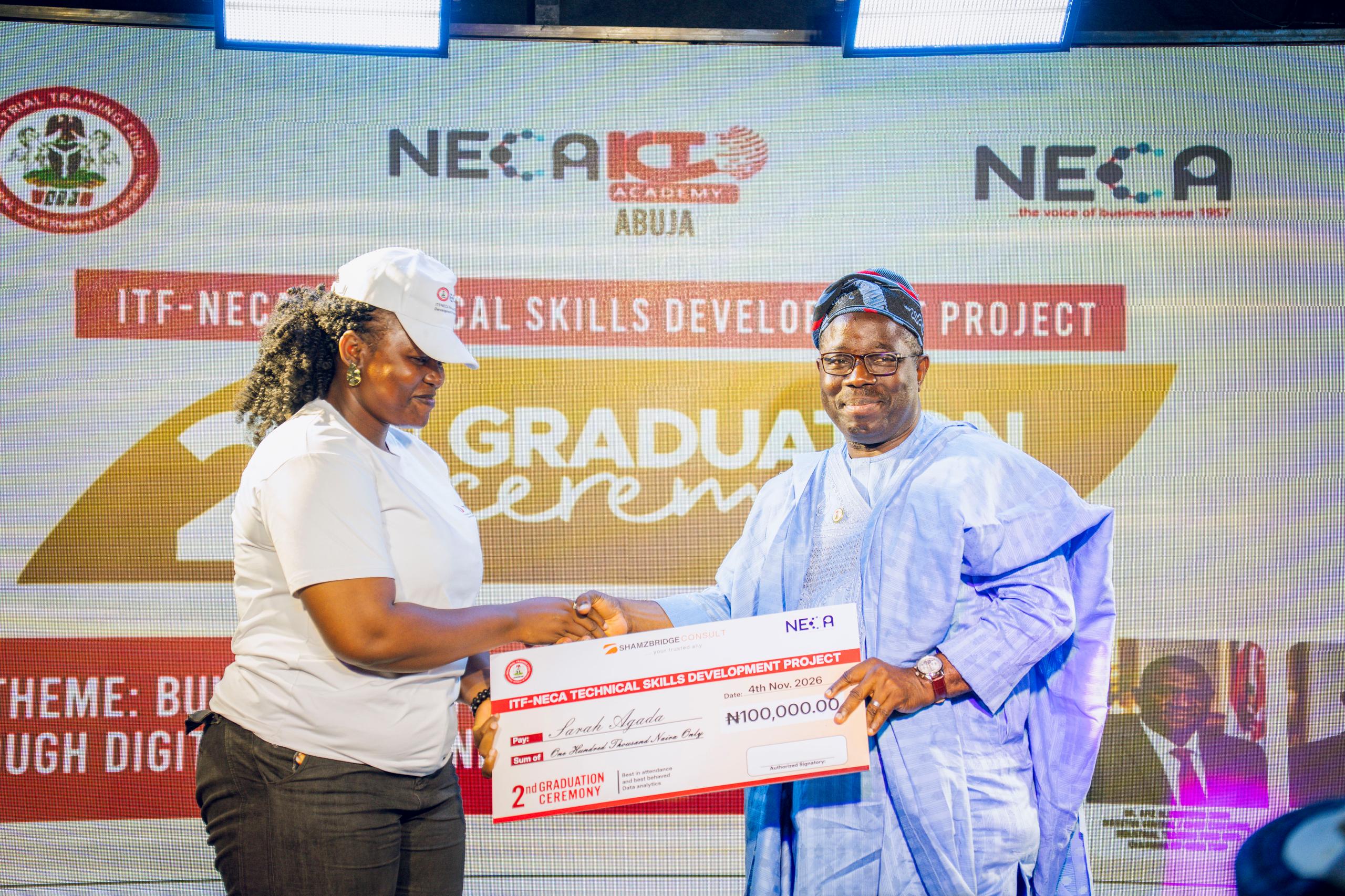
* graduates over 100 tech talents
Nigeria Employers’ Consultative Association (NECA) on Thursday called for stronger collaboration between government, employers and training institutions to equip young Nigerians with digital skills and connect them to employment and entrepreneurship opportunities in the changing world of work.
The association said its ICT Academy, established in 2020, had empowered more than 100 young people with specialised technology skills, including Artificial Intelligence (AI), Data Analysis, Python Programming, Cybersecurity and 3D Animation.
The Director-General of NECA, Mr Adewale-Smart Oyerinde, made this known at the graduation ceremony of the second cohort of the Technical Skill Development Project (TSDP) of the NECA ICT Academy in Abuja.
Oyerinde noted that the academy was established out of the conviction that every young Nigerian should have access to self-sustaining opportunities in technology, adding that its training model combined technical knowledge with mentorship and personal development.
He said: “Our model goes beyond training; it is a transformative journey of knowledge, mentorship, and personal growth,” he said.
The NECA DG urged the graduates to deploy their skills responsibly, demonstrate excellence and become worthy ambassadors of the academy, stressing that technological advancement must translate into practical solutions that improve lives.
“Remember, the future belongs to those who not only embrace technology but use it to make a difference. Go forth, lead with integrity, and illuminate your world.”
The Director-General urged the graduands to explore entrepreneurship and use their newly acquired competencies to address challenges in their communities.
“Do not limit yourselves to seeking employment alone. Look for problems within your communities, industries and society that technology can help solve. Develop solutions, collaborate with others and explore entrepreneurship as a pathway to creating value and generating employment,” he advised
Delivering the keynote address, the Director-General of NITDA, Kashifu Abdullahi, said the changing nature of work required Nigeria to move beyond training people to use technology to developing a workforce capable of creating and adapting technologies to local needs.
Abdullahi, whose address was titled “Building a Future-Ready Workforce Through Digital Skills and Emerging Technologies,” said Artificial Intelligence, automation, cloud computing and data science were fundamentally changing the global labour market.
He warned that Nigeria’s ability to compete globally would depend on the quality of its human capital and the capacity of its workforce to adapt to emerging technologies.
Citing the World Economic Forum’s Future of Jobs Report 2025, he said global structural changes were expected to create 170 million jobs and displace 92 million existing ones by 2030, representing a net increase of 78 million jobs.
He added that 39 per cent of workers’ existing skills were expected to change within the period.
Abdullahi said the Federal Government’s Three Million Technical Talent (3MTT) programme, implemented by the Federal Ministry of Communications, Innovation and Digital Economy, had trained more than 160,000 fellows across three cohorts in areas including Artificial Intelligence and Machine Learning, Data Science, Software Development, Cloud Computing and Cybersecurity.
He also disclosed that Nigeria was targeting 70 per cent digital literacy by 2027 and 95 per cent by 2030 through NITDA’s Digital Literacy for All initiative.
According to him, the National Digital Literacy Dashboard had recorded more than 2.78 million verified digital literacy achievements through contributions from federal and state governments, development partners, civil society organisations and private training providers.
The NITDA boss further highlighted the agency’s efforts to strengthen indigenous technological capacity through the National Centre for Artificial Intelligence and Robotics and the development of N-ATLAS, Nigeria’s open-source multilingual and multimodal large language model designed to reflect local languages, including Yoruba, Hausa, Igbo and Nigerian-accented English.
He said Nigeria must develop young people who could build and manage emerging technologies rather than remain consumers of solutions developed elsewhere.
“Our ambition must go beyond producing workers who can simply operate AI tools. We must develop a generation of Nigerians who can build, manage and innovate with these technologies.
“The responsibility for building a future-ready workforce cannot rest with government or training institutions alone. Employers must actively participate in identifying emerging skills requirements, supporting industry-relevant training, providing internship and apprenticeship opportunities, and creating pathways through which trained individuals can transition into productive employment,” he said.
Also speaking, the Permanent Secretary, Federal Ministry of Labour and Employment, Kamil Shoretire, said the graduates must embrace continuous learning, practical problem-solving and professional integrity to remain relevant in the evolving labour market.
“Skills are a beginning, not a destination. The technology you learned in this programme will change. Some tools you use today will be replaced within a few years. What will last is your ability to learn, to unlearn, and to learn again.”
Shoretire cautioned that employers were increasingly interested in the ability of workers to deliver solutions rather than merely present academic or professional qualifications.
“Employers do not hire certificates alone. They hire people who can take a messy problem, break it down, and deliver a solution that works for ordinary people.
“In the digital economy, trust is everything. Protect the data entrusted to you. Be honest about what you can and cannot do. Give credit to others. Over time, a reputation for reliability will open more doors than any qualification.”

