
By Palma Ileye
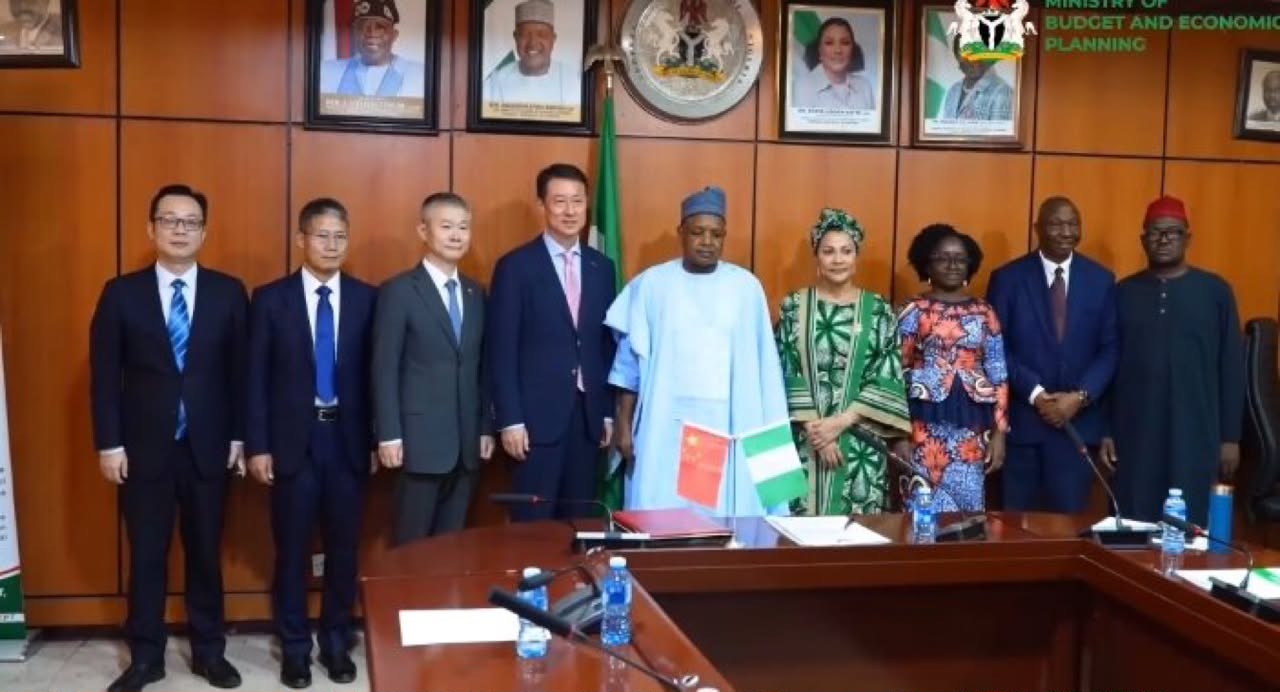
Nigeria and China have signed a grant agreement worth RMB 200 million, equivalent to about $30 million, to finance community-focused development projects aimed at improving livelihoods and addressing grassroots needs across the country.
The agreement was signed at the Ministry of Budget and Economic Planning in Abuja as part of efforts to strengthen bilateral relations and support Nigeria’s development priorities.
Speaking at the ceremony, the Minister of Budget and Economic Planning, Senator Abubakar Atiku Bagudu, described the partnership as an important platform for development cooperation, knowledge exchange and mutual understanding between the two countries.
Bagudu said the grant would support mutually agreed projects under China’s Small but Beautiful initiative, which focuses on practical, community-level investments capable of delivering tangible benefits to citizens.
He disclosed that the Ministry, in collaboration with the Nigeria–China Strategic Partnership Office, had been developing proposals submitted by states to address specific development needs at the grassroots.
The Minister also highlighted Nigeria’s Renewed Hope Ward Development Plan, which seeks to identify economic opportunities and map economically active people across the country’s 8,809 wards to promote inclusive and targeted development.
According to him, Nigeria is interested in learning from China’s experience in poverty reduction and economic development to expand opportunities, tackle poverty and improve citizens’ livelihoods.
Bagudu further stressed the need for capacity building, including training Nigerian officials in China, noting that knowledge exchange and institutional development were essential to strengthening the country’s ability to implement its development priorities.
He thanked the Chinese Ambassador to Nigeria, Yu Dunhai, and his delegation for their continued support, adding that the grant builds on previous Chinese assistance, including a $1 million contribution earlier in 2026 to strengthen Nigeria’s technological and knowledge development capacity.
In his remarks, Dunhai described the agreement as a demonstration of China’s commitment to Nigeria’s development priorities and the strategic partnership between both countries.
He said the agreement was in line with the consensus reached by President Bola Ahmed Tinubu and Chinese President Xi Jinping during their meeting in China, as well as the outcomes of the Fourth China–Nigeria Cooperation Forum in Beijing.
The Ambassador noted that 2026 marks 55 years of diplomatic relations between Nigeria and China, with both countries sustaining cooperation across various sectors over the decades.
On trade, Dunhai said bilateral trade reportedly reached $18 billion in the first half of 2026, while Nigeria’s exports to China increased by 80 per cent following the implementation of China’s zero-tariff policy on Nigerian exports on May 1, 2026.
He said the policy presents opportunities to expand market access for Nigerian businesses, attract investments, promote industrial development and encourage the export of value-added Nigerian products.
However, the Ambassador noted that the current zero-tariff arrangement would expire on May 1, 2028, urging both countries to use the remaining period to negotiate an economic development partnership agreement that would consolidate existing gains and provide a sustainable framework for trade cooperation.
He called on the Ministry of Budget and Economic Planning to work with the Federal Ministry of Industry, Trade and Investment to advance discussions on the proposed agreement.
Earlier, the Permanent Secretary of the ministry, Dr. Deborah Odoh, expressed appreciation to the Chinese government for its continued support, describing the grant as a demonstration of confidence in Nigeria’s development priorities.
Odoh also commended the ministers, the Chinese Embassy and relevant ministries, departments and agencies, particularly the International Cooperation and Legal Departments, for their contributions to the successful conclusion of the agreement.
The Ministry reaffirmed its commitment to working with Chinese partners and relevant institutions to ensure transparent and efficient implementation of the projects in line with the agreed objectives.
The agreement is expected to strengthen development cooperation between the two countries, with emphasis on community-level initiatives and practical outcomes for Nigerians.

