
By Eunice Orike
The League of Women Voters of Nigeria NILOWV, has called on political parties to set measurable targets for women candidates and remove nomination barriers limiting women’s participation in elective positions ahead of the 2027 general elections.
The organisation also urged the government to implement the 35 per cent benchmark for women in appointive positions, saying more deliberate action was needed to translate commitments to gender inclusion into concrete results.
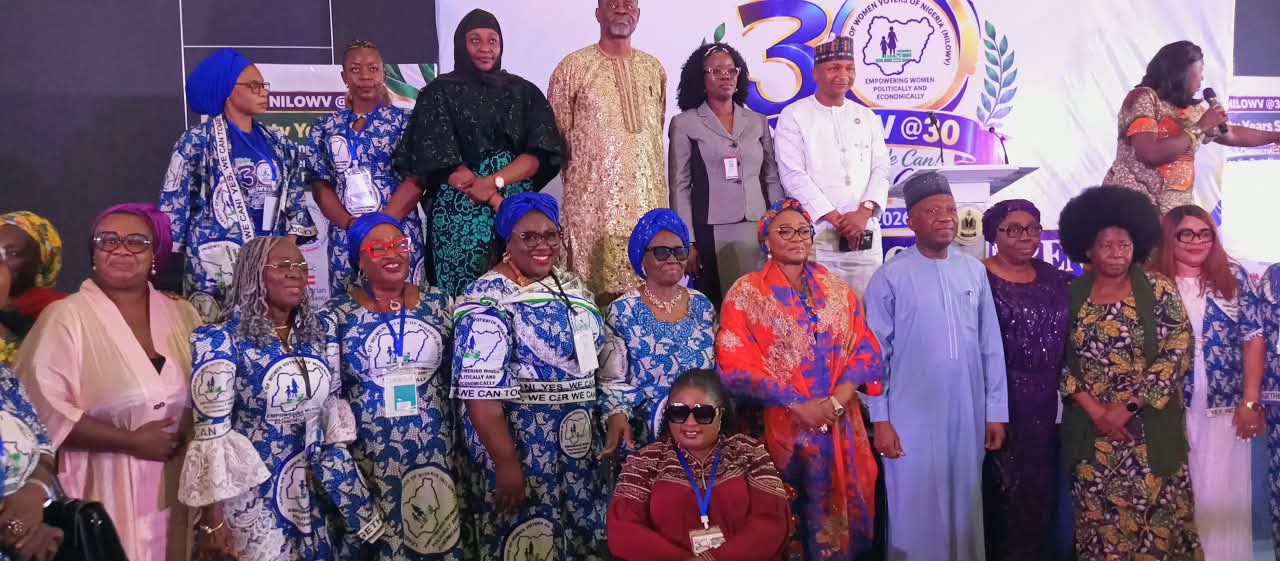
The founder and Chairperson of NILOWV’s Board of Trustees, Dame Esther Uduehi, made the call on Tuesday at the organisation’s all-women conference in Abuja, held to mark its 30th anniversary.
Uduehi said Nigeria had made progress in several areas of women’s development, but their representation in legislative institutions remained low despite their contributions to national development.
“Figures from the 10th National Assembly show that only four of the 109 senators and 16 of the 360 members of the House of Representatives are women,” she said.
She said the figures showed the need for reforms that would provide women with a fairer opportunity to participate in governance and decision-making.
Uduehi identified high nomination fees, exclusionary party processes and intimidation as some of the obstacles confronting women seeking elective office.
She urged political parties to adopt measurable targets for women’s nominations and called for investment in leadership development to prepare more women for political responsibilities.
The NILOWV founder also identified advocacy for the proposed Special Seats Bill for Women as one of the organisation’s major priorities.
The proposed constitutional reform seeks to create additional legislative seats for women to address their underrepresentation in the National Assembly and state Houses of Assembly.
Uduehi said the proposal was not intended to suggest that women could not win elections, but to address structural barriers that had kept their representation unequal.
“The Special Seats proposal is not a rejection of women’s ability to win elections, it is a call to address structural barriers that have kept representation unequal,” she said.
She called on the National Assembly, State Houses of Assembly, political parties and other relevant institutions to support reforms that would expand women’s access to leadership.
According to her, the passage of the bill would be an important milestone but must be accompanied by leadership training, access to resources and a political environment in which women could serve effectively.
Uduehi also called for stronger government support for women’s development, including adequate funding for relevant institutions and practical measures to improve women’s access to education, finance, employment and leadership opportunities.
“ We have made progress, but meaningful and equitable inclusion remains unfinished business,” she said.
In her remarks, the National President of NILOWV, Irene Awunah-Ikyegh, called on members and other women’s organisations to move beyond anniversary celebrations and renew their commitment to grassroots mobilisation and political participation.
“As we mark 30 years, I invite us all to move from celebration to renewed commitment,” she said.
Awunah-Ikyegh urged the organisation to invest in political education, leadership development and mentorship, while engaging political parties early enough to influence their decisions on candidates and leadership.
“Let us engage political parties early, When I read early, I mean tomorrow morning,” she said.
She also stressed the importance of documenting the experiences and achievements of women’s organisations, warning that stories not recorded risked being forgotten.
“Let us document our stories,stories that are undocumented will be forgotten,” she said.
Looking ahead to the 2027 general elections, Awunah-Ikyegh said women needed to organise themselves to turn their numerical strength into meaningful representation.
“The influence is huge and we need meaningful representation to match our numbers,” she said.
She urged women to organise their votes and strengthen their collective voices, adding that the movement should aim to influence decisions rather than merely seek recognition.
“Not merely to demand a place at the table, but to shape the decision that determines our collective future,” she said.
Awunah-Ikyegh pledged to build on the foundation laid by the organisation’s founder and maintain strong connections with grassroots communities, which she described as the source of the movement’s strength and democratic influence.
Also speaking, the Minister of Women Affairs and Social Development, Hajiya Imaan Sulaiman-Ibrahim, urged NILOWV to intensify efforts to mobilise women and encourage them to participate actively in the democratic process.
She called on the organisation to reach women in markets, village squares, worship centres and polling units to educate them about their political rights and responsibilities.
“Do not merely sit at the table and wait for opportunities to reach you, go into the trenches, into every market, every village square, every worship center, and every polling unit to enlighten, organize, and mobilize Nigerian women to own their political power,” the minister said.
Sulaiman-Ibrahim said the collective strength of women could help advance equity, integrity and good governance if they worked together across ethnic, religious and generational lines.
She also highlighted the Federal Government’s nine-pillar framework under the Ministry of Women Affairs and Social Development, anchored by the Renewed Hope Social Impact Intervention, RH-SII 774.
According to her, the initiative is designed to reach 50 million women, children and vulnerable citizens, while targeting the economic empowerment of more than 10 million women over five years.
She said programmes such as Women Agro-Value Expansion, WAVE, and PowerHer were part of efforts to expand economic and digital opportunities for women.
The minister added that government institutions could not achieve the desired progress without partnerships with organisations such as NILOWV.
“The Federal Ministry of Women Affairs and Social Development cannot walk this road alone,” she said, expressing confidence that collaboration with women’s organisations would help advance the country’s development.
She formally declared the conference open and urged participants to use the anniversary to strengthen their commitment to women’s leadership and participation in national development.
The conference marked three decades of NILOWV’s advocacy for women’s empowerment, leadership and democratic participation in Nigeria.

