
By Michael Oche
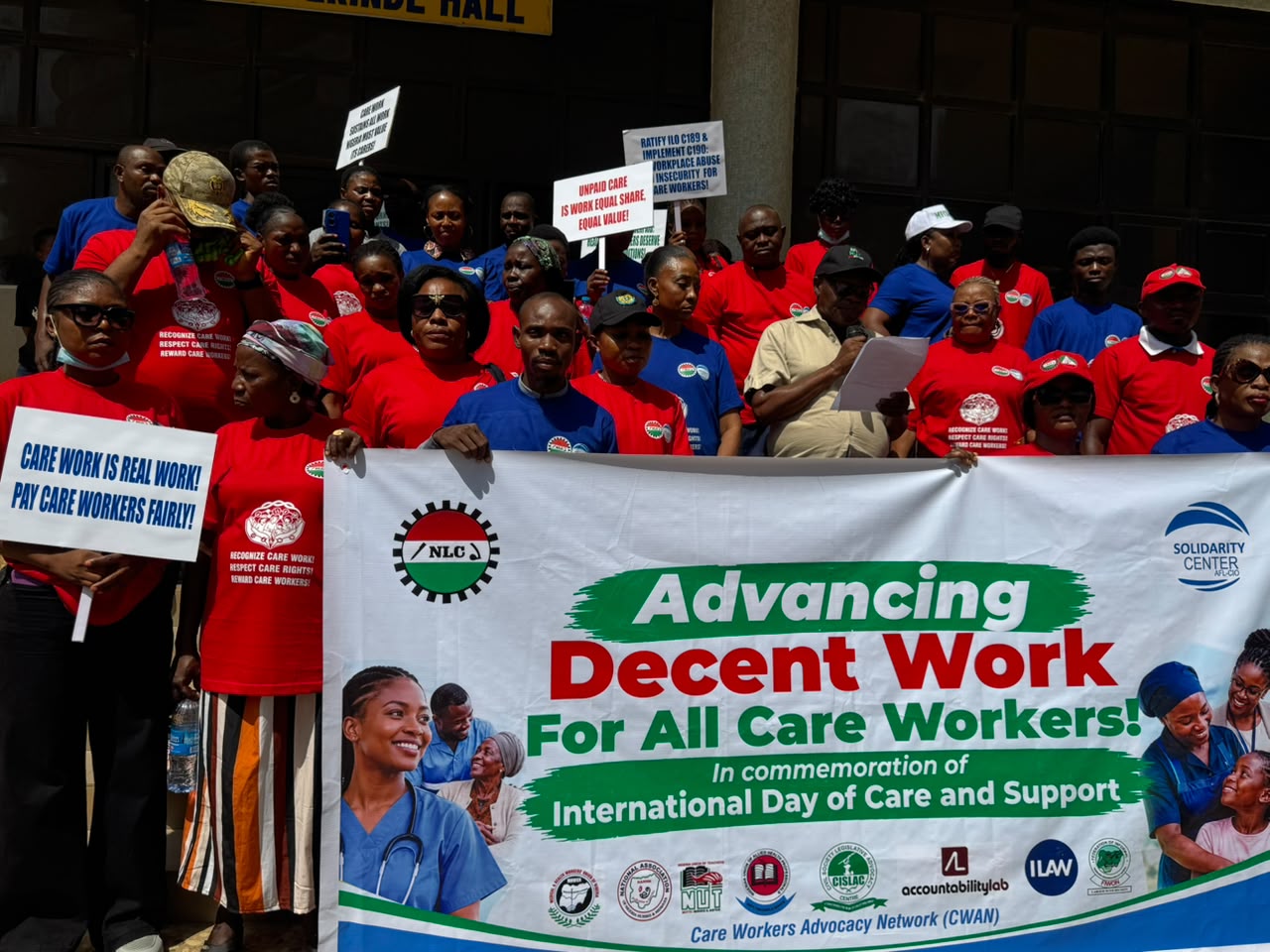
Trade unions led by the Nigeria Labour Congress (NLC) and civil society organisations, with support from the Solidarity Centre, have called on the Federal and state governments, as well as private employers, to improve wages, expand social protection and guarantee decent working conditions for care workers in Nigeria.
The coalition said care workers, despite their contributions to healthcare, education, childcare and the national economy, remained undervalued, underpaid and inadequately protected by existing labour laws and social security systems.
They made the call on Thursday October 29, 2026 in Abuja at an event to commemorate the 2026 International Day of Care and Support.
Speaking on behalf of the coalition, the Acting General Secretary of the NLC, Comrade Benson Upah, said care work was fundamental to economic productivity and social stability but continued to be undermined by poor wages, unsafe working environments and limited access to labour protections.
The coalition comprises the NLC and the Careworker Advocacy Network, which includes the Medical and Health Workers’ Union of Nigeria (MHWUN), the Nigeria Union of Teachers (NUT), the Federation of Informal Workers’ Organisations of Nigeria (FIWON) and the National Association of Nigerian Nurses and Midwives (NANNM).
Other partners include Accountability Lab, International Lawyers Assisting Workers (ILAW) and the Civil Society Legislative Advocacy Centre (CISLAC).
The coalition noted that care work cuts across formal and informal sectors, involving healthcare and social care workers, childcare providers, domestic workers and millions of women and family members who provide unpaid care for children, older persons and people living with chronic illnesses or disabilities.
It said many paid care workers, particularly domestic caregivers and private health aides, earned below the national minimum wage and lacked access to social security and retirement benefits.
The groups also raised concerns over the disproportionate burden of unpaid care responsibilities on Nigerian women, attributing the situation partly to inadequate public infrastructure, including limited access to clean water, electricity and affordable childcare services.
They identified long working hours, physical strain, inadequate personal protective equipment, harassment and arbitrary dismissal as some of the challenges confronting informal domestic and community care workers.
According to the coalition, many informal care workers are excluded from statutory labour protections and collective bargaining arrangements, leaving them without adequate legal protection, sick leave and maternity benefits.
To address these challenges, the coalition urged the Federal and state governments and private employers to adopt and implement the International Labour Organisation’s (ILO) 5R Framework for Decent Care Work.
The framework advocates the recognition of paid and unpaid care work in national economic planning and labour statistics; reduction of unpaid care burdens through investment in social infrastructure; redistribution of care responsibilities; decent rewards for paid care workers; and representation of care workers in policy decisions.
The coalition also called for the ratification and domestication of ILO Convention 189 on domestic workers and Convention 190 on violence and harassment in the world of work.
It urged governments to invest in affordable public childcare centres, clean water, rural electrification and specialised eldercare facilities to reduce the burden on households and improve access to care services.
On workers’ welfare, the groups called for the enforcement of the national minimum wage across care services, equal pay for work of equal value, safer workplaces, and access to health insurance and pension schemes.
They also demanded that care workers in both formal and informal sectors be guaranteed the right to join trade unions, engage in collective bargaining and participate in decisions affecting labour and economic policies.
The coalition stressed the need for greater collaboration among governments, employers, households and workers to ensure that care responsibilities were shared fairly between men and women and supported through progressive maternity, paternity and parental leave policies.
It further insisted that care workers must be included in discussions on public infrastructure, social protection and labour budgets, stressing that policies affecting them should not be developed without their participation.

