
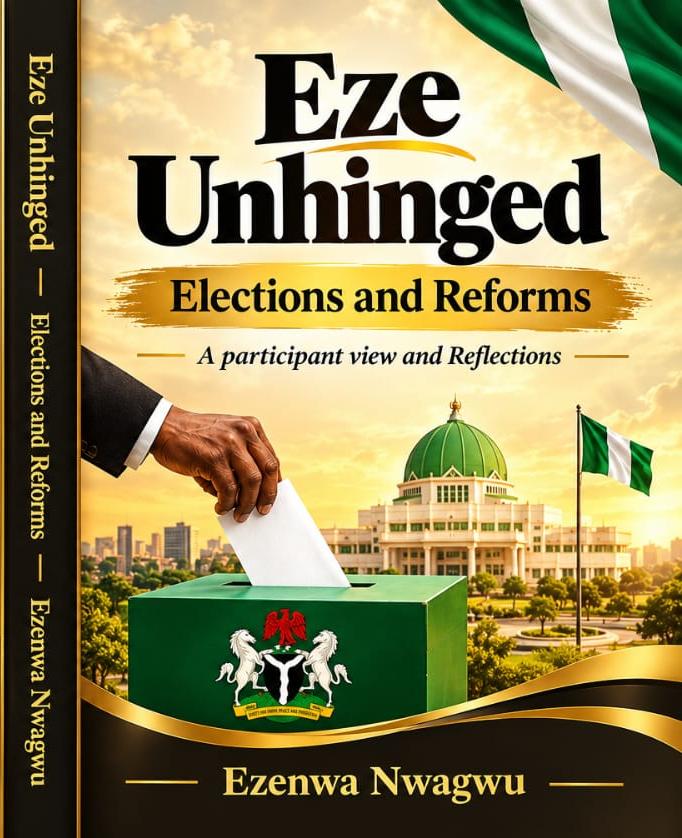
A Review of Ezenwa Nwagwu’s- Eze Unhinged: Elections and Electoral Reforms A Participant’s View and Reflections.
By Adaora Onyechere Sydney Jack
Biographer:
There are books one reads for information, books one reads for scholarship, and books one reads because they disturb something that has been sitting too comfortably in the national conscience.
Ezenwa Nwagwu’s Eze Unhinged, belongs to the third category.
It is not a book that merely tells us what is wrong with Nigeria’s elections. It is more uncomfortable than that. It asks whether we have been looking in the wrong direction altogether.
For more than two decades, Nigeria has treated electoral reform almost as a national ritual: amend the law, introduce another technology, redesign the ballot, reform INEC, deploy another acronym and wait for democracy to somehow become better. Nwagwu turns the mirror around and asks the question many would rather avoid: what if the real problem is not primarily how we conduct elections, but how we practise politics?
That question is the beating heart of Eze Unhinged. And it is precisely why the book is likely to irritate some people.Good. Democracy, after all, should not be a country club for comfortable opinions.
Nwagwu writes from the peculiar authority of the participant-observer someone who has not simply studied Nigeria’s electoral machinery from the balcony but has spent years inside the arena, engaging electoral officials, civil society actors, journalists, political actors and citizens. The book therefore reads less like an academic autopsy and more like the testimony of someone who has been in the room when the decisions were made, in the field when the consequences unfolded, and in the aftermath when everybody suddenly became an expert. That is its first major strength.
Its second is its refusal to romanticise either side. The most controversial argument may also be the book’s most important one. Perhaps the most provocative proposition in Eze Unhinged is that Nigeria’s democratic problem cannot be solved by electoral reform alone.
Nwagwu argues, rather bluntly, that electoral reforms repair the roof while political reforms rebuild the foundation. This is where the book departs from the conventional reform conversation.
For years, we have behaved as though BVAS, IReV, better voter accreditation and stronger electoral legislation can somehow compensate for political parties that remain structurally weak, transactional and excessively dependent on patronage. Nwagwu challenges that assumption head-on.
And he does not spare the political class.
Political parties, he argues, have too often ceased to behave like democratic institutions and instead operate as vehicles for patronage, elite bargaining, personal ambition and access to power.
That is a dangerous argument not because it is necessarily wrong, but because it moves the conversation from the safer territory of “How do we fix INEC?” to the much more politically inconvenient question: Who benefits from keeping our political parties the way they are?
That is where the book begins to draw blood. Nigeria’s electoral problem did not begin on election day. One of the book’s most insightful contributions is its insistence that the election does not begin at the polling unit. It begins much earlier in the political party. In the delegate list. In the primary. In the money exchanged. In the godfather’s endorsement. In the candidate-selection process. In the political bargain struck long before the voter ever reaches the ballot box.
Nwagwu makes the compelling case that vote-buying at the general election can be understood partly as the final expression of a process of monetisation that may already have begun during party primaries. Candidates who spend enormous resources buying political support can begin to see public office not as a public trust but as an investment to be recovered.
That is a profoundly important observation. Because if the seed is rotten, changing the flowerpot will not change the harvest.
The book’s greatest courage is that it watches the watchdogs. The chapter on civil society may be the one that generates the most raised eyebrows and perhaps it should. Nwagwu turns his gaze toward the very community from which he emerges and asks a deceptively simple question: Who watches the watchdogs?
This is not an attack on civil society. It is a demand that civil society apply to itself the same standard of accountability it applies to government, INEC and political actors.
Election observation, he argues, must be grounded in neutrality, evidence, professionalism and impartiality. Civil society organisations must also be prepared to disclose their funding, distinguish advocacy from observation and examine their own institutional conduct.
That argument is uncomfortable because civil society has traditionally occupied the moral high ground in democratic discourse.
But Eze Unhinged reminds us of an old African wisdom: when you point one finger at another man, three fingers are pointing back at you, Accountability cannot be selectively administered.
A democracy in which government must explain itself, but civil society does not; in which politicians must disclose their interests, but observers need not interrogate theirs; in which INEC must be transparent, but those judging INEC cannot withstand scrutiny is not yet a mature democracy. It is merely a democracy learning to perform accountability.
The media is not innocent either…
Nwagwu extends the argument to the media, particularly its role in shaping electoral narratives. His concern is not that journalists report political claims. That is their job. His concern is what happens when political claims become political facts simply because they have been repeated often enough.
The book argues that politicians should not be allowed to become the primary authors of public understanding of elections. Journalists must interrogate, corroborate and independently verify claims rather than merely amplify competing political narratives.
This is particularly relevant in an age where misinformation can travel faster than verification.
In other words, the battle for democracy is also a battle over who controls the narrative. The ballot can be manipulated. So can the story about the ballot.
But is Nwagwu sometimes too generous to the system? This is where I would push the author. One of the book’s most controversial positions is its insistence that Nigeria has made genuine, incremental electoral progress since 1999 and that dismissing all progress because elections remain flawed is intellectually dishonest. There is merit in this argument.
The transition from ballot-box snatching and results written in hotel rooms to biometric accreditation, BVAS and IReV is not insignificant. The system has evolved. The author is right that reform should not mean pretending that history began yesterday.
But here lies the book’s most interesting tension. At what point does incrementalism become an excuse for institutional timidity? There is a danger in celebrating evolution so much that we become satisfied with survival. Africa has become exceptionally good at surviving broken systems. The real question is whether we are becoming equally good at transforming them.
Nwagwu himself recognises this tension. He does not argue that Nigeria’s elections are perfect. He acknowledges operational failures, violence, voter suppression and institutional weaknesses. His argument is that these failures should not erase genuine gains, that distinction is important. Because hope without honesty is propaganda, but criticism without recognition of progress is also propaganda.
And this is where the book becomes Pan-African. Although Eze Unhinged is fundamentally a Nigerian story, its questions are unmistakably African.
Nigeria is not an island. What happens to Nigeria’s democracy reverberates across West Africa and across the continent because Nigeria is not merely Africa’s largest democracy by population; it is also one of the continent’s most consequential political laboratories.
The problems Nwagwu identifies political patronage, personality-driven parties, monetised politics, weak internal party democracy, youth and women’s exclusion, misinformation, institutional distrust and the tension between domestic priorities and external democratic assistance are not exclusively Nigerian questions. They are African questions.
Across the continent, democracy is increasingly confronted by a paradox: the institutions of democracy may exist, while the culture required to sustain them remains fragile. We have constitutions without constitutionalism. Political parties without ideology. Elections without sufficient trust. Parliaments without adequate institutional autonomy. And sometimes democracy without enough democrats.
That is why Eze Unhinged deserves to travel beyond Nigeria. Its deeper proposition is that African democracy cannot be strengthened merely by importing institutional templates. Reform must be rooted in political realities, civic culture, institutional behaviour and the lived experience of citizens.
This is particularly significant in the book’s treatment of external influence. Nwagwu does not dismiss international partnerships outright. Instead, he asks a more sophisticated question: do external interventions ultimately serve the democratic priorities of the country in which they operate?
That is a question Africa should be asking much more confidently. Partnership, yes. Dependency, no. Support, yes. Substitution, no. African democracy must ultimately belong to Africans.
Another important strand of the book is its recognition that political reform cannot be meaningful while large sections of the population remain structurally excluded.
Nwagwu points specifically to the barriers confronting women and young people, arguing that money, patronage and elite networks often shut them out before the general election even begins.
This deserves even greater emphasis. Because the future of African democracy cannot be built by continually recycling the same political class and merely changing the campaign posters.
If young people are told that they are the future but are perpetually denied meaningful political agency, democracy becomes a waiting room. If women constitute roughly half the population but remain dramatically underrepresented in political decision-making, then democratic inclusion remains unfinished business.
The question is no longer whether Africa can afford to include women and young people. The question is whether Africa can afford not to.
What makes Eze Unhinged stand apart? It is not that Nwagwu has discovered that Nigeria’s politics is broken. We already know that. Nor is it that he has discovered electoral reform. There are shelves of books about that. What makes Eze Unhinged distinctive is the author’s willingness to interrogate every actor in the democratic ecosystem including those who consider themselves the good guys.
INEC must answer questions. Politicians must answer questions. Political parties must answer questions. Civil society must answer questions. The media must answer questions. And ultimately, citizens must answer questions. That is the book’s most important intellectual contribution.
It refuses to allow democracy to become somebody else’s responsibility.
“Unhinged… but not hopeless”
There is an irony in the title. Eze Unhinged sounds like the manifesto of a man who has finally lost patience with the system. In reality, it is the opposite.
The author is frustrated precisely because he still cares. The foreword captures this beautifully: the “unhinged” condition is not madness or despair, but the patriotic anguish of expectations repeatedly raised and repeatedly frustrated. Yet beneath that frustration is a robust belief that Nigerian democracy can still evolve. That distinction matters. Cynicism says nothing works, Complacency says everything is improving.
Nwagwu says look carefully. Some things have improved. Some things have not. Now decide what must change.
That is a much harder position to occupy. The verdict- Eze Unhinged is not a comfortable book. It is not intended to be. It is a book that asks Nigerians and, by extension, Africans to stop treating democracy as an event and begin treating it as a culture.
It reminds us that a credible election is not created by technology alone; that a democratic institution is not strengthened merely by legislation; that political parties cannot remain private fiefdoms and still claim democratic legitimacy; that civil society cannot demand accountability while resisting scrutiny of itself; and that the media cannot defend democracy while allowing political actors to manufacture the public narrative unchecked.
Most importantly, it reminds us that the quality of democracy cannot ultimately rise above the quality of the political culture that sustains it. The book’s central lesson can therefore be reduced to a simple African truth: You cannot harvest democracy from seeds planted in patronage. You cannot build democratic institutions on the foundation of political impunity and expect technology to do the masonry.
And you cannot keep changing the rules of the game while refusing to examine the players, the culture of the game and the incentives that determine how it is played.
That is why Eze Unhinged matters.
It is not simply a record of Nigeria’s electoral journey since 1999. It is a political mirror.
And mirrors are dangerous things not because they distort what we are, but because they sometimes show us what we would rather not see. Ezenwa Nwagwu has held up that mirror.
The real question is whether Nigeria and Africa will have the courage to look.
I know politicians will find this book intrusive and INEC may find it a little to blazing, but Ezenwa Nwagwu has never been a person for conformity so do with this book what you will but it will stir the odds.
EZE UNHINGED: WHEN DEMOCRACY MUST LOOK IN THE MIRROR; Provocative. Reflective. Politically uncomfortable. Institutionally necessary.
Adaora Onyechere Sydney Jack FIMC FINBA CIMC,
Writes from Abuja, Nigeria.
Adaoraonyechere1@gmail.com

