
By Michael Oche
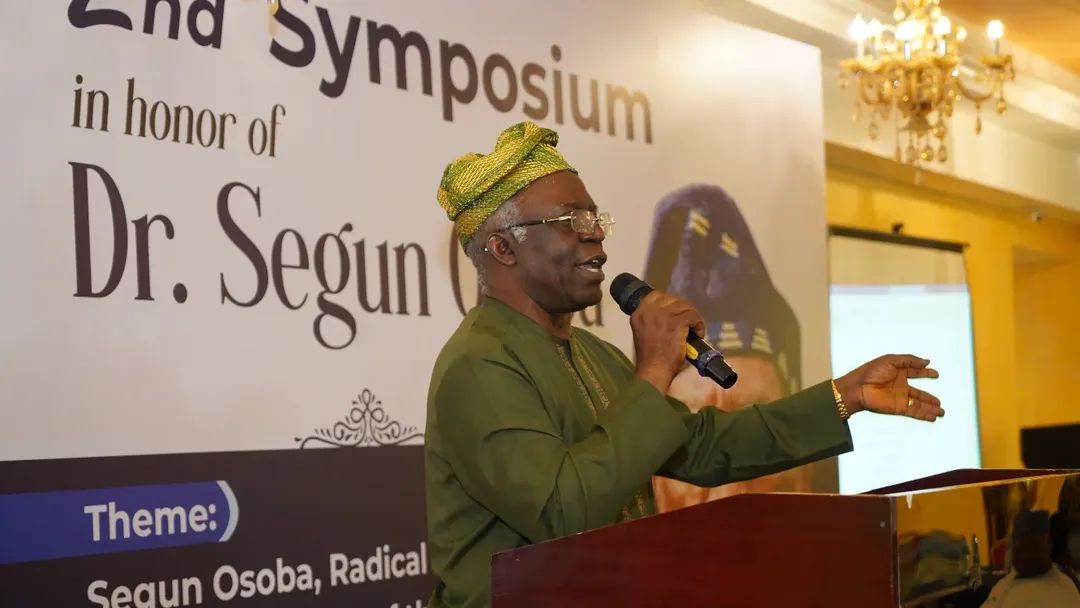
Senior Advocate of Nigeria (SAN), Femi Falana, has urged organised labour to embrace the social justice ideology of late historian and activist, Dr. Segun Osoba, by shifting its engagement with government beyond demands for periodic increases in the minimum wage to broader socio-economic reforms that directly improve workers’ welfare.
Falana argued that while wage reviews remain important, labour unions should sustain Osoba’s lifelong commitment to social justice by pressing government to implement policies that guarantee affordable housing, improved pension administration, quality healthcare and education for workers.
He spoke on Tuesday in Abuja at the Second Memorial Symposium held in honour of Dr. Segun Osoba, a renowned Marxist scholar, historian and social justice advocate whose life and works were celebrated by academics, labour leaders and civil society activists.
According to Falana, labour should prioritise the effective implementation and review of key social welfare laws, particularly the National Housing Act and the Pension Reform Act, to address the country’s deepening socio-economic challenges.
“For labour, rather than asking only for minimum wage, we have tried to insist that beyond asking for improvement, labour should also insist that the National Housing Act, which allows the state to deduct three per cent from the monthly wages of workers to fund the Federal Mortgage Bank, should be used to provide affordable houses for workers,” he said.
He noted that government statistics indicate that about 28 million Nigerians currently lack decent housing despite the existence of mechanisms meant to finance affordable homes.
Falana also expressed concern over the administration of pension funds, saying workers should demand greater accountability in the utilisation of the over N30 trillion accumulated under the Contributory Pension Scheme instead of allowing governments to continue seeking loans while huge pension assets remain underutilised.
“Today, government claims that 28 million Nigerians have no accommodation. I am sure you are also aware of the Pension Reform Act. Many people are dying while queuing for pensions. As of today, the pension fund is about N30 trillion. Workers are not demanding that this money be invested, while the federal government and state governments continue to seek loans,” he added.
The human rights lawyer further argued that Nigeria’s ruling elite continue to deny citizens social justice partly because many people remain unaware of the rights guaranteed to them under the Constitution.
The symposium also featured reflections on the life and legacy of Osoba, who taught in the Department of History at the University of Ife, now Obafemi Awolowo University, from 1967 until his retirement in 1991. Widely respected for pioneering class-based and socio-economic interpretations of African history, Osoba was remembered for rejecting a professorship in protest against institutional corruption and dedicating his life to the struggle for social justice and the emancipation of the poor.
Delivering a keynote presentation, Professor Jibrin Ibrahim described Osoba’s death as a profound loss to Nigeria’s progressive movement, describing him as “a comrade, mentor, friend, guide and teacher” whose socialist convictions and patriotism shaped generations of scholars and activists.
Earlier, chairman of the symposium planning committee, Dr. Y.Z. Ya’u, said the event was organised to preserve and promote Osoba’s enduring ideas on social justice, constitutional reform and the transformation of Nigeria.
Ya’u said the “Osoba for Eternity” platform would continue to organise public engagements, establish academic prizes and build institutions dedicated to advancing the late scholar’s vision of a just and equitable society.
He stressed that Osoba’s ideas remained relevant to contemporary debates on constitutional reform, democratic governance and the welfare of ordinary Nigerians, urging participants to treat his intellectual legacy not merely as history but as a guide for action towards building a more just nation.

