
By Asuelimen Osasuyi
Nigeria’s U-17 women’s team, the Flamingos, will today face Japan in what promises to be a captivating battle of contrasting football philosophies as both nations contest the final of the 2026 FIFA U-17 Women’s World Cup in Morocco.
For Nigeria, it is an opportunity to complete a remarkable journey and secure a first-ever world title at this level. For Japan, it is a chance to crown an impressive campaign with the trophy after demonstrating consistency, technical excellence and resilience throughout the tournament.
The final sets up a fascinating tactical contest between two sides whose routes to success have been built on different strengths. While the Flamingos have relied on physical intensity, aggressive pressing and direct attacking play, Japan have thrived on technical quality, intelligent movement and quick passing combinations.
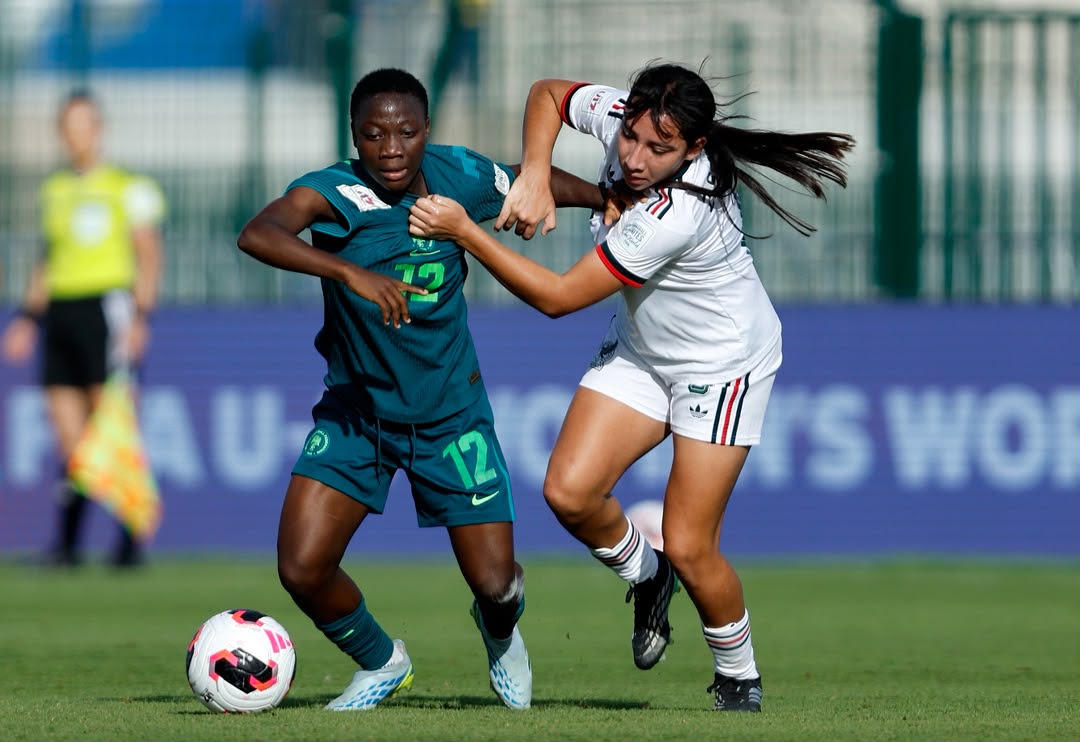
Nigeria booked a historic place in the final with a convincing 3-1 victory over Brazil in the semi-finals. After a tightly contested first half ended goalless, the Flamingos came alive after the break.
Queen Joseph broke the deadlock in the 55th minute before Awuwu Bashiru produced a clinical display, scoring twice in the 71st and 80th minutes to put the contest beyond Brazil’s reach. Although Greise Kelly pulled one back late on for the South Americans, Nigeria remained firmly in control to secure a memorable victory.
The triumph over Brazil was another significant statement from a team that has grown in confidence with every passing match.
Nigeria’s knockout journey began with a hard-fought 2-1 victory over Mexico in the Round of 16 before a dramatic 1-0 quarter-final success against Venezuela. In that encounter, Azeezat Oduntan emerged the hero, converting an 89th-minute penalty to send the Flamingos into the last four.
The team’s progress has been particularly impressive considering the difficult start to the competition.
Nigeria opened the tournament with a 2-1 defeat to Poland, a result that left many observers wondering whether the team would progress from the group stage. However, rather than allowing that setback to derail their campaign, the Flamingos responded strongly.
Victories over Puerto Rico and defending champions DPR Korea not only secured qualification but also revealed the character and resilience within the squad. The 3-1 triumph over DPR Korea was especially significant, given the Asian side’s reputation and pedigree at youth level.
Since then, the Flamingos have continued to improve, combining discipline with attacking efficiency to emerge as one of the tournament’s strongest teams.
Japan’s route to the final has been equally impressive.
The Asians announced themselves as serious contenders from the opening day, producing a commanding 5-0 victory over Zambia. They followed that result with victories over France and Venezuela, completing the group phase without conceding a goal.
Their defensive organisation proved just as impressive as their attacking quality, making them one of the most balanced teams in the competition.
Japan continued their march with a 3-1 victory over Kenya in the Round of 16 before edging Ghana 1-0 in a tightly contested quarter-final encounter.
Their sternest examination came in the semi-final against defending champions DPR Korea.
For much of the match, Japan appeared to be heading out after Ri Ui-gyong put the North Koreans ahead in the 52nd minute. However, the Japanese refused to surrender and continued searching for an opening.
Their persistence paid off deep into stoppage time when they forced an equaliser through an own goal. The dramatic comeback shifted momentum in their favour, and they ultimately prevailed in the ensuing penalty shootout to secure their place in the final.
The semi-final victory highlighted one of Japan’s most valuable qualities: composure under pressure.
Even when facing elimination, they remained committed to their style of play and were rewarded for their patience.
For Nigeria, understanding and neutralising Japan’s strengths could prove decisive.
Japan’s football is built on technical discipline. Their players are comfortable in possession, move intelligently off the ball and excel at creating space through quick combinations. They are particularly dangerous in transition, where their ability to move the ball rapidly can expose defensive weaknesses.
Their midfield operates with impressive fluidity, often drawing opponents out of shape before exploiting gaps with incisive passing. If given time and space, they are capable of controlling matches and dictating the tempo.
However, Japan have also shown vulnerabilities.
Kenya managed to score against them in the Round of 16, while DPR Korea pushed them to the verge of elimination before their dramatic late recovery. Those matches demonstrated that disciplined opponents capable of matching their work rate can create problems.
Nigeria will take encouragement from those performances.
The Flamingos have built their campaign on energy, determination and physical presence. Their aggressive approach has unsettled several highly rated opponents and enabled them to compete effectively against technically gifted teams.
Against Brazil, Nigeria demonstrated an ability to press high up the pitch, disrupt the opposition’s rhythm and quickly turn defensive situations into attacking opportunities.
The challenge now will be to reproduce that performance against a Japanese side that thrives on movement and quick ball circulation.
Head coach Akeem Busari will likely emphasise intelligent pressing rather than reckless aggression. While Nigeria’s physicality can be a major weapon, it must be used strategically.
The Flamingos cannot afford to chase the ball unnecessarily or leave spaces for Japan’s midfielders to exploit.
Maintaining compact defensive lines and narrowing passing lanes will be essential if they are to frustrate Japan’s build-up play.
At the same time, Nigeria’s attacking players must be prepared to exploit opportunities when possession is won.
Japan’s willingness to push forward can leave spaces behind their defensive line. Quick transitions and direct attacking play could therefore provide the Flamingos with opportunities to create scoring chances.
The pace of Nigeria’s forwards may be one of the team’s most important assets in the final.
Set pieces could also prove decisive.
In matches of such magnitude, dead-ball situations often provide the breakthrough, particularly when open-play opportunities are limited. Nigeria’s physical advantage could make corners and free-kicks an important source of attacking threat.
Defensively, concentration will be crucial.
Japan possess the ability to punish even brief lapses in organisation. Their quick passing around the penalty area means that defenders must remain alert throughout the entire contest.
A single mistake could be enough to determine the destination of the trophy.
Beyond tactics, the final is also likely to be decided by mentality.
Nigeria’s journey to this stage has already become one of the success stories of the tournament. Having recovered from an opening defeat and eliminated powerful opponents including defending champions DPR Korea and traditional giants Brazil, the Flamingos have demonstrated remarkable resilience.
The belief within the squad will be stronger than ever.
Yet the players must guard against complacency. Reaching the final is a significant achievement, but history remembers champions more than finalists.
For many members of the current squad, this represents the biggest match of their young careers.
Victory would not only secure a first FIFA Women’s World Cup title at the U-17 level for Nigeria but would also further enhance the country’s growing reputation in women’s football.
The success of the Super Falcons at senior level has long inspired younger generations, and the Flamingos now have an opportunity to create their own chapter in Nigerian football history.
Fans can expect a compelling encounter between two of the tournament’s most impressive teams.
Japan will seek to dominate possession through quick combinations, intelligent movement and technical precision. Nigeria will attempt to impose their intensity, physical strength and direct attacking style.
It is a clash between finesse and force, patience and power, technical artistry and relentless aggression.
The margin between victory and defeat may ultimately come down to which team executes its game plan more effectively.
For the Flamingos, the objective is clear: disrupt Japan’s rhythm, remain defensively disciplined, exploit attacking opportunities and play with the courage that has carried them this far.
The world title is now just one match away.
Nigeria have already made history by reaching the final. To complete the journey, the Flamingos must produce one more inspired performance and seize the moment on the biggest stage of all.
The final will be played today, Saturday, November 7, 2026, at the Prince Moulay El Hassan Stadium in Rabat, Morocco, with kickoff scheduled for 6:30 p.m. local time.

