
By Bimbo Adenrele
Nkiruka’s world came crashing down the moment a doctor pronounced her husband, Ikenna, dead. Overcome with grief, she broke down in tears.
“Where will I start?” she cried. “What will become of me and my four children?”
However, her pain was only the beginning of a harrowing ordeal.
Even before the family had time to mourn, Ikenna’s relatives accused Nkiruka of causing her husband’s death.
“You are responsible for the death of our son,” they repeatedly alleged without any evidence.
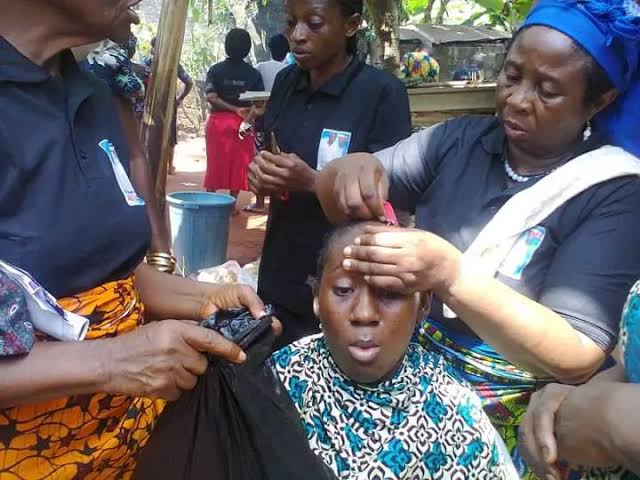
As tradition demanded, Ikenna’s body was taken to his hometown of Umuokwara for burial. There, Nkiruka was subjected to a series of degrading widowhood rites. Her head was shaved, and her four children were taken away from her.
She was forced to endure inhumane practices, including spending the night locked in the same room with her husband’s corpse. According to local belief, if she had a hand in his death, his spirit would kill her before morning.
The following day, her ordeal worsened. She was compelled to bathe with the water used to wash her late husband’s body and was even forced to drink the same water, despite the obvious health risks. Afterwards, she was locked alone in a dark room, where she wept uncontrollably.
Barely had the burial rites ended when another shock awaited her.
Nonso, Ikenna’s younger brother, asked her to become his wife, insisting that she remain within the family so he could continue his late brother’s lineage. But Nkiruka had never loved Nonso. Her only wish was to return to Onitsha and rebuild her fashion business.
When she rejected his proposal, the family retaliated. They seized her four children, drove her out of the family home, and dispossessed her of all her late husband’s assets, including his shops and other properties. Ikenna had been a successful and wealthy spare-parts dealer.
Heartbroken and empty-handed, Nkiruka returned to Onitsha, where she recounted her painful experience to her family and close friends. During the funeral, she had even been prevented from leaving with her own relatives.
Known for her kindness, compassion, and generosity, Nkiruka soon found support. Her family and friends rallied around her and sought the intervention of a non-governmental organisation dedicated to protecting the rights of widows. Through the organisation, a formal petition was submitted to Her Excellency.
The intervention proved decisive.
Her Excellency facilitated a meeting involving Nkiruka, her family, and Ikenna’s relatives.
Following discussions, Nkiruka was reunited with her four children. The properties and businesses that had been confiscated by her late husband’s family were also restored to her and her children.
For Nkiruka, what began as a tragic loss became a determined fight for justice. Her story highlights the challenges many widows continue to face under harmful traditional practices, while also demonstrating the importance of legal protection, community support, and timely intervention in safeguarding the rights and dignity of widows.
In the words of Ijeoma Nnabuihe, an Associate Counsel at Signature law firm explaining the reasons why many widows in Nigeria still struggle to claim what rightfully belongs to them, she said the struggle often has less to do with the law and more to do with societal attitudes and deeply rooted customs.
Explaining further, she noted that in many communities, a widow is seen as someone who only had access to her husband’s property because he was alive, while daughters are sometimes viewed as belonging to another family once they marry. As a result, relatives may attempt to take over the deceased’s assets before the widow or children even have the opportunity to understand their legal rights.
She observed that sadly, many widows are also grieving, emotionally vulnerable, and financially dependent at that point, making it easier for others to intimidate or pressure them into giving up what they are legally entitled to.
She affirmed that cultural traditions and family pressure is standing in the way of widows and in inheriting property in Nigeria because in many cases while culture is an important part of our identity and should be respected, no tradition should be used to deny people their fundamental rights.
She also asserted that family pressure can be overwhelming. She noted that some widows are told not to question decisions made by the husband’s family, while daughters are sometimes excluded simply because they are female. She stated that these practices continue in some places despite court decisions affirming that discrimination based on gender is unacceptable.
She encouraged the need for greater awareness that protecting widows and daughters is not an attack on culture; it is about promoting justice and fairness within our families.
Noting the protections Nigerian law offers to widows when disputes over inheritance arise, she noted that Nigerian law provides significant protection. Furthermore, she said that the Constitution prohibits discrimination, including discrimination based on sex. In addition, she said that our courts have repeatedly held that customs which deny daughters the right to inherit simply because they are women are invalid.
She explained further that a widow may also have rights depending on the type of marriage, the applicable succession laws, and whether the deceased left a valid will. Where disputes arise, the courts can intervene to protect lawful beneficiaries and prevent the unlawful seizure of property.
She observed that the challenge is that many people are either unaware of these protections or lack the resources to enforce them. She said that this is why legal education is so important.
Explaining the reason why inheritance battles often begin immediately after funerals, and who really benefits from these conflicts, she noted that unfortunately, emotions are high immediately after a funeral, and some people see that period as an opportunity to take control of the deceased’s assets before proper legal processes begin.
Furthermore, she noted that these conflicts are often driven by greed, misunderstanding, or long-standing family disagreements. In the end, nobody truly benefits. She said that families become divided, expensive court cases drag on for years, and relationships are damaged, sometimes permanently. Most importantly, the wishes of the deceased may never be honoured.
Preferring solutions how Nigerians can balance respect for tradition with the need to protect the inheritance rights of widows she averred that the first step is recognising that culture and justice should work together, not against each other. Traditions that promote family unity and support should be preserved, but practices that discriminate or deprive people of their rights should evolve.
Likewise, she noted that we also need greater public awareness, community engagement, and legal education so that families understand both their cultural values and their legal responsibilities. She said that encouraging people to prepare valid wills can also reduce disputes and provide clarity.
In conclusion she said that ultimately, protecting widows and daughters is not just a legal issue, it is a moral one. A society is judged by how it treats its most vulnerable members. When we ensure that widows and daughters receive what is rightfully theirs, we strengthen families, uphold justice, and build a more equitable society.

