
*As Nigerian govt commits to cross-border protection of migrant workers
By Michael Oche
African trade unions under the umbrella of the African Regional Organisation of the International Trade Union Confederation (ITUC-Africa) have called on African governments to urgently address unemployment, underemployment and insecurity to curb dangerous migration across the continent.
The unions warned that the absence of decent jobs, rising poverty among employed workers and violent conflicts were forcing many Africans to undertake desperate and dangerous journeys in search of better opportunities.
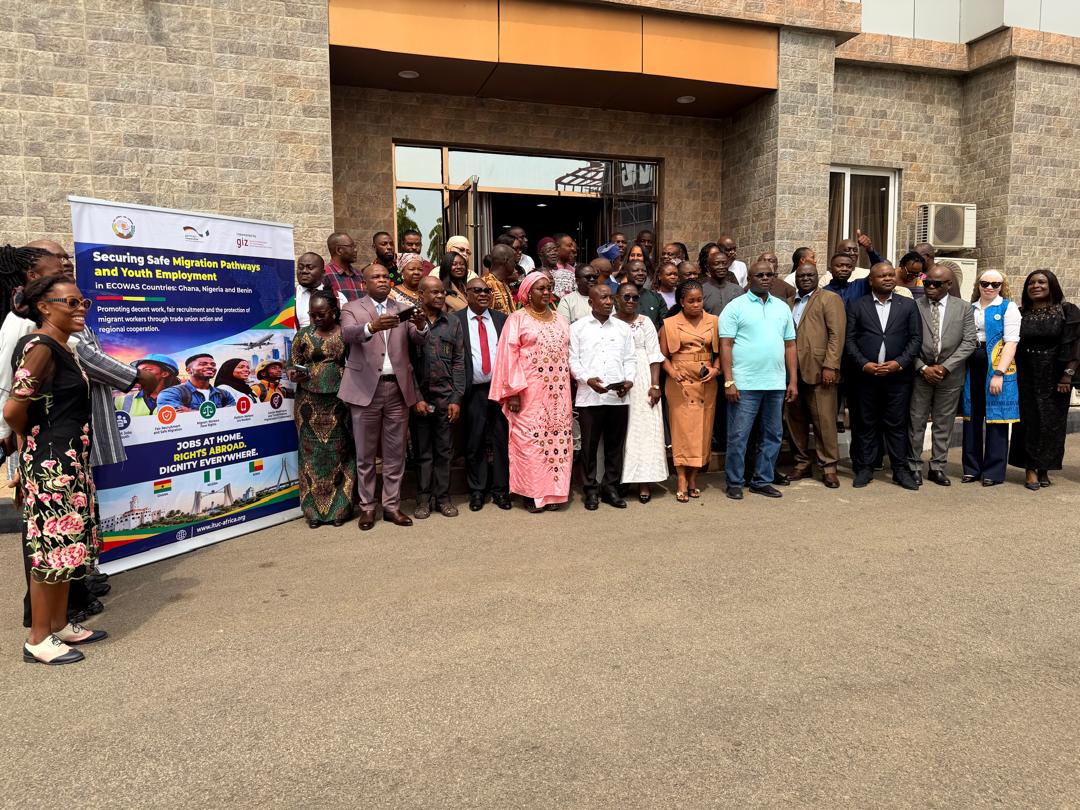
The call was made on Monday at the opening of the 3rd ITUC-Africa Continental Workshop on Migration, Peace and Security, holding in Abuja with support from German Cooperation through the German Federal Ministry for Economic Cooperation and Development (BMZ) and the German Agency for International Cooperation (GIZ).
ITUC-Africa General Secretary, Akhator Joel Odigie in his welcome address at the workshop, said migration should be a matter of choice rather than desperation, lamenting the experiences of African migrants stranded, abused and enslaved in Libya and other transit countries.
He said the continent must confront the conditions driving irregular migration by creating decent employment opportunities, addressing insecurity and strengthening social protection systems.
According to him, unemployment is only part of the problem, as underemployment and the growing number of workers who remain poor despite having jobs have become equally troubling.
“This is why we are committed to the issue of how we address unemployment in Africa. Underemployment is also huge in Africa. This crisis is worse when we see people who are in employment but are poor. The rising number of working poor is alarming,” he said.
The ITUC-Africa general secretary also called for greater integration among African countries, urging governments to make movement across the continent easier for African citizens.
“We don’t need visas for ourselves as Africans. We should open up to ourselves,” Odigie said.
He explained that ITUC-Africa had been campaigning for greater freedom of movement among African countries, noting that the initiative was already producing results as some countries were opening up their borders to fellow Africans.
He said the economic advantages of greater continental integration were enormous and described it as part of the Africa the organisation wanted to see.
On the relationship between migration and security, Odigie warned that violent conflicts in countries such as Nigeria, Sudan and Ethiopia, DR Congo has resulted in displacement, with consequences extending beyond the affected countries.
He stressed that insecurity in one African country could have wider implications for neighbouring states and the continent, making peace and regional cooperation essential to addressing migration challenges.
Odigie said ITUC-Africa would pursue an evidence-based approach to the challenge, build partnerships and alliances, and expand its migration intervention beyond the pilot countries of Nigeria, Ghana and Benin.
He added that capacity building would form a key component of the initiative, alongside efforts to strengthen social protection for workers across Africa.
The Federal Government, meanwhile, has reaffirmed its commitment to collaborating with organised labour and other stakeholders to improve the protection of migrant workers and promote safe labour migration.
In a goodwill message to the workshop, Minister of Labour and Employment, Dr Muhammad Maigari Dingyadi said it was committed to establishing clear coordination arrangements for the Ghana-Benin-Nigeria Union Migration Corridor Partnership.
The minister who was represented by Mrs Mary Awon, assistant director at the ministry, pledged to support bilateral and cross-border trade union agreements on migrant workers’ protection, strengthen fair recruitment practices and improve the implementation of Bilateral Labour Migration Agreements.
He further identified migrant worker organising, workplace monitoring, access to trade union representation and functional grievance mechanisms as priority areas requiring coordinated action.
Dr Dingyadi described the Ghana-Benin-Nigeria corridor as one of the most active labour migration routes in West Africa, stressing that migrant workers along the route must have access to reliable information, effective representation and adequate protection.
He said the workshop’s deliberations would contribute to the development of the African Trade Union Peace and Security Barometer and the Abuja Action Plan on Migration, Peace and Security.
The ministry reaffirmed its commitment to working with the Nigeria Labour Congress (NLC), ITUC-Africa, regional institutions and development partners to translate the workshop’s recommendations into practical actions.
He said, “the Ministry reaffirms its commitment to working hand-in-hand with organised labour and other stakeholders in the following critical areas: Establishing clear coordination arrangements for the Union Migration Corridor Partnership; Developing bilateral and cross-border trade union agreements on the protection of migrant workers; strengthening fair recruitment practices and the implementation of Bilateral Labour Migration Agreements”
He also said the ministry is committed to working with trade unions on improving migrant worker organising, workplace monitoring, and access to trade union representation; and agreeing on realistic national and corridor-level implementation plans that will deliver tangible results”
Also speaking, NLC President, Joe Ajaero, identified inequality, poor governance, austerity and unemployment as major factors driving migration across Africa, arguing that migration was increasingly becoming a response to crises rather than a matter of choice.
Ajaero, who was represented by acting General Secretary, Comrade Benson Upah said many Africans were abandoning their communities, families and livelihoods because conditions at home offered them little opportunity for a decent life.
He stressed that addressing migration required confronting its root causes rather than merely managing its consequences, urging governments to prioritise decent job creation, investment in public services, peace and security.
The NLC president also expressed concern over the exploitation of African migrant workers, citing unfair recruitment practices, wage theft, unsafe working conditions, denial of social protection, confiscation of travel documents, forced labour and human trafficking.
He noted that women migrant workers, particularly those engaged in domestic and care work, faced additional vulnerabilities and exploitation.
Ajaero further condemned rising xenophobia and Afrophobia across the continent, insisting that African workers should not be turned against one another in the name of protecting national interests.
He warned that insecurity and violent conflicts were destroying livelihoods, displacing communities and pushing workers into precarious informal employment and dangerous migration routes.
He called for greater involvement of trade unions in negotiating, monitoring and evaluating bilateral labour migration agreements, arguing that arrangements made without workers’ representatives could prioritise labour export over the protection of workers’ rights.
Ajaero urged African governments to implement free movement protocols, ensure the portability of social security benefits, recognise migrant workers’ qualifications and guarantee their access to justice and trade union representation across borders.
He said African countries must build a continent where migration was a choice rather than a necessity, stressing that workers’ rights and dignity must be protected regardless of national boundaries.
The three-day workshop brought together trade unions, government representatives, development partners and other migration stakeholders to examine the relationship between migration, peace and security and develop practical responses to challenges facing migrant workers across the continent.

